A Quick And Simple Cracker Recipe

by A.J. Coltrane

For future reference and before the notes evaporate — the cracker recipe for Iron Chef Leftovers’ big dinner party.

These crackers were served with three cheeses and three chocolates selected by ICL. I wanted to go for a cracker that would have good initial crispness but would have a small amount of chewiness as well. They also needed to taste good on their own but not compete with the cheese and chocolate. I think that overall the crackers fulfilled those goals.

This particular recipe is an amalgam of a bunch of different recipes that I looked through online. I ended up choosing this Alton Brown recipe as a loose template, though they’re still very different:

Ingredient This Recipe Alton Brown
AP Flour 8 oz 4-3/4 oz
Wheat Flour 1-1/2 oz 5 oz
Semolina Flour ½ oz
Table Salt 1-1/2 tsp
Kosher Salt 1-1/2 tsp
Aluminum Free Baking Powder 1-1/2 tsp 1-1/2 tsp
Olive Oil 3 TBP 3 TBP
Water 6 oz 6-1/2 oz
Poppy Seeds 1/3 cup
Sesame Seeds 1/3 cup

Instructions –

1. Knead until the dough *just* comes together and the flour is incorporated. (AB calls for kneading “4-5 times”.) Do NOT knead any further — the goal is develop as little gluten as possible. (More gluten = a chewy cracker, and not in a good way.)

2.  Rest 15 minutes. (So that the flour has a chance to hydrate.) Preheat oven to 450 F.

3.  Cut off 1/8 of the dough. Lightly dust the back of a sheet tray with semolina flour. Roll out the dough as thin as you can. Poke the dough all over with a fork. (So that it doesn’t puff up very much when baked.) Using a pizza wheel, cut the dough into cracker-sized pieces.

4.  Bake for 6 minutes on the first side. Rotate the pan and flip the crackers over. (Work quickly.) Bake 4-6 minutes on the 2nd side. Spread the crackers on a cooling rack to cool. Note that they’ll get crispier as they cool.

When we did these we used three sheet trays — one would be baking on the first side, one would be baking on the 2nd side, and one we’d vigorously wave around to cool it off, then prep the next dough to go into the oven.

Tips:

Don’t overwork the dough.

Roll it out super duper thin.

Keep practicing. The recipe makes many batches. By the time you’re on the 5th batch some things will start making more sense and you’ll likely have an “aha!” moment. And then you’ll be done.

Even the less than ideal ones will still taste good.

Feel free to add sesame seeds or poppy seeds or cheese or coarse salt or spices or whatever to make them more interesting. Lightly sprinkle the “topping” over the dough when it’s rolled out and pat it in a little bit. Again, these crackers were intended to be complimentary and not try to hog attention from ICL’s dinner, they’d be somewhat “plain” as-is if eaten solo.

Have fun!

AB’s Quick and Easy Pasta Dough

By Iron Chef Leftovers

Homemade pasta is one of those things that is insanely easy (with the right recipe) and will impress the crap out of your guests if you make it. It also comes in handy because you can make it with a few ingredients you have at home. I have made pasta completely by hand and it is hard work – mixing and kneading the dough and rolling it out. Taste-wise it is outstanding, but time wise, it isn’t worth it. A few years back, Alton Brown came out with a recipe that significantly cuts back on the time – all of the mixing is done in a food processor. It takes about 3 minutes to make the dough with this process, so you could actually make fresh pasta for a Tuesday night dinner rather than a special occasion.


The Software

10 oz. All Purpose Flour

1 teaspoon salt

2 large eggs

3 tablespoons water

1 teaspoon olive oil


The Recipe

In the bowl of the food processor combine the salt and flour and pulse for 2 seconds to combine. In a measuring cup, combine all of the remaining ingredients and beat lightly. Turn on the food processor and slowly stream the liquid into the bowl, until all of the liquid is incorporated or the dough just begins to pull away from the side of the mixer bowl. If you have used all of the liquid, slowly stream in 1 tablespoon of water at a time until dough is ready (It should feel slightly tacky, but not wet or sticky). Remove from the bowl, give it about 10 seconds of kneading to bring it together and wrap in plastic and refrigerate for at least 30 minutes or up to 24 hours (the longer you refrigerate, the easier it is to work with).


Notes

It is hard to describe exactly what the dough should feel like, so you will probably have to experiment a bit with it. Sometimes you need to add a tablespoon or two of additional water, other times you will not end up using all of your liquid, so there is really no exact way to do this. Some fun additions to pasta – a couple of tablespoons of minced spinach or stinging nettles (just make sure you remove as much water as possible), fresh herbs, lemon zest and pepper or hot pepper flakes. Just add them in with the flour salt and pulse to combine.

Beranbaum — The Bread Bible. Rosemary Focaccia Sheet

by A.J. Coltrane

Rose Levy Beranbaum’s Rosemary Focaccia Sheet from The Bread Bible. To quote:

This intriguing dough presents an apparent contradiction: it is incredibly light yet moist and satisfyingly chewy. Consider the percentage of water in this dough! In relation to the flour, it has 113.5 percent water, making it the highest percentage of any dough in this book. [ed:  most doughs generally run 60-70 percent water as a percentage of the flour weight.] Who would have thought it even possible to make a dough this wet and still produce bread? And that is the secret of its incredible texture. The exceptionally high amount of water keeps the gluten in the flour from breaking down during the very long beating process. This enables the dough to develop into long stretchy strands that hold the air and give a chewy texture. It will remain a soupy batter until toward the very end the twenty-minute beating, when it suddenly metamorphoses into a shiny, smooth, incredibly elastic dough.

I adapted this recipe from my favorite neighborhood bakery, the Sullivan Street Bakery in New York City…

So yeah, that’s some great pedigree. I had four hours before I needed to be out the door, instead of the five hours called for the recipe, so I goosed the yeast a little and figured I’d sacrifice a bit of the flavor associated with the rising time — the bread was getting rosemary and a healthy amount of salt and olive oil anyway, so it seemed like a reasonable tradeoff.

The recipe (notes are in italics)

390 g AP Flour

3/8 tsp instant yeast (I increased this to 3/4 tsp)

442 g warm water

3/4 tsp each sugar and salt

36 g extra virgin olive oil

2 tsp rosemary, fresh

1/4 tsp sea salt or fleur de sel

Sheet pan

1. Mix the dough. In the mixer bowl, with the paddle attachment on low speed (#2 Kitchenaid), combine the flour and yeast. With the mixer running, gradually add the water, mixing just until the dough comes together, about 3 minutes. It will be very soupy. Increase the speed to medium (#4 Kitchenaid) and beat until the dough is transformed into a smooth, shiny ball, about 20 minutes. (This never happened, or at least it hadn’t after almost 30 minutes. It just stayed soupy. I wound up adding about 1/2 cup+ of flour so that the dough would cooperate. It was a humid day, which may have effected it somewhat. I added a tiny amount of salt and sugar to compensate for the added flour — otherwise it might have tasted “flat”.)

Add the sugar and salt and beat until they are well incorporated, about 3 minutes.

This went on for too long.

2. Let the dough rise. Lightly oil a bowl, cover and let rise for about four hours. (I did this directly in the Kitchenaid bowl. With the greater quantity of yeast that I used, this only took about 90 minutes.)

3. Shape the dough and let it rise. Coat the sheet pan with a heaping tablespoon of the olive oil. Pour the dough onto it. Spread the dough as thin as possible without tearing it.  Let it rest 10 minutes, then stretch again. Cover the pan and let rise until doubled 1-1/2 to 2 hours. (I used another sheet pan upside down as a cover. Mine was ready after about 60 minutes. Typically I use parchment paper to make “unmolding” easier. As it turned out, this dough decided to completely cement itself to the tray. The unmolding was a hassle.)

4. Preheat the oven. Preheat the oven to 475 degrees F for 1 hour before baking. Have an oven shelf at the lowest level and place a baking stone or baking sheet on it before preheating. (Maybe I’m just too cheap… I let it preheat 30 minutes. I can’t believe that the oven will retain *that* much more heat if I let it go for an hour. I used a baking stone.)

5. Sprinkle on toppings and bake. Uncover the dough and drizzle on the remaining olive oil. With oiled or wet fingertips deeply dimple the dough. Sprinkle evenly with the rosemary and salt. Place the pan directly on the hot stone or sheet tray and bake 12-13 minutes or until top is golden. Remove from oven and drizzle on a little extra olive oil if desired. (Mine was done at closer to 15 minutes.)

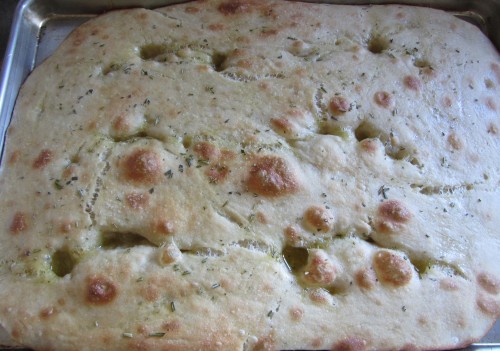
052313 focaccia

Other than resolutely sticking to the pan, it was a nice bread. I wouldn’t call the texture “incredible” like Beranbaum does, but for a fairly fast bread it was better than serviceable.  The crust had a light chew to it. The crumb had an almost spongy, open texture, similar in appearance to the structure of a luffa. (Appetising, I know — I mean that in a nice way.) The hole size was very consistent throughout. (It really sucked up Iron Chef Leftovers’ terrific pig sauce.)

One reason I chose to try this bread, as close to the recipe as I had time for, was the 20 minute mixing time and super high hydration. Both of those parameters were well outside of what I make usually make. Normally I would try to minimize the oxidizing of the dough by not mixing for that long, but for this bread, it worked. I can see making this one again, though I’m sure the Kitchenaid won’t dig having to run  for that long if I choose to make multiple breads for a crowd.

For a crowd, though, the Go To potato onion focaccia recipe is here.

Yeast, Bacteria, Temperature, And Taste

by A.J. Coltrane

While browsing pizzamaking.com I’d been noticing a bunch of references concerning the effect that temperature has on flavor during fermentation, though I hadn’t been able to find real, concrete specifics.

While looking for that information and re-reading Rose Levy Beranbaum’s The Bread Bible, I came across this [pg 30]:

…When chilled, the yeast goes into dormancy, slowing its activity and producing more alcohol. The decreased activity gives the bacteria a chance to feed on the sugar, develop more, and produce more acetic acid. Temperatures of 40F to 50F are ideal for the formation of acetic acid; 55F to 90F results in the formation of blander lactic acid. Acetic acid imparts a far more sour quality to bread than lactic acid. As an added benefit, acetic acid also strengthens the dough’s structure, although too much of this acidity would ultimately weaken it. Some bakers prefer the milder flavor provided by lactic acid.

Emphasis mine. The angels weren’t singing or anything, though right now I’m thinking it’s a key component of flavor development that I’d initially overlooked/undersold.

On a not-unrelated point, within the last year Iron Chef Leftovers and I attended a bread-baking class taught by a local professional baker. The guy kind of wrinkled his nose when one of the students expressed a high opinion of Peter Reinhart’s level of knowledge and contribution to the craft. (I don’t think it was one of us, though we had previously attended a class taught by Reinhart and learned quite a bit.)

Anyway:  a quote from Reinhart’s Artisan Breads Everyday [pg 52].

Pain a l’Ancienne Rustic Bread

I first introduced the concept of cold-fermented wet dough in The Bread Baker’s Apprentice. While the idea isn’t new or original, it has blossomed during the past few years into various no-knead, overnight rise permutations…

Maybe it’s just me, but it feels to me like Reinhart is taking credit in a backhanded kind of way for the no-knead idea and the general increase in popularity in the use of the refrigerator to retard fermentation. “it has blossomed the last few years into… (these other guy’s come-lately stuff)”. It’s a fairly common thread that runs through his writing — I can see now why the guy might have wrinkled his nose.

It’s just me, right?

—–

Note: The Bread Baker’s Apprentice is still highly recommended.

Easy Cracker Recipe

by A.J. Coltrane

The recipe below is from this allrecipes post. I’ve added a few modifications and suggest some other options.

1 3/4 cups whole wheat flour

1 1/2 cups all-purpose flour

3/4 teaspoon salt

1/3 cup vegetable oil [I used canola this time]

1 cup water

salt for sprinkling

[I added some minced rosemary to the dough — other tweaks are suggested below]

——–

1.  Preheat the oven to 350 degrees F.

2.  In a medium bowl, stir together the whole wheat flour, all-purpose flour, and 3/4 teaspoon salt. Pour in the vegetable oil and water; mix until just blended. [I allow for a 20-minute rest at this point]

3.  On a lightly floured surface, roll out the dough as thin as possible – no thicker than 1/8 inch. Place dough on an ungreased baking sheet, and mark squares out with a knife, but don’t cut through. Prick each cracker with a fork a few times, and sprinkle with salt. [I used my kitchenaid pasta roller attachment instead of a rolling pin.]

4.  Bake for 15 to 20 minutes in the preheated oven, or until crisp and light brown. Baking time may be different depending on how thin your crackers are. When cool, remove from baking sheet, and separate into individual crackers.

Why this works:  The crackers maintain their “snappiness” at least in part because of the key phrase in the recipe above — “mix until just blended.” Working the dough any more than that develops gluten, which makes the crackers unpleasantly chewy instead of the desired result of snappy/crispy. The docking (“pricking with a fork”) prevents the crackers from blowing up like balloons.

Into the oven.

The Mark Bittman recipe posted here uses 2 TBP oil to 1c flour. That’s a 1:8 oil to flour ratio. The recipe above calls for 1/3c oil to 3-1/4c flour — a ratio of about 1:10. Bittman also bakes the crackers at 400F rather than 350F. I think Bittman is basically almost frying the crackers.

The recipe is also flexible — minced rosemary can be added into the dough, or the “sprinkle with salt” step can be augmented with sesame seeds, paprika, poppy seeds, or anything else that sounds good. Peter Reinhart’s “Lavash Crackers” recipe calls for misting the dough lightly before adding the extras. (Reinhart also calls for a 350F bake.)

The completed crackers. More rosemary would have been a good thing.

Mark Bittman’s Eggless Pasta And Crackers

by A.J. Coltrane

No, it’s not pasta with crackers, it’s pasta and crackers. What got my attention is that they’re basically the same recipe:

Eggless Pasta Ingredient Crackers
2 cups Flour 1 cup
1/2 cup (hot) Water 1/4 cup
2 TBP (Olive) Butter or Oil 2 TBP (Corn)
1 tsp Salt 1/2 tsp

These are both “4 servings.” I’ll rescale the pasta recipe so that the flour is equal in both:

Eggless Pasta Ingredient Crackers
1 cup Flour 1 cup
1/4 cup (hot) Water 1/4 cup
1 TBP (Olive) Butter or Oil 2 TBP (Corn)
1/2 tsp Salt 1/2 tsp

The more I cook the more I’m convinced that most recipes are just variations on a theme. For example, compare those two recipes to Ming Tsai’s shallot pancake recipe that I posted in January 2011:

1 cup flour:  Check.

1/2 cup (hot) water: This is the variation, it’s wetter, as it’s a bread/dough rather than pasta or crackers. Related sidenote – I’m beginning to think a key to making crackers may be keeping them as dry as possible without totally dehydrating the flour.

1 TBP Oil: Check again, in this case it’s sesame oil.

1/2 tsp salt: Check.

As far as the actual recipes go —

The pasta recipe recommends letting the pasta dough rest for at least 30 minutes after kneading, then rolling out and cutting the dough. (Again, the Ming Tsai Shallot Pancake recipe calls for a rest too, as do many recipes that involve hydrating flour.)

The cracker recipe does not specify a rest, though I’ve seen cracker recipes that do. Roll out the cracker dough thinly and cook in a 400 degree oven for about 10 minutes or until lightly browned.

Source for the Bittman recipes: The excellent “How To Cook Everything Vegetarian“, which also gets a “Favorite Cookbooks” recommendation.

Ming Tsai’s Shallot Pancake Recipe

by A.J. Coltrane

Ming Tsai’s Shallot Pancakes.  It may look like quite a few steps, but it’s fast and easy.  (Seriously, it’s super easy and the results are impressive.)  The original recipe is here.  The recipe below is scaled down in size.

Ingredients:

1 cup All-Purpose Flour

1/2 cup Very Hot Water

1 large Shallot, or substitute Scallions

~1 TBP Sesame Oil

~1 TBP Canola Oil, plus more for the skillet.

Sesame Seeds (Optional, but good.)

Salt

Step 1.  Combine flour and hot water in a mixer or food processor.  (I use a little food processor; the dough is ready in about 5-10 seconds.  Pulse it a few times and it’s done.)  When the dough comes together sprinkle a small amount of flour on a counter and knead for a couple of minutes — until the dough is smooth and not sticky.  If the dough is sticky add small amounts of flour to fix it.

Step 2.  Form the dough into a disk, wrap in plastic wrap.  Refrigerate for an hour.  (On Simply Ming, Tsai calls for overnight.  The linked recipe calls for up to 48 hours.)  In theory the minimum rest would be about 20 minutes — long enough for the dough to hydrate.

Step 3.  Combine sesame oil and canola oil in a small bowl.  Slice shallots thinly. 

Step 4.  Flour work surface and roll out dough to around 1/8″ thick.  Brush Oil mixture over the top of the dough.  Sprinke the dough with sliced shallots and salt.

The next time I made this I used more shallots.

Step 5.  Roll the dough into a “jelly-roll.”  Twist each end of the “jelly-roll”  in opposite directions 3-5 times.   (This will add more layers.)  Roll the “jelly-roll” up like a snail, tucking the end underneath.  Finally, roll out the snail to about 1/4″ thick.

The "jelly-roll", twisted.
The Snail.
The Snail, squishified.

Step 6.  Heat a skillet over medium heat.  (Ming recommends cast iron.)  Oil the pan with 2-3 tablespoons canola oil.  Brush the dough on top with the sesame/canola oil mixture and sprinkle with sesame seeds.  Place the dough in the skillet, with the oil/sesame seed side down.   Brush the new “top” with the oil mixture and sprinkle with sesame seeds.  Cook each side 3-4 minutes per side, until golden brown.  (The recipe calls for 2-3 minutes per side.  I found mine took longer, especially on the first side, but I didn’t use cast iron.)  Slice into wedges and serve.

Ming’s “Dim Sum Dipper”, pictured above, is 1/2 cup soy, 1/4 cup rice vinegar, 1 TBP Sambal Oelek.  You may want to halve (or less) those amounts… It’s basically a 2:1 ratio of soy to rice vinegar and a dash of something hot.

This recipe is so good, and so easy.. I figured I must have overlooked it in a cookbook at some point.  So I went looking.  The nearest thing I could find was in Jeff Smith’s “The Frugal Gourmet Cooks Three Ancient Cuisines”, but that recipe used lard to maintain the layers instead of oil.  That would explain why I haven’t made it.  (Two points:  Cookbooks by Jeff Smith are still readily available for cheap — go figure.  Also, Smith says that he got the recipe out of cookbooks by someone named Pei Mei.  A little research and.. there it is!  (One of the books anyway, Smith references Volumes I-III.)  Published in 1969.  It’s actually Fu Pei-Mei.)

The neat thing about this recipe is that it makes a nice “laminated” dough (think phyllo) with very little time or effort involved.  The recipe can also be scaled to whatever size is needed — the ratio is 2:1 ap flour to hot water, everything else is negotiable.

I’m thinking pesto might be a good substitute, or a roasted red pepper coulis…