Pizza Bianca — A Sizeable Superbowl Sendup

by A.J. Coltrane

A Superbowl sendup on the Roman “Pizza Bianca”, inspired by this recipe, created by J. Kenji Lopez-Alt at Serious Eats. He describes his process here. Here’s the photo from Serious Eats:

Kenji's Pizza Bianca. Check out his process at Serious Eats.
A little bit of background:  The Pizza Bianca I’m referring to is created at Antico Forno in Rome. It’s a flatbread about 2 meters long; made with olive oil, salt, and rosemary. The baker scrunches up the dough like an accordian onto a peel, then shimmies the dough out to its full expanse in the oven. The pizza is sold by length, rather than by the slice.

That sounds good to me, though I don’t have an oven that’s six feet across.

What I do have is a grill that’s 24″ x 18″. It’s my biggest cooking surface, and I thought that for the Super Bowl it’d be fun to make a flatbread the size of the grill.

Here are the two formulas, Kenji’s is the “Original” in the center column (Baker’s Percentage definition here):

Weight in Grams Original Sizeable
Flour 500, Bread Flour 800, AP Flour
Water 375 544
Salt 10 16
Yeast 5 5
Olive Oil 1/4 cup 3/8 cup
Rosemary 1 TBP, minced 1.5 TBP, minced
     
     
Baker’s Percentage Original Sizeable
Flour 100 100
Water 75 68
Salt 2 2
Yeast 1 0.63
Olive Oil 10.6 10
Rosemary 1 TBP, minced 1.5 TBP, minced

Kenji’s uses a 75% hydration and an overnight rise, since his is based around the Lahey No Knead recipe. I decided in advance that if I used a hydration that high then I’d be unlikely to get *that* much wet, oily, dough onto the grill without a mishap. I cut back the hydration to a more manageable 68% and allowed for a three day rest in the refrigerator. (My “regular” pizza dough is 60% hydration.)

Sizeable.

The recipe:

Use a spatula to combine all of the ingredients above in a large bowl, cover with plastic wrap. Leave the dough in the refrigerator for 3 days in total, folding the dough (in the bowl) a couple of times per day. Remove the dough from the refrigerator about 4-5 hours before it’s time to grill. (If the dough is threatening to rise too much then either go ahead and grill it, or fold it again to buy another hour or two.) Flour a work surface and roll the dough out to into a 16″ x 22″ rectangle.

Arrange the dough so the long dimension goes from left to right. Generously brush both the dough, and the back of an inverted sheet pan, with olive oil. Fold the dough in half (left to right) to transfer it to the sheet pan (see below).

Further explanation:  The 16″ side of the dough (what *was* the short side) goes lengthwise on the sheet pan, the “long” side of the dough (which is now 11″, because it’s folded in half) sits folded across the short dimension of the sheet pan. The “inside” of the dough has now already been oiled. The bottom on the dough is now sitting on oil. All that remains is to oil the new top. Preheat the grill to medium.

To transfer to the grill:  Pick up the dough (still folded in half) and rapidly move it over to the grill, then unfold the dough and carefully try stretch it out a little if it needs it. When the dough stiffens up, shows some color on the bottom, and feels about half cooked then it’s time to flip the monster. I slid a cheap pizza pan under the dough and flipped it over. I used the same pan to remove the finished pizza from the grill — the pan was smaller than the pizza, but it worked ok overall. Hot pads are recommended, the pizza will be lava hot. I used a pizza cutter to score the pizza, to try to make it easier for everyone to tear off a piece. As part of a nice Super Bowl layout this easily fed 10 people with leftovers — it’s basically the same size as two large pizzas, combined.

Pasta all’amatriciana

By Iron Chef Leftovers

I like incredibly simple meals. One of the simplest and tastiest is pasta all’amatriciana. It has a whopping 5 ingredients – guanciale (essentially pork jowl bacon), tomatoes, pepper flakes, cheese and pasta (well, technically 6 if you count the pasta water) and takes probably 20 minutes to prepare. The recipe that I used was stolen (with a few modifications) from Jennifer McLagan, James Beard Award winning cookbook author, who pilfered it from another cookbook. The only thing that I really did differently was used cappelini instead of bucatini since Mrs. Iron Chef doesn’t like thick pasta. It worked, but it would have been better with thicker pasta as the thin pasta really does absorb more of the sauce. Either way, this was a pretty killer dish.

Note – I converted the measurements from metric, but I used the metric measures when I made this, so it might be a little off. I also left the metric measurements in there if you are so inclined.

The Software
6 oz (175 g) guanciale – sliced into 1/4 inch lardons
2 cups of diced roma tomatoes
1/2 teaspoon red pepper flakes
2 tablespoons grated Parmiggiano Reggiano
2 tablespoons grated Pecorino-Romano (plus extra for topping the pasta)
16 oz (400 g) pasta
1 cup reserved pasta water

The Recipe
Cook the pasta until al dente (time depends on the type of pasta), reserving 1 cup of the pasta water. Cook the guanciale over medium heat until browned, stirring occasionally, about 10 minutes. DO NOT DRAIN THE FAT FROM THE PAN. Add the tomatoes. Cook over medium heat for about 5 more minutes. Add about 1/2 of the pasta water and cook for 2 more minutes. If the sauce is still too thick, add more of the pasta water (it should be slightly watery). Add the pasta and cheese, stir to combine. If the sauce looks too thick, add a bit more pasta water, if not, serve with some grated cheese and ground black pepper.

Notes
If you like more heat, add more red pepper. If you can’t find guanciale, use really fatty pancetta or bacon and you may need to add some olive oil to the pan for additional fat. It won’t be as good, but it will work in a pinch. Use your judgment in adding the water – my tomatoes were very dry so I needed more water that I thought I would. You can add less. Canned tomatoes would probably work if you drained them before adding them to the guanciale. I didn’t take a picture of the sauce, but here is what it should look like before you put the pasta in (I am linking rather than posting my pictures because Chef McLagan is a professional and, frankly, hers was much prettier than mine).

No Knead Bread — What Happens When It’s Slashed

by A.J. Coltrane

Jim Lahey’s No Knead Bread doesn’t need to be slashed.

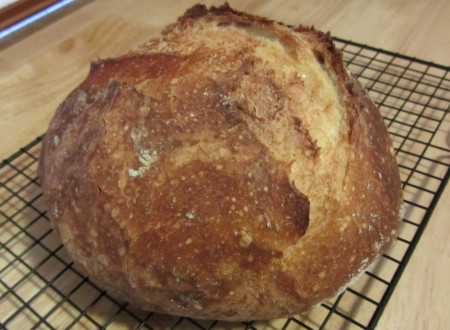
Usually though, it comes out looking something like this:

Or these:

This is a lucky outcome, from an appearance standpoint:


But here’s what I got the first time I put it in the pot, then slashed it:

The nice thing is that the attractive slash and rise in the last photo represents a reproducible result. Note that the shape is a little more “regular” too — the bread didn’t just crack organically.

Which looks most appetising?

—–

Postscript:  Four different photos of bread using four different photo techniques, and the last picture uses the newer camera. The first bread obviously used more flour for proofing, and the left of the twin breads used a non-preheated pot. Still, at this point the baking has a more predictable outcome than I get from the photography — there are a lot more hours invested in the baking to date.

A Reality Check On The Jumbaco By Serious Eats

by A.J. Coltrane

The commercial for the Jack In The Box “Jumbaco” has been almost unavoidable — it’s even spawned a petition page on facebook, collecting signatures to bring it to market for real.

The Jumbaco is a Jumbo Jack sandwiched between two tacos:


serious eats has taken the next logical step:  Erin Jackson made one, then ate the end product. Here’s the link, follow it for photos and her take on the taste.

I may have to make one for myself!

Chicken Breast, The Wonder Bread of the Meat World

By Iron Chef Leftovers

This article appeared in Seattle Weekly recently. It had the lovely title “Should a Restaurant Warn Its Customers Before Serving Dark Meat”. Basically, there was an editor of the Weekly, Caleb Hannan, who went to Skillet and ordered a fried chicken sandwich, expecting it to be a chicken breast but it was not. Hannan asked:

“When a menu says chicken, don’t you assume it’s the breast?,”

To which the author of the article, Hanna Raskin replied:

I don’t. I figure the chef will use whichever part of the chicken is best suited for the dish. While that’s frequently a breast, chefs who prize flavor aren’t averse to working with legs and thighs. If I received an unanticipated thigh, I’d be pretty psyched.

I am with Hanna Raskin here. If you went to a restaurant and ordered a burger, are you expecting it to always be ground chuck? If a menu just said steak, would you expect them to be serving fillet. Do you expect that your fish in your fish sandwich or fish and chips is always halibut? Of course not, so then why in hell would you expect a chicken sandwich to be breast meat.

To Caleb – if you don’t like dark meat and it doesn’t specifically say breast, DON’T FREAKING ASSUME IT IS BREAST MEAT. The rule in dining out or buying food to cook at home is always: if you are not sure about something, ASK!

I personally don’t understand the aversion to dark meat. It has tons of flavor, it doesn’t dry out (bones and collagen are wonderful things), it is at least as healthy if not more healthy for you than white meat and it is several dollars a pound cheaper. From the National Chicken Council:

The domestic preference for white meat is considerable. White meat beats out dark by a 2-1 margin, a statistic boosted by queasiness about eating meat on the bone and the false belief that white meat is healthier. Since the 1950s, when chicken processers began packaging meat so buyers wouldn’t be stuck with whole birds, white meat’s reigned as the default definition of chicken.

It also appears that the rest of the world prefers dark meat to white by about the opposite margin. Once again, America does the opposite of what the other 6.5 billion people on the planet do.

Chicken Breast is the Wonder Bread of meat – it is relatively flavorless, doesn’t provide you with a great deal of nutrition outside of the calories and is just a vehicle for whatever you are putting on it. People – buy the whole bird (I wrote about the reasons for it here). If you hate dark meat, just make stock out of it. Trust me, it will still be cheaper in the long run than buying those prepackaged chicken breasts, and who knows, you might start to appreciate the tastiness that is dark meat poultry.

A Very Agreeable Bread

by A.J. Coltrane

Here’s a typical french bread recipe (scaled to “15 servings”)

  • 3 cups all-purpose flour
  • 1-1/4 (.25 ounce) packages active dry yeast
  • 3/4 teaspoon salt
  • 1 cup warm water (110 degrees F/45 degrees C)

This is the same basic ratio of flour to water (3:1) as my “go to” pizza dough recipe. 3 cups of flour weighs about 375-400 grams (I’ve been using Lahey’s 400 grams as standard). 1 cup of water weighs 237 grams. Expressed as a baker’s percentage, the water weight is about equal to 60-63% of the flour weight.  (By rounding the water up very slightly to 240 grams:  240/400 = .60)

The beauty of using weights instead of volumetric measures is that it removes all of the variables from the paragraph above, and removing variables leads to more consistent results. Baking is enough of an inexact science as it is, without intentionally introducing variables into the process.

So here’s the point:  When using baker’s percentages a “classic” french bread formula would be called out as “60-2-2”. For every 100 parts flour the formula calls for 60 parts water, 2 parts salt, and 2 parts yeast. Everybody knows what french bread “is”, and that makes for a good jumping off point to try other things:

Ingredient Original French Bread Percentage Approx French Bread Volume French Bread Weight Agreeable Bread Weight
White Flour 100 3 cups 400g 300g
Wheat Flour 0     100g
Water 60 1 cup 240g 268g
Salt 2 1-1/4 tsp 8g 8g
Yeast 2 2 tsp 8g 8g

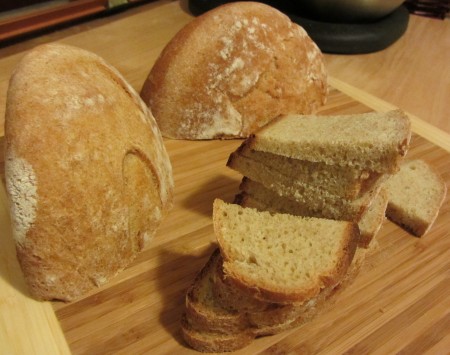
What happened here, exactly? I replaced 1/4 of the white flour with wheat flour, and I increased the hydration from 60% to 67% by adding 28 grams of water — about two tablespoons. The end goal was a slightly more rustic, somewhat “wheaty” bread. I also added two tablespoons of butter to the dough because there was butter in the fridge and I felt like adding it.

To bake the bread I used the Lahey “covered pot” technique (30 minutes covered, 15 minutes uncovered), decreasing the baking time from 45 minutes down to 40 (only 10 minutes of uncovered baking) —  the hydration of the Agreeable bread was 67% rather than the 75% in Lahey’s “no knead” dough; there was less water to cook out.

If I had to do over again I would have removed the pot lid 5 minutes sooner, to try to get a little more color on the crust. Slashing the dough may have also produced a slightly more open crumb, a “better” result — 60% hydration doughs pretty much always get slashed, and high hydration (75%) doughs basically never get slashed (they’ll often collapse into the slash); there’s a point in between there where slashing the dough is a good thing. Now I just have to figure out what that “point” is.

In any event, the Agreeable Bread went well with Saint Andre cheese, and it made a good breakfast sandwich too.

Odd Bits Dinner Menu

By Iron Chef Leftovers

There will be a dinner at the house of Iron Chef Leftovers in honor of the book Odd Bits and for my sister-in-law who wanted to try them. Recipes and review to follow next week.

The menu is as follows:

Course 1
Better than McDonald’s Chicken Nugget
-Fried Chicken “Oyster” , Honey Mustard Dipping Sauce

Course 2
Sweeter than Bread Raviolio
-Poached Sweetbread Raviolio; Taleggio, Mushroom and Marsala Cream

Course 3
Cheesesteak, Wiz, Wit
– Eye Round and Tongue Cheesesteak, Beecher’s Flagship “Cheese Whiz”, Caramelized Onions, Essential Baking Baguette

Course 4
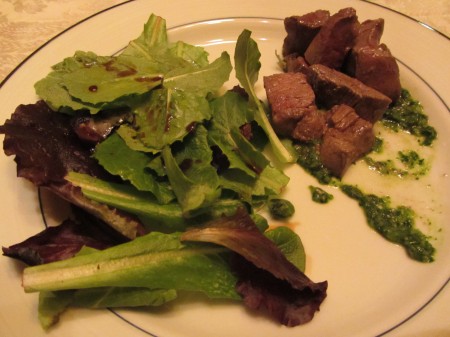
Peruvian Style Beef Skewers
-Grilled Marinated Heart and Tenderloin Skewers, Salsa Verde; Side Salad

Course 5
TBA*

* Course 5 was supposed to be Pig Blood Chocolate Ice Cream. Finding usable pig’s blood is pretty much impossible to find unless you can find someone slaughtering a pig, so I haven’t quite figured out the dessert at this point.

Celebrating “Respect for the Aged Day” a Little Early

By Iron Chef Leftovers

Note: Respect for the Aged Day is a Japanese holiday celebrated annually to honor elderly citizens.

I happened to go into {REDACTED}* today looking to purchase a bottle of Sam Adams Infinitum since a friend of mine highly recommended it and {REDACTED} had it last time I was in there.

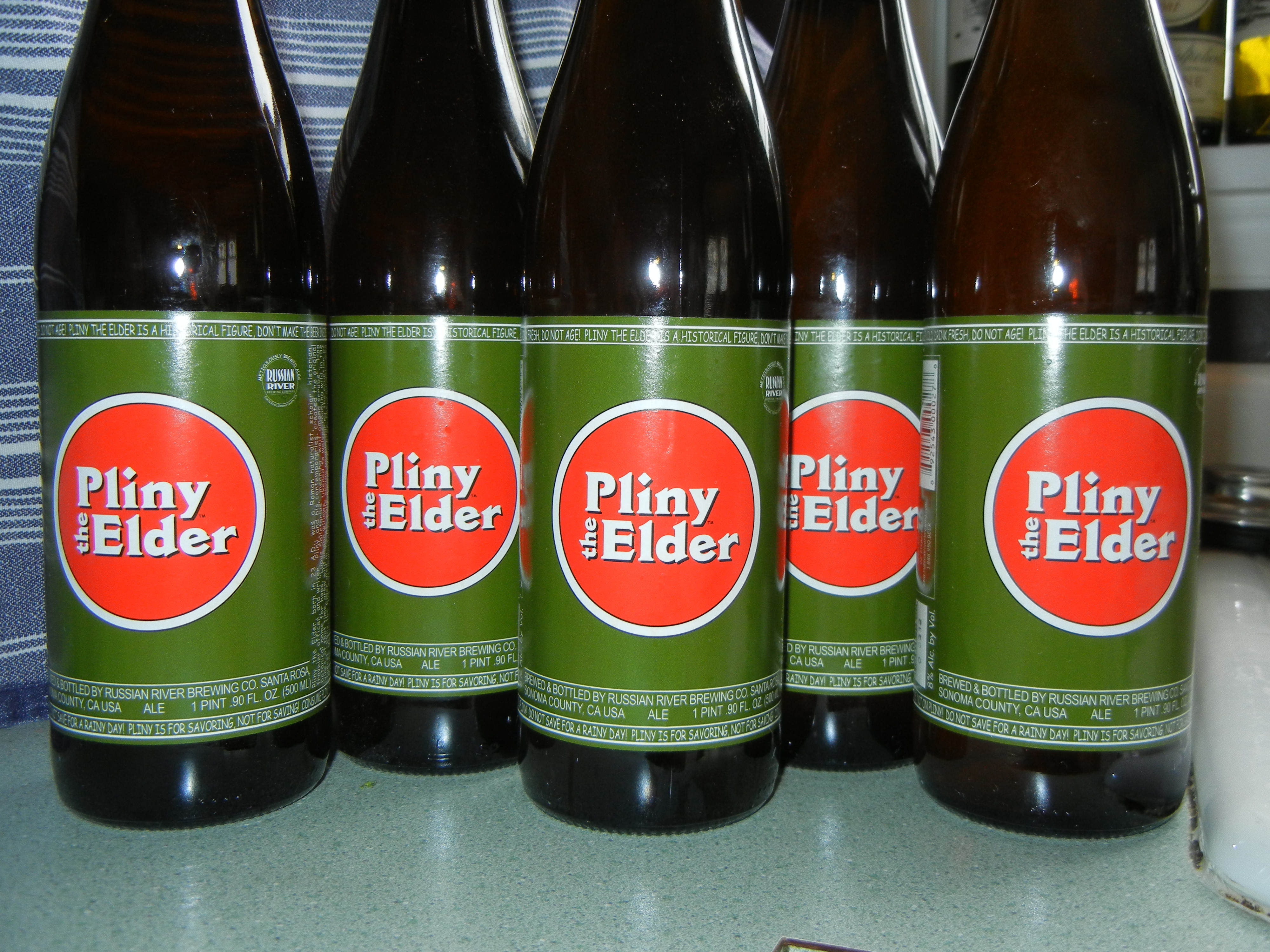
Well, they didn’t have it, so I decided to see if there was anything else interesting. They had an IPA from Driftwood Brewing in Victoria BC which I picked up. Last time Mrs. Iron Chef and I were in Victoria, our bartender at a wine bar and I got into a beer discussion and he highly recommended Driftwood. I didn’t get a chance to sample it, so I picked up a bottle. As I was looking, I saw something out of the corner of my eye that got me excited. Then another, and another. When all was said and done, these fine specimens followed me home…

Yep. I purchased 5 bottles of Pliny the Elder. No, I won't tell you where I got them, but if you are nice, I might share them with you.

No limit, so I cleaned them out. If they had more, I would have bought it. I am one very happy Iron Chef right now. It was like Christmas in January.

* I {REDACTED} the name of the establishment where I made my purchase because, well, I like that I have a source of potentially getting Pliny that doesn’t limit me to one beer a day.