The website thedailymeal.com, released their list of the 101 best restaurants in America. Seattle did fairly well, sporting 3 restaurants on the list, with Canlis coming in the highest at number 31. Here are the Seattle restaurants that make the list:
96. The Walrus and the Carpenter
70. Herbfarm
31. Canlis
Portland, despite the same number of restaurants on the list, did better in the overall rankings:
69. Beast
62. Le Pigeon
12. Pok Pok
Of the 6 on the list from the Northwest, I have been to 2 of them – Canlis (once) and Le Pigeon (four times). Honestly, Le Pigeon is a much better restaurant than Canlis and I can think of at least a half dozen places that I would rank ahead of Canlis just in Seattle.
Overall, the list is predictably dominated by restaurants from New York and San Francisco, which should surprise no one.
My problem with this list, and list like it, is that you end up with a lot of places on the list that have been around for a long time and, while they are excellent meals, are very dated and on their list because of their reputation. A couple that jump out: Peter Luger in NYC, Katz’s Deli in NYC, Al Forno in Providence, RI, and Canlis. I have eaten at all of these places. Canlis (which I have been meaning to review for a few months now) was a fine experience and well prepared, but was horribly expensive and didn’t really leave me thinking I have to come back to this place. Peter Luger and Al Forno were both the same way as Canlis and Katz’s is an overpriced tourist trap.
That being said, I think this list does a pretty good job accounting for newer restaurants and probably got the top 10 close to right.
One thing that I did notice – Boston, which is apparently on the short list for the next Top Chef season along with Portland, only had 1 restaurant on the list – O-Ya at number 88. Just another reason Boston is not really a great location for Top Chef to visit.
If you happen to be free this Thursday morning and in the Fremont neighborhood, you might want to stop into the Book Larder on Fremont Ave. for a talk with Gail Simmons, of Top Chef fame. She and the boys will be in town promoting her new book from 9:30 – 10:30.
I may just have to come down with a case of something.
Gail Simmons and the boys are coming to Seattle for a visit; and I am not referring to Tom and Padma.
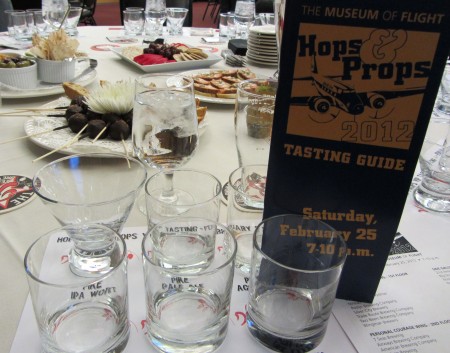
Photos from Hops & Props, a benefit/ beer event at the Museum of Flight.
The VIP pre-event
Next year we’ll skip the VIP dinner. Too much talking by the speakers. Too little drinking and tasting. Ostensibly it was a Pike beer and food pairing. It was mostly a lecture, and a numbing one at that. I think we sat there about 25 minutes before we were allowed to taste the first actual beer, and the event ran over its alloted 1 hour timeframe due to the windbag element.
I’m always the most amped about the piston-powered planes. The black plane on the left is either the same model that the Red Baron piloted, or a very close relative.
A view of one of the buffets. The sandwiches were mostly bread. I think they might have attempted to be a little “classier” the last couple of years as compared to this year, but after some beverages I’m not arguing with a tasty corn dog.
The very sluggishly moving coat check line.
A portion of the coat check line. The moral: Don’t bring a coat to these events.
I think the last couple of years there were more people that came to the event for the airplanes. It seems to have shifted to more of a beer crowd, and some of the lines were really long.
Having said all of that: I’d highly recommend this event — it’s probably my favorite event every year.
I don’t have a great ego when it comes to cooking, but I am pretty good at it. Contrary to what some people think, I really couldn’t be a professional chef nor would I want to – I enjoy cooking and it is my relaxation. Baking on the other hand is not something I am good at – where I excel in cooking a savory dish is that I know how flavors work together, I can improvise and improve a recipe on the fly and I can adjust the dish during the cooking process to correct it, baking it’s the opposite. I hate that you can’t tell if you got it right until the finished product comes out of the oven and by that point it is too late to do anything about it. Don’t get me wrong, I understand the science behind baking and why ingredients do what they do, but I hate the lack of improvisation that baking delivers.
Why do I mention this, well up until a few weeks ago, my greatest culinary failure had been a tiramisu that I forgot to add the egg whites. I realized this after I put the entire thing together, when it was too late to add the egg whites, but fortunately, I was able to save it by putting in some cream and running it though an ice cream machine and I ended up with tiramisu ice cream. It turned out to be edible at least.
A few weeks ago, I had a few bananas that were well past being edible (they were black), perfect for banana bread. I remembered there was a really easy recipe for it on cooksillustrated.com, so I went there to grab it. Instead of printing it out, I wrote down the ingredients. Unfortunately, Mrs. Iron Chef came home as I was doing this and I got distracted. I picked up where I left off and this is what I wrote down:
My ingredients list. Any idea what I missed?
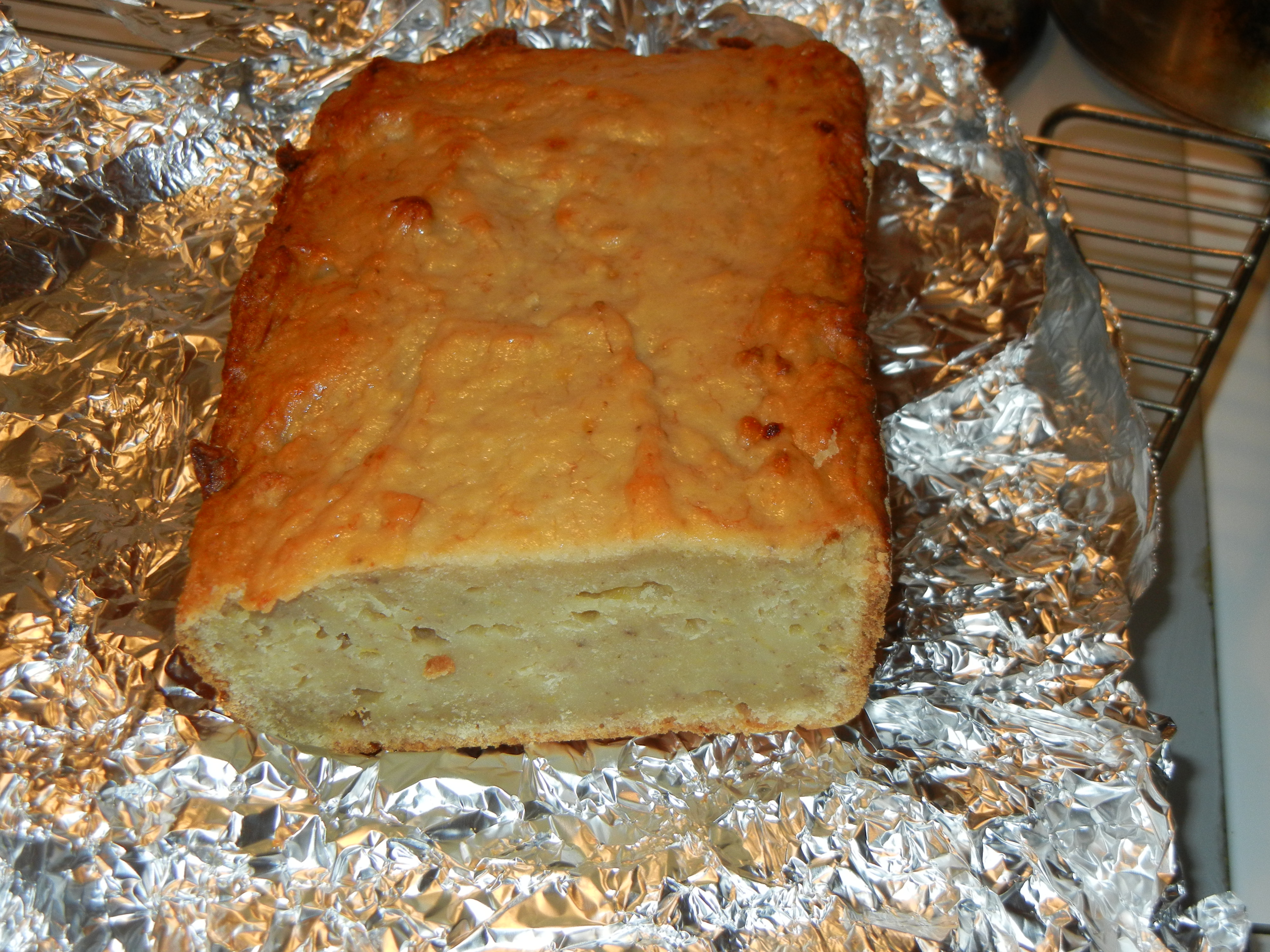
I looked at the ingredients list and thought it looked a little strange, but I figured that it was right, so I proceeded to put everything together and bake the bread. It smells wonderful in the house the entire time it is baking. After and hour I check for doneness and pull it out of the oven and think, it looks a little odd. I finally pull it out of the pan and onto the rack and think, it looks really flat. I let it cool, it settles and looks like this:
I know at this point I screwed it up. I taste it and it tastes good, but the bread is so dense that it is practically inedible. You could probably build a house with this thing it is so dense.
So what did I screw up? I left out one simple but very important ingredient – the leavening agent, in this case, baking soda. The leavening is what causes baked goods to rise by adding gas to the batter as it cooked. When you don’t you get something that is dense enough to collapse in on itself and form a black hole.
I believe I can actually see the gravity well forming in this banana bread brick.
In case you are wondering, here is the actual recipe, and I do recommend it. It is quick to assemble and produces pretty good banana bread. From cooksillustrted.com:
Makes one 9-inch loaf
Greasing and flouring only the bottom of a regular loaf pan causes the bread to cling to the sides and rise higher. If using a nonstick loaf pan, on which the sides are very slick, grease and flour sides as well as the bottom.
Ingredients
* 2 cups unbleached all-purpose flour
* 3/4 cup granulated sugar
* 3/4 teaspoon baking soda
* 1/2 teaspoon table salt
* 1 1/4 cups toasted walnuts , chopped coarse (about 1 cup)
* 3 very ripe bananas , soft, darkly speckled, mashed well (about 1 1/2 cups)
* 1/4 cup plain yogurt
* 2 large eggs , beaten lightly
* 6 tablespoons unsalted butter , melted and cooled
* 1 teaspoon vanilla extract
Instructions
1. Adjust oven rack to lower middle position and heat oven to 350 degrees. Grease bottom only of regular loaf pan, or grease and flour bottom and sides of nonstick 9-by-5-by-3-inch loaf pan; set aside. Combine first five ingredients together in large bowl; set aside.
2. Mix mashed bananas, yogurt, eggs, butter, and vanilla with wooden spoon in medium bowl. Lightly fold banana mixture into dry ingredients with rubber spatula until just combined and batter looks thick and chunky. Scrape batter into prepared loaf pan; bake until loaf is golden brown and toothpick inserted in center comes out clean, about 55 minutes. Cool in pan for 5 minutes, then transfer to wire rack. Serve warm or at room temperature.
I really don’t like Alice Waters. Yes, she is one of the original eat local/sustainable gurus, but there are few people who are as full of themselves as she is. She loves to name drop and really has the opinion culinarily that she is right and everyone else is wrong.
I bring this up because there is a site, food52.com that holds an annual cookbook competition called “Piglet”. It is basically a head to head competition between 16 books to determine their “Cookbook of the Year”. Each battle is judged by a celebrity chef (red flag right there), with the winner advancing to the next round. This year, the finale was Momufuku Milk Bar Cookbook vs. The Art of Living According to Joe Beef. In case you don’t know, Joe Beef is a restaurant in Montreal (and currently #1 on my list of places that I want to go to eat in North America) and Momufuku Milk Bar is a restaurant in NYC, owned by David Chang, who is equally full of himself as Alice Waters.
I will be honest, I don’t own either book (although I do have Joe Beef on my Amazon Wish List), so I really can’t say which is the better book. My issue is with the comments made by Alice Waters. I figured this competition was in trouble when the write up started this way:
I am always so hopeful that young cooks with a lot of passion and talent will write books that help to transform the North American diet in a positive way. That is why I have to admit that I am more than a little disappointed in the two finalists for this year’s Piglet.
Buy this book instead of hte two Piglet finalists. That way Alice Waters won't yell at you.
Fine you are disappointed because neither of these books follows your manifesto to the letter. You would think after getting her personal feelings out of the way, she would be a bit more objective. You would be wrong:
Not because the authors are not talented, both obviously are, but because both books seem to contribute to feeding our addiction to sugar and fat.
Thanks for playing Ms. Waters. You just lost all of my respect for falling into the “fat is bad” camp. This is for another post, but fat is not inherently bad for you (it will make you feel fuller quicker, which is why people tend to overeat “low fat” foods) but it of course depends on what kind of fat you are consuming. Do you realize that 1 tablespoon of pasture raised pork fat has more omega-3 fatty acids than olive oil, and don’t even get me started on how much better it is than hydrogenated fats. Fats also allow you to get more nutrients out of your food. Most of what your body needs is fat soluble, and the lack of fat is why many vegetarians end up with health issues, your body can’t process raw vitamin D without the fat to help break it down.
As she continues, she really has nothing positive to say about either book:
Sadly, it is in the ingredients that Milk Bar really loses me — it seems that they don’t have real ingredients in their pantry. I understand the creative appeal of turning something bad into something surprising but I can’t support the choice of highly processed ingredients when fresh and organic ones are increasingly so readily available. Across the board the Milk Bar recipes are too rich, too sweet, and just too intense for me. The fact that “Crack Pie” is their most famous recipe is quite telling.
…
Many of the recipes in The Art of Living According to Joe Beef are heavy-handed and high in fat, but not all of them.
Here finally just sent me over the edge:
Appropriately, the decision between who wins the Piglet award this year between Joe Beef and Milk Bar came back to crack, and ultimately, I would rather be building a garden from a den than to be an addict.
So basically, she votes for Joe Beef because of a single story. Nothing to do with how well laid out the recipes are, or the flow of the book, or, putting her feelings aside, how difficult or easy it would be to make the recipes at home for your average cook. There is a reason why Tony Bourdain said, “Alice Waters annoys the shit out of me.” I completely agree with him on that one.
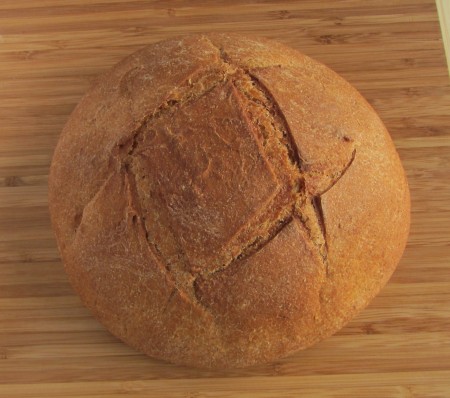
An improvised bread. I would highly recommend using a scale instead of measuring cups when baking breads — the process becomes dead simple, really nearly impossible to screw up. Once you have a feel for what the baker’s percentages should be (the relative weight of the ingredients), recipes aren’t necessary anymore.
Ingredient
Baker’s Percentage
Weight
Approx Volume
Bread Flour
75
300g
2-1/4 cups
Wheat Flour
25
100g
3/4 cup
Water
65
260g
1 cup + 5 tsp
Sea Salt
2.5
10g
1.5 tsp
Yeast
1.75
7g
2 tsp
Sugar
1.5
6g
1.5 tsp
Process: I kneaded the ingredients for six minutes in the kitchenaid, covered the bowl with a towel, and allowed the dough to rise for a couple of hours. I put a Le Crueset in the oven to preheat with the oven to 450 degrees. (This is the same process that I use for the Lahey No Knead method, referenced many times on this site.) The bread was set in the pot, slashed, then allowed to bake, covered, for 22 minutes. The lid of the pot was removed and the bread was baked for another 20 minutes. The bread was then moved to a cooling rack.
The postmortem: 25% of the bread flour was swapped out for wheat flour. The combination of the wheat flour, the 65% hydration, and the sugar made for a relatively dense interior. I think the bread may have benefitted from the slashing going a little deeper than it did — it may have allowed a little more expansion in the oven. Still, it tasted good, and was virtually no work, so I’ll call that a win.
Seattle is on the short list of places for the next season of Top Chef. Seattle is really overshadowed by San Francisco and LA as a culinary mecca, but you have some really cutting edge stuff coming out of here (the Modernist Cuisine Crew) and some fantastic chef doing amazing stuff with local and seasonal ingredients. It would be a real boon to Seattle’s culinary reputation if they get Top Chef, although somehow I see an elimination challenge involving digging up a geoduck.
Marche Jean Talon in Montreal. Everything is local and seasonal here. There is a reason why most Montreal chefs shop here.
I bring this up because I read an article on boston.com that the Boston mayor is pushing for a twitter campaign to have Top Chef come to Boston. I lived in Boston for 12 years and I am back there a couple of times a year on business, so I am still pretty in tune with the Boston dining scene. Let me tell you, cutting edge and memorable are 2 words you won’t hear me use to describe it. Staid, stogy and mediocre are the ones I would use. Yes, there are some great restaurants in Boston (check out my review of what may be the best one here), but generally most places are generic and dated. Folks in Boston are not cutting edge when it comes to dining out nor is there the push for local/sustainable/organic that you would expect to see from a city with that many institutions of higher learning.
You want Italian in Boston, everyone will tell you to go to the North End. What you will find is 30 restaurants all serving “classic” Italian dishes like lasagna, chicken parm and veal piccatta. There are a few “trendy” places there, but their menus are equally as lackluster. You won’t find any place like Altura, or Assiaggio or even Swingside café there, and the North End is “the” Italian neighborhood in Boston.
If you want the best food in Boston, you have to go very high end, which in most cases excludes the bulk of the dining public (Zagat’s has the Legal Seafood restaurants ranked 1-10 and they aren’t at all cheap; everything in the top 25 is $30+ entrée type places). By contrast, the #2 and #3 rated food places in Seattle by Zagat’s are the sister locations of Paseo, where nothing is more than $15. The number 4 place? Mashiko, one of 2 sustainable sushi places in the US where you can easily fill up for less than $25 a person. Paseo and Mashiko are both amazing places to eat.
You want gastro pub, forget it in Boston. You won’t find a Quinn’s or a Tavern Law there. Great burger joint? None that I can think of in Boston (although there are a few pretty good ones around).
My favorite quote from the article:
But so far, Boston — a.k.a. the land of the bean and the cod and the home of the first gastronome to put cream in the chowder — has been terra incognita for “Top Chef.”
Right there to me is the reason to NOT shoot in Boston.
Top Chef has been to New York, Chicago, LA, San Francisco and Austin, all culinary hot spots. Seattle and/or Portland are due. Boston, meh, not so much. Heck, I would love to see them shoot in Montreal before they shoot in Boston. They could have an amazing challenge just by dropping the chefs in either Marche Jean Talon or Marche Atwater and letting them go to town.
Seattle Met Magazine has an interview with Le Gourmand Chef/Owner Bruce Naftaly in which he announced that Le Gourmand will be closing its door in June of this year. Le Gourmand is expensive. Dinner for 2 will run you close to $200 with drinks. Mrs. Iron Chef and I have been there twice and let me tell you, it is worth every penny that you pay.
It is not a fast meal; you are probably looking at 2 to 3 hours for dinner. Le Gourmand is French using Northwest seasonal ingredients. Chef Naftaly has been doing the local/seasonal/well-sourced thing since before anyone ever thought it to be trendy.
The menus change based on what is available on any given week, the ingredients are impeccably sourced (Chef Naftaly can tell you where any specific thing he uses comes from if you really want to know) and they are masterfully prepared, flavor bombs that come out of the kitchen looking like works of art. It is not a Tuesday night quick dinner place, but a place to go for a special occasion romantic dinner and a meal that you will remember for years to come. Heck, I still can taste the rabbit saddle in the mushroom sauce that I had 2 years ago at Le Gourmand. I can also probably tell you exactly what was in it from memory.
All of this artistry comes out of a kitchen that really isn’t significantly bigger than most people’s home kitchen.
Le Gourmand has been around 27 years with Chef Naftaly cooking practically every meal. In addition to that, one Sunday a month is dedicated to a cooking class (well two of them actually) which Chef Naftaly somehow manages to cram 12 people into an already crowded space and then shows them the secrets of the Le Gourmand kitchen, preparing a 3 or 4 course meal over 3 hours. The cost for this privilege, $75 per person, including wine, or to put it in perspective, the same price as other places like Dish It Up, charge for their cooking classes.
I have attended a number of these classes and I have found Chef Naftaly funny and personable, willing to explain everything he is doing and why he is doing it and more than happy to give you the secrets of his restaurant to create at home, albeit probably less successfully than he can.
While I hate to see a Seattle icon close after so long, Chef Naftaly has decided it is time to move on. He wants to write a cookbook, which I will be the first in line to buy when it comes out, and he has decided to continue to teach cooking classes, which I would be more than happy to continue to attend.
If you have had the pleasure in dining at Le Gourmand, go back for one last hurrah. If you have not, I can’t recommend enough that you should go before the doors close. You won’t regret it.
In other sad Seattle restaurant news, there was a fire at DaPino’s in Ravenna, causing 20,000 dollars in damage. You may not know Chef Pino Rogano or his work by name, but chances are you have had either his sausages or cured meats at any number of the fine Italian eateries in Seattle. Heck, he probably makes the best sausages in Seattle done by someone not named Batali and has been doing it for over 25 years (and I personally think Pino’s salami is better).
On the bright side, I believe Canlis is still standing and serving dinner and Paseo reopened after their 6 week vacation, so all is right again with the world.
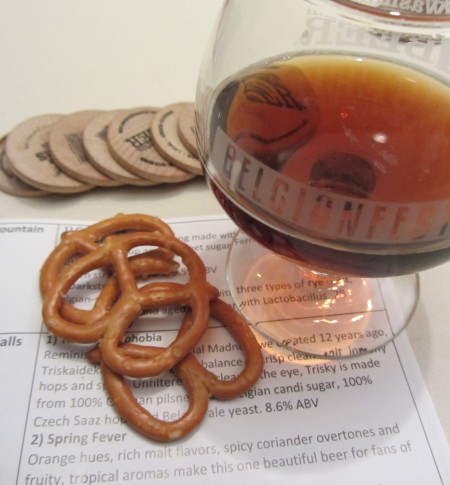
Last weekend, Coltrane, Annie S., Mrs. Iron Chef and I ventured to the Bell Harbor Conference Center for the 3rd Annual Belgianfest, presented by the Washington Beer Commission. Thirty plus breweries, 70+ Belgian style beers and 600 people graced the new venue for what is rapidly becoming a great event. The beers ranged from golden and abbey style beers on the lighter end of the taste spectrum to heavy wood aged and sour beers on the other end of the spectrum, most of which were high in alcohol. I took copious amounts of notes, but I didn’t take notes on everything that I had. After a couple of hours, palate fatigue set in, so I stopped writing things down. Here is what I had (listed by order of their appearance in the Belgianfest program):
The lines at the men's rooms were long. Total Johnsonfest.
American Brewing Company
• Big Pucker – a beer that lives up to its name. Lip puckering sour all the way through with no hint of wood. Like sucking on a sour patch kid all day.
Anacortes Brewing
• Dubbel- slightly sweet and off dry, hints of hops with honey and sugar on the back of the palate.
• Trippel – a very characteristic Belgian Trippel on the front of the palate, with a refreshing crispness on the back, with subtle banana hints teasing you the entire way.
• Sour Red – A great beer to introduce someone to sour beers. Slightly sour with the initial hit on the palate but fading into a malty red ale with hints of wood. Not overpoweringly sour like most brett beers.
Black Raven Brewing
• Cask Saison – Off-dry on the front of palate yielding to a malty saison with a hint of sour. Nicely balanced and not overwhelming.
Diamond Knot
• Strong Belgian IPA – great hop character on the initial sip that does not overpower with a long finish reminiscent of an abbey beer. If you drank this one blind, you would not be sure if you were drinking an IPA or an abbey beer.
Elliott Bay Brewing
• Long Black Veil – drinks like a wonderful dry stout with a hint of sweetness on the finish from the Belgian yeast. A beer worth sipping on a cold winter day.
Engine House No. 9
• Love Child Kriek – a crisp beer that had overtones of oak with a hint of cherries on the back of the palate. Too much oak, not enough cherry, but not unenjoyable.
Fremont Brewing
• Return of the Blood Funnel Saison – heavy citrus notes on the palate and the nose give way to a crisp ending. Very refreshing and reminiscent of an aranchata.
Sweet waffle with brie and basil. I think they've shrunk since we first saw them. Still, a hit everytime.
Gallagher’s Where U Brew
• The Monk – orange and coriander on the nose and palate. A supercharged version of a Celis White.
• Black Imperial Belgium – a confusing beer with fruity overtones and a malty finish. Liquid dark bread. Did I detect some Rye or Caraway in this beer?
Hales Ales
• Tres Fem – collaboration brew. Tart cherries and malt dominate this beer. Made me want to get a pint and a scoop of vanilla ice cream and make a float.
Schooner Exact
• Biere de SODO – a beer with a confused identity in a very good way. It first wants to be a pilsner, then Belgian ale and then an IPA. Throw in a slight funkiness at the end and you have 3 great beers in one.
Silver City
• The Giant Made Of Shadows – lots of dried fruit with a distinctive Tempranillo hit on the back of the palate from aging in Tempranillo barrels. This beer paired wonderfully with a piece of 85% dark chocolate.
• Nutcracker 2005 Special Brown Ale – a very crisp beer. Yeast gives way to citrus fruit with a pleasant oak finish. Really great for a 7 year old beer (and that was by design).
• La Fat 2007 – a Belgian/Scotch hybrid. Lots of toffee and caramel but no noticeable oak or Belgian character.
Snipes Mountain
• Darkstrong – a “sweet and sour” beer. Lots of sugar on the front of the palate with a sour finish. Detected hints of chocolate but none of the rye malt that it was made with.
Wingman
• Black Widow – subtle hints of Cab Sav on the nose and a touch of oak on the finish, but predominately figs and dried fruit. Didn’t pick up much of the Belgian character, but it hid its 11.4% alcohol really well.
Not Iron Chef Leftovers' floral cursive, in case you were wondering.
So many great beers. I loved the trend of brewing more common styles with Belgian yeast strains and I am starting to see a lot more restraint with the use of wood in Washington beers – for so long, oak dominated most barrel aged beers brewed here. The brewers are still using the oak, but tuning it back and really letting the beer shine. It was nice to see some new breweries at the event and a few aged beers making an appearance. Overall, it was a fun 4 hours of beer tasting.
My top 3 for the day:
The Bronze Monk goes to:
Silver City – The Giant Made Of Shadows. I love Tempranillo and was happy to see someone use a Tempranillo barrel in brewing.
The Silver Farmhouse goes to:
Anacortes Brewing – Sour Red. So balanced, I probably could drink this one all day long and be very happy (and it has nothing to do with my love of Anacortes beers).
The Gold Abbey goes to:
Schooner Exact – Biere de SODO – I really loved that you could taste all of the individual components in this beer. The pilsner characteristics were there without being overwhelmed by the hops and the Belgian characteristics really displayed without being overrun buy the bret that was present. I want to drink this beer again and again.
In keeping with the “excess” theme for Superbowl food, I thought it’d be fun to make an oddball dish (in addition to the Sizeable Pizza Bianca Sendup.) Something like Hum Bao. Or something like a pulled pork sandwich. Except that I wanted a crisp, crunchy, wonton wrapper instead of the typical Hum Bao steamed dough, or a floppy pulled pork hamburger bun.
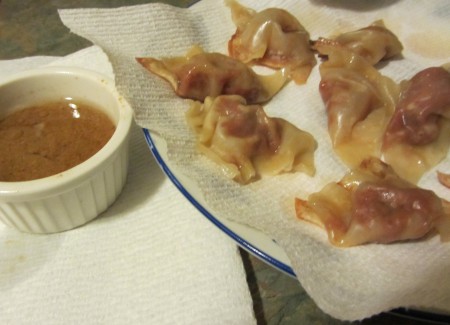
I settled on BBQ Pulled Pork Potstickers.
We put these together in the morning before the Superbowl. I had intended to cook them once everyone got to the house… By that point though, we had so much food on the table that I forgot all about them.
We didn’t miss them. We even decided to skip baking the pizza rolls (a SB tradition) and still did fine on food.
The filling was a combination of pulled pork, bbq sauce, soy, worcestershire, lime juice, lemon juice, red wine vinegar, and sambal oelek.
The dipping sauce was Gulden’s mustard, soy, sesame oil, canola oil, and honey. Sort of an asian inspired honey-mustard.
The cooking was standard potsticker technique: Preheat a non-stick skillet with a little canola oil. Add the dumplings and cook 3-4 minutes. Add 1/8 cup of water and quickly cover the pan, cook about 6 minutes covered. Uncover and cook about another 3 minutes until the bottoms of the potstickers are crispy.
I was fairly pleased with how it came out. The honey mustard sauce played nicely with the bbq pulled pork, the bottoms were crispy/crunchy, and the asian “bend” to the whole thing kept it from feeling like something I’ve had 1,000 times. I wouldn’t make it again for the Superbowl though — it’s too much cooking to do with that many guests in the house.










 FlatbreadGarden