This was a very disappointing season for fresh hopped beers. Even ones that I have had in the past and loved seemed to be lacking something this year. One of the few exceptions to this was Elysian’s entry into the style, their Prairie Rose Wet Hopped IPA. Elysian described the beer as follows:
Named for the scented flowers of the Yakima Valley and the Texas Panhandle – Amarillo – Prairie Rose is a fresh hop IPA bittered with eponymous hop shooting stars – Galaxy and Comet – to a magnitude of 60 IBU’s and finished with 40 pounds worth of we Amarillo hops from Virgil Gamache Farms. 6.5% ABV.
The beer pours vaguely orange in color with citrus and citrus peel dominating the nose with background green hops and grain. A burst of citrus on the palate initially but quickly moving to slightly floral hop bitterness with a touch of resin. The beer then finishes with a mild burnt citrus peel that lingers pleasantly with just a hint of bitterness. Big bold hop character dominates without overpowering your palate, leaving a rich and complex flavor profile when you debate if a second pint is a good idea.
Elysian’s Prairie Rose Wet Hopped IPA saunters in riding high with a handsome 4 gauchos out of 5.
My ideal gardening book would have a title similar to: Four-Season Urban Container Gardening In The Pacific Northwest, Seattle Edition.
That book doesn’t seem to exist, and for good reason. It’d sell about four copies. Digging around the internet gives a hodge-podge of information, but nothing concise and organized.
I was looking through the book options at the local nursery and came across Food Grown Right, In Your Backyard. It’s written by the co-founders of the Seattle Urban Farm Company, published in 2012. The book has an emphasis on small-scale organic urban gardening. It includes sections on designing the garden space, general gardening knowledge, detailed profiles of popular vegetables and herbs, and (my favorite) tables indicating the appropriate schedule for starting seeds indoors, transplanting, or direct seeding outside. (I loves me some tables and charts, y’know.) It doesn’t talk much about winter gardening, but other than that it’s an excellent all-around resource.
Amazon link here. To date it has received 5 stars out of 5 stars for all 35 Amazon customer reviews.
In a related note, I think I’ll be checking this out in 2014 — Bastille Cafe & Bar has a 4,500 square foot rooftop garden installed and maintained by one of the authors. Bastille offers tours on Mondays, April through September. The cost is $10, which includes a cocktail.
Now if I just need to figure out the best way to succession-plant an EarthBox.. I’ve got some ideas, but searching “succession planting” on the EB forums doesn’t turn up much. Time for a new thread..
Populuxe in its short lifespan has produced several distinct versions of their blonde – the Euro Blond was followed by the British Blonde and those two have now been joined by the American Blonde (they also have a Belgian Blond which I haven’t yet reviewed). Their blondes are a great exercise in what a slight change to the beer recipe, for example, yeast, can do to the beer, producing a completely different character. Each beer has its own distinct character and, while they share the style name, it should not be assumed that these beers are similar to each other
The American Blonde pours golden yellow in color with just a hint of orange tinge. The beer is really light on the nose with just the smallest hint of yeast and grain. On the palate, it does a complete 180, starting out slowly and building from a pleasant grain to a slightly spicy and malty sweet middle before finally finishing with a tease of hop bitterness at the very end that lingers in a good way in the background with notes of pineapple, complimenting and playing hide and seek with the yeast and the malt. The beer is pleasant to drink with a nice clean and refreshing balance to appeal to lighter beer drinkers (it clocks in at 4.8% ABV) but has enough character and depth to please a hard core beer nerd.
Populuxe American Blonde sails its way across the pond a drops anchor with a solid 4 Mayflowers out of 5.
Sometimes with all of the new breweries and beers on the market, it is easy to lose track and miss out on a good brewery. Relative newcomer, 10 Barrel Brewing out of Bend, Oregon, is one of those that I can’t believe that this is the first review of one of their beers I am posting. They have a nice lineup of beers that are available in bottles at most good bottle shops in Seattle. I was lucky enough to take a crack at their Swill, a Grapefruit Radler, on tap at a visit to Chuck’s Hop Shop this summer. In case you are not familiar with what a radler is, the internet can help you. From the Germanbeerinstitue.com website:
What does a German drink, when he or she wants a low-alcohol beer, but does not want to resort to a “light” brew? Radlermass or Alsterwasser (its northern German name) to the rescue — a beverage that is a half-and-half mix of blond lager (usually Pils or Helles) and lemonade. This drink originated in Bavaria in the early 20th century, but it is now bottled and canned premixed and available in all of Germany. However, it generally does not make its way across the sea to North America.
I don’t know exactly how this was done by 10 Barrel, but I assume that the beer was brewed and some percentage of grapefruit juice was added to the beer to make it a radler.
The beer pours hazy yellow in color with a nice white head with notes of grapefruit and grain and hints of citrus peel on the nose. The first sip yields a slight sweetness before changing direction with a slight tartness before moving onto a significant grapefruit presence – making the beer feel more like a grapefruit cocktail than a beer, before finishing with bitter peel, grain and lemon in a short finish. The balance of this beer was way off and the flavors felt like they weren’t integrated and the beer became much sweeter as it warmed, throwing the balance further off. I found myself wanting more hops and less grapefruit to try to cut some of that sweetness. Unfortunately, this was pretty much everything I dislike about grapefruit beers.
10 Barrel Swill Beer fails to make it to the finish line with a less than stellar 2 flat tires out of 5.
Reuben’s has temporarily gotten away from its cask program, and that is not a good thing since their beers generally do well with a cask treatment, revealing an incredibly deeper flavor that you don’t get on their regular versions – it is not to put down the regular versions of the beer, but the cask seems to take the fantastic regular version to a completely new level. One of the last casks that they did was their Imperial IPA dry hopped with Citra and Amarillo. If there was ever a beer that was screaming for the cask treatment, it is this one.
The beer pours heavy orange-brown, almost the color of tea with an in your face citrus nose with notes of grain on the background and just hints of resin interspersed. The beer builds slowly at first with citrus peel and grapefruit gaining traction on the palate for quite a long while before transitioning into a somewhat tea –like profile with a slightly tannic finish that is enhanced with a mild bitterness that lingers for a few seconds before fading away. For a high alcohol cask beer, there is no alcohol burn and the beer is clean and smooth with great balance and layers of flavor that evolve as you get further into the pint. The beer goes down almost too smooth and, despite the significant hopping, isn’t a palate killer, giving you the chance to actually move on to a different beer, but honestly, if you are drinking this one, you probably aren’t going to consider anything other than ordering a second pint of the IIPA.
Reuben’s Cask Imperial IPA with Citra and Amarillo dances into the picture with a graceful 4 Texas two-steps out of 5.
Double Mountain Brewing out of Hood River, Oregon has been around since 2007, but is a recent newcomer to the Seattle beer market. The have a small lineup of beer that are available year-round in bottles at your local bottle shop and can occasionally be found on tap at your local watering hold. Loyal reader Annie S. was kind enough to bring over a bottle of the kolsch a while back and share it with me.
From the Double Mountain Website:
In Cologne, many a brewery produces a light-bodied ale with a delicate fruitiness and rounded maltiness, attributable to the unique yeast strain commonly used. Our Kölsch is unfiltered and more generously hopped than its German cousin. Brewed with Gambrinus Pilsner and Munich malt and Perle hops. 5.2% ABV, 40 BU
The beer pours hazy yellow in color with strong notes of lemon and yeast, supported by touches of grain and malt. The beer starts out dry and crisp with traces of sweetness up front and a short grain finish in the back. Notes of lemon hide at various points in this beer, providing a nice contrast to the grain and adding a touch of hop character to the beer. This is a pretty easy drinking beer with no remarkable flavors, as it should be for the style, but just a touch more character than what you normally find in a kolsch.
Double Mountain Kolsch builds up a solid 3 cathedrals out of 5.
The second of the seasonally themed Mountainbeers from NW Peaks is their dessert beer – a nut brown ale made with the inclusion of actual pecans, basically setting you up for the end of the meal.
From the NW Peaks Website:
The name. The mountain. Easy Peak is not so much a mountain, but the high point on Easy Ridge, the ridge located on the other side of the Chilliwack river from popular Copper ridge. While the payoff is stupendous one must ford the Chilliwack river and ascend 3,000 feet back up to the ridge. On the ridge, I don’t know if there is a more beautiful, easy-going, completely back country experience in the N Cascades, including the hike up to the high point.
The beer. Last year we did Spickard Spice for Thanksgiving dinner, this year we moved towards Thanksgiving dessert. We brewed a nut brown as the base – a medium bodied, malty brown with a nice nutty hop (and malt) character. Per our desire to make a Thanksgiving beer, we added some pecans and pie spices, but just enough to give it a perceivable note. The result was a nut brown that dominates the character with a nice pecan note and a barely perceptible spicy note. With a nice brown color, the beer even has the color of a typical pecan pie, so we’d like to believe that it’s just like pecan pie in a glass. Maybe not “exactly”, but it goes down “easy as pie.”
The beer pours amber brown in color with hints of spice and nuts on the nose. The beer starts out on the palate with a nice mild sweetness before building into a slightly spicy nutmeg middle and then moves into deeper brown sugar and pecan nuttiness before finishing with a long, pleasant roasted pecan flavor. The beer has a small amount of perceptible pie spices, but they are definitely background flavors and work wonderfully supporting the deep richness of the nut flavors. This beer is really as close to a liquid pecan pie with great flavors of roasted nuts and I would love to see how this beer did if it got a short aging in a whiskey barrel (hint…hint). One note to add – when we drank this beer, we inadvertently left a small amount in the growler and ended up trying it a room temperature. The spice become the dominant flavor in the beer at that point, so I would say if you enjoy the nut flavor more than the spice, drink it around 45-55 degrees. If you want more noticeable spice flavor, go 55+ with your temp.
NW Peaks Easy Peak-an Nut Brown goes crazy with a spectacular 4 Carya illinoinensis out of 5.
It’s been in the 20’s basically every other night over the last ten days or so. Yesterday we had snow. Life goes on in the plant house:
New growth in December. [L-R – Pac Choi, Parsley, Cilantro, Spinanch]. The new leaves look happier than the leaves that were on the plants at the time of transplanting.For comparison, November 2:
(L-R) Pak Choi, Parsley, Cilantro, Spinach
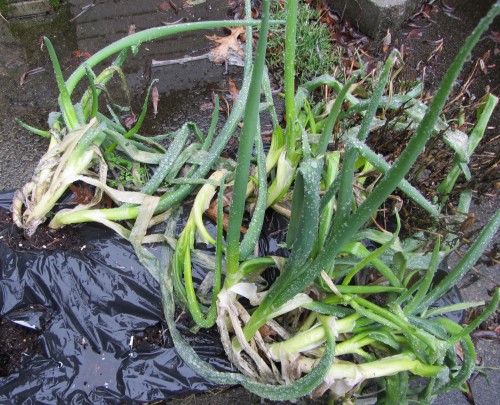
The bunch onions didn’t seem to mind the snow too much:
A few thoughts about the plant house:
1. Mid-late October is too late to move the cool weather plants into the plant house. Closer to the truth would have be sometime in August, or starting the plants from seeds even earlier. I’m still in the process of figuring out what the “correct” dates will need to be, accounting for the fact that it’s cooler here than in Seattle, though we’re still very near Puget Sound.
2. During the winter months there’s not enough sun to drive the current plant house location. Tucked up against the west side of the Real House, the plant house *might* get about a 1.5 hours of sunlight on a good day. It’s situated in a location that’s among the hottest during June and July. I’ve been surpised at just how far down the horizon the sun rotates during the winter. A permanent greenhouse installation would likely either need to go in the front yard, or the center of the back yard, or somewhere nearer the south end of the west side of the Real House.
In a related aside, I’m now seeing why ancient peoples would build structures to accurately track the stars, and by extension the seasons and the position of the sun. If your life actually depended upon forecasting the upcoming weather you’d do everything you could to try to be accurate about it. As for me, thank you NOAA weather service.
3. The 4′ x 4′ dimension of the plant house is small enough that the pac choi are tending to lay up against the walls. It seems everything touching the walls is perpetually too wet and too cold and generally rotting away. Two EarthBoxes is probably closer to the correct amount in a 4′ x 4′ space.
4. If the goal is winter greens, it might be that the right answer is some form of protected [raised bed/ whiskey barrel/ cold frame] in the front yard. It may be that the EarthBoxes could be adapted by removing the plastic cover… maybe.
I think a four-season harvest is possible, it’s just a matter of figuring out the location, technique, and the appropriate greens.
Thanks to the ever-changing tap list at Elysian, there is always a new beer to try, and I am especially happy when that new beer happens to be an IPA. This was a big beer, clocking in at 7% ABV and 70IBU, but considering that Elysian makes some of the more solid IPA’s around, I gave it a whirl.
The beer pours hazy golden orange in color and is brimming with hop character – I could smell this beer from over a foot away. Closer inspection yields light notes of grapefruit and citrus, light green hops and grain. The hop character dominates the front of the palate with significant orange peel with notes of grapefruit and a pleasant light bitterness than carries throughout the beer. These notes are then joined by moderate grain middle before finishing slightly sweet and grassy with those mild bitter notes. There is no obvious alcohol burn despite its ABV and the beer has a nice progression of flavors without being one note. Oblivion is more hop forward than most of the Elysian IPAs, but not so much that it will blow your palate.
Elysian’s Oblivion IPA races toward destruction with a brave 3 perils out of 5.
 This was a very disappointing season for fresh hopped beers. Even ones that I have had in the past and loved seemed to be lacking something this year. One of the few exceptions to this was Elysian’s entry into the style, their Prairie Rose Wet Hopped IPA. Elysian described the beer as follows:



![New growth in December. [L-R - Pac Choi, Parsley, Cilantro, Spinanch]. The new leaves look happier than the leaves that were on the plants at the time of transplanting.](https://flatbreadgarden.com/wp-content/uploads/2013/12/31be0-122113-plant-house-e1387665861495.jpg)

 FlatbreadGarden