A couple of times a year, the brewers from New Belgium and Elysian get together and brew a beer in a collaboration series called “Hop Trip”. These beers are generally unusual and pretty good. In honor of fresh hop season, they brewed an Imperial Fresh Hop, basically a fresh hop double IPA. I couldn’t find much info on the beer other than it was 8.6% ABV and ran $6.99 for a 22 oz. bottle.
The beer pours hazy orange in color. There is light grain on the nose, but it is dominated by citrus and green hops with hints of spice in the background. The initial taste is potent – burnt orange peel and citrus juice on the front end followed by green hops and resin with a long, slightly bitter, grapefruit finish that lingers with a slight sweetness. This beer is a great balance of sweet and bitter with huge citrus character. This is definitely one that you don’t want to drink if you don’t like a big hoppy beer, but it is complex and assertive and should please just about any hop head.
Elysian Trip XIV Imperial Fresh Hop meanders down the road with a smooth 4 Winnebagoes out of 5.
March Madness is upon us and there is more going on than just basketball. There are at least 2 beer related competitions going on in Seattle.
First up is the Thirsty In Seattle Beer March Madness. This is just a paring of 64 beers in a bracket and you vote on the better beer. It seems to be somewhat random parings and I don’t think I agree with some of their selections (some breweries have multiple entries, some do not), but it is what it is, so vote early and often.
If you happen to be voting, please consider voting for my friends at the newly opened Populuxe Brewing in their matchup against Foggy Noggin’s Bit O’ Beaver. Populuxe is getting smoked right now and they could use some help. If you haven’t been to the brewery, you should stop by. They have really good beers and the owners are nice people. You can also stop by Ballard’s only wine tasting room, Domanico Winery, across the street (OK, my shameless plug is done).
Also consider their Ballard neighbors, NW Peaks, in a tough matchup of their Redoubt Red vs. American Brewing’s Caboose Oatmeal Stout. Both are fantastic beers and worthy of moving on in this competition.
The other pairing that was tough for me was Reuben’s Imperial Rye IPA (which has been previously reviewed on this site) against Anacortes Old Sebastes. If it was any other Anacortes beer, I probably would have voted for Anacortes, but Old Sebastes is their beer I like the least, and I have a beer crush on the Imperial Rye, so you can guess how that one went. I feel like a guy cheating on his hot wife with an even hotter girlfriend with this matchup.
Opening round voting ends March 22nd at 10 PM
The other and, in my opinion, more fun March Madness is going on at the Latona Pub. Their annual March IPA Madness started last night. Each Monday and Friday for the next couple of weeks, they will be tapping 3 beers. The most popular beer from those 3 advances to the final 4. You will most likely find yours truly at the Latona on March 25th when they are tapping the Anacortes IPA. It should make easy work of its 2 competitors – Triplehorn IPA (although I have never actually had it, I may have to size up the competition) and Laurelwood Workhorse IPA. The Final Four tapping is April 2nd.
Games That Got Played: Cards Against Humanity, Citadels, Gardens of Alhambra, Guillotine, Magic the Gathering, Mystery of the Abbey
Games That Didn’t Get Played: Agricola, Fjords, Fluxx (Python), Hector and Achilles, King of the Elves, Munchkin, San Juan, Settlers of Catan
I don’t know if it was the variety of caffeine-spiked beverages we were consuming, or what, but the gaming didn’t wrap up until about five in the morning(!) The record turnout could have contributed to that too — almost double that of any other GNOIF. We may need to purchase another card table, or a low table to put near the couch. Maybe something like this, though it’s only 27 inches square. It might work for a small game.
We started the evening with a game of Alhambra. It’s a good warmup game because it’s fairly simple and goes fairly quick. Four of us (2.5 new players) learned the rules and completed a game in about 35-40 minutes. Thanks to JH for correcting us on the scoring rule that we had been doing wrong since we’d bought the game. I had thought the game was unbalanced to the point of broken. It’s a dramatically better balanced game when played the right way.
I played a few games of Citadels. We started the evening playing with seven players, and the game “worked” with that many people. Later in the evening we played with four players, and it works that way too. Learning the game I’d played with two players and I enjoyed it that way as well. Point is, the game seems to scale to more players really well, and even with seven players it didn’t take an hour. (Though we only played to 6 districts all night in the interest of keeping the games breezy and fast. The games didn’t really seem to suffer for it.)
While I was playing Citadels, there was an epic game of Mystery of the Abbey. I could swear that they had 11 players, though the box says 3-6 players, and there are only 6 “Monk” miniatures. Maybe somebody who played could comment on how they swung that?
Cards Against Humanity was a hit again. The game seems to benefit from being played late — after the aggregate beverage consumption has passed a certain critical threshold.
The game that seemed to get the most portmortem was Guillotine, with it’s abundant coulda-shoulda-woulda events.
Thanks to everyone for playing! (And yeah, in retrospect the better name was “GNOIF Of The Round Table”. Oh well.)
The WBC’s 2013 edition has had its share of surprises. The group stage of the Far East bracket went mostly according to plan, with Netherlands, Japan and Cuba advancing to the knockout stage. The mild surprise was that the 4th team to advance was Taipei rather than Korea, but it wasn’t as earth shattering as what happened in the North American bracket. It was generally assumed that the US and Mexico would advance out of Group D and it would be a dog fight between Dominican Republic, Puerto Rico and Venezuela for the 2 spots in Group C. Well the Dominican and Puerto Rico advanced (with Venezuela basically looking inept despite what essentially amounted to an all-star lineup) but the shocker came out of Group D, where Italy, easily the worst team in the group, knocked off both Mexico and Canada to advance along with the US, who survived an early defeat to Mexico to win its last 2 to advance.
How shocking was Italy’s feat? Their lineup consists of only 2 guys who are every day MLB players – Nick Punto and Anthony Rizzo. Their two most productive hitters, Chris Colabello and Anthony Granato are effectively career indy minor league hitters. Their “best” pitcher is Brian Sweeney and the staff includes such notable names as Dan Serafini, Jason Grilli, Tim Crabbe and Pat Vendette (whose chief claim to fame is that he is ambidextrous). There is a really good chance that they are pretty much going to be 2 and out in the knockout round. This team is just not very good.
Speaking of the knockout round, that is done in the Far East (it hasn’t started yet in North America since the finals are in the US, it gives those teams time to adjust to travelling half way around the world). In a huge shocker, Cuba was eliminated by Netherlands. The Dutch team isn’t bad, but what is shocking is that they managed to eliminate Cuba by beating them twice in the knockout round, with the second time in a come from behind win. It made me start to wonder if all of the defections over the last few years from Cuba have finally started taking its toll on that country’s team.
I still don’t have a great deal of interest in watching the WBC, but at least there were some interesting stories this year.
Ken Pomeroy made some great points in February of 2012 (subscriber only):
…It’s the manufactured stories that attempt to explain the often-unexplainable variability in a team’s performance that I take issue with. Some team salvages its season by going on a late winning-streak and the origins of the streak are explained by a players-only meeting or the team captain stepping up and being a leader, or a renewed emphasis on defense, etc. When in reality, the causes of the change may have been more complicated that anyone could truly understand. (Naturally, this xkcd comic comes to mind.)
Murray State’s loss last week provided one of the clearest such examples of this method of analysis. The general assumption after the loss was that the Racers cracked under the pressure [(1), (2), (3)] of their unbeaten record. Even the coach said so! The thing is, Murray never reached a point during the season where they were better than a 50% proposition to go unbeaten in conference. You play enough games in which you are heavily favored, and you are going to lose eventually. Put more precisely, a team that plays ten games as a 90% favorite is expected to lose once during that span, and the Racers have played a lot of such games this season, including the game against Tennessee State…
and
…There’s lots of unexplained variance in a college basketball game. The Vegas line has long been proven to be the best predictor of outcomes, and while it has the reputation among some of being scarily accurate, the average error in the Vegas line is 8.4 points. And, with all due respect to other prognosticators out there, that’s the best we can do.
Keep in mind that 8.4 points of unpredictable variability is the combination of the variability of the two teams involved in a game. When Duke unexpectedly won at North Carolina last week, was it because Duke played better than usual and UNC played worse than usual, or was it because UNC played better than usual and Duke played much, much better than normal? Or was it because both teams played worse than usual, but UNC just really played badly? I think it’s nearly impossible to disentangle the two. If one team shoots poorer than expected, is it because their form was off or because the defense was better than usual? It is difficult to determine the answers to questions like this without some serious video breakdown…
I love the comic that Pomeroy linked, it’s exactly why I don’t listen much to the talking heads:
This SI piece talks about Rick Peterson, then of the A’s, managing the pitching staff to try to avoid the 39th batter in a game. (That’s the cleanup hitter’s 5th plate appearance.)
…Oakland’s Opening Day rotation that year had four lefthanded starters, and Peterson learned that it was best to use his righthanded-specialist, Chad Bradford, as a preemptive strike against tough righty hitters even before his starter was exhausted. The reasoning was often to avoid matchups two or three innings later as much as it was about a particular at-bat in the present.
Peterson asked the team’s analytics department to research the correlation of winning percentage with the number of batters faced in a game. That research, he said, found a tipping point between 38 and 39 batters faced.
“Once they came back with that information,” said Peterson, who advocates for the use of biomechanics and advanced analytics in pitching through his company 3P Sports, “that answered my question. You’ve got to manage your bullpen [because] it’s critical that the 3-hole hitter doesn’t come up for the fifth time.”
Here’s why: Since 1991 home teams that have faced fewer than 39 opposing batters in a nine-inning game — four full times through the lineup, plus three additional hitters — win roughly three-quarters of the time (74 percent) while teams that have faced 39 or more hitters have won only 31 percent of games.
Moreover, in the last 22 seasons home teams that have faced 39 opposing hitters have won almost exactly 50 percent of their games — 50.082 percent, to be more precise — making 39 the inflection point of winning or losing.
The piece is accompanied by this table:
Winning Percentage As Correlated With Batters Faced 1991-2012
Batters Faced
Winning Percentage
Batters Faced
Winning Percentage
27
100.0
41
36.2
28
97.4
42
31.2
29
96.4
43
23.4
30
95.2
44
21.9
31
93.2
45
17.4
32
89.2
46
12.6
33
87.0
47
11.2
34
82.1
48
6.7
35
77.0
49
7.5
36
69.4
50
3.0
37
65.2
51
5.7
38
57.4
52+
2.4
39
50.1
Summary 27-38
74.3
40
44.7
Summary 39+
31.0
Now, is that really useful? Possibly to the pitching coach, though I’d think that there are a lot of other variables associated with it that make that observation fairly useless in practice.
Of course, the direct way to determine win probability is just to look at the scoreboard. Factoring in the runners on base, inning, and the out situation gives win probability, for an example check out the excellent post-game wrapups at Lookout Landing.
..and here’s a Win Probability Inquirer at the Hardball Times. That might a good link to save to the mobile device…
As a fan though, wouldn’t it be great to have a simple rule to know when the game is likely “over” without needing the assistance of an app? Maybe a high certainty to the results could be had with something like the following statement: “If at any time during the game a team’s leadoff hitter has two more plate appearances than the opposition’s leadoff hitter, then the game has been decided at a 85% confidence level.” then “At three more plate appearances the certainty is 97%.”
For that matter it could be “If at any point after the 3rd inning one team has sent 10 more batters to the plate than their opponent then they’re 95% likely to win.” Maybe the number is 15. Maybe it’s 7… Maybe it’s the 5th inning and 8 batters…
Matt (Kansas City)
Would Lorenzo Cain, Johnny Giavotella, Jorge Bonifacio, Chris Dwyer, Mike Montgomery, and Bruce Chen be enough to land Giancarlo Stanton from a value and a Union standpoint?
David Schoenfield
(2:10 PM)
No. You don’t really see the poo-poo platter trades in MLB.
Hehe. He said poo.
As Homer Simpson would say, mmmm…sampler platter….
 A couple of times a year, the brewers from New Belgium and Elysian get together and brew a beer in a collaboration series called “Hop Trip”. These beers are generally unusual and pretty good. In honor of fresh hop season, they brewed an Imperial Fresh Hop, basically a fresh hop double IPA. I couldn’t find much info on the beer other than it was 8.6% ABV and ran $6.99 for a 22 oz. bottle.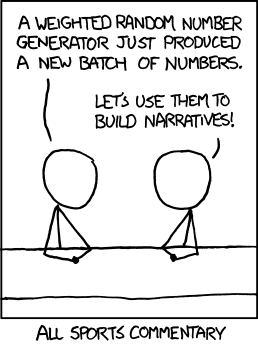
 FlatbreadGarden