Tulle

by A.J. Coltrane

Last year we had no idea that those white moths lay eggs on the bok choi and brussels sprouts (both members of the cabbage family). The eggs turn into voracious caterpillars.

Which is very uncool.

So for this year I purchased tulle. (Link here. I paid $46 at the time. It now says $54.96. There may be a better deal out there.)

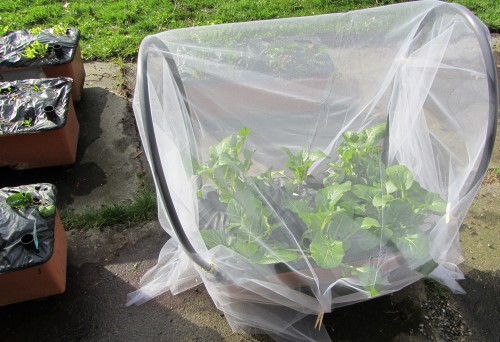
I used the hoop house idea again, but this time I made the hoops larger. I cut the dowels to two at 10″ and two at 14″, rather than all four at 12″. The dowels sit a little more even in the EarthBox that way. Below, there are clamps on the corners and clothespins on all four sides – the clothespins keep it tidier and add weight to the bottom of the cover.

140331 tulle

Pictured is the Pak Choi that was started from transplants on October 22. It’s come a long way.

Along about May I’m going to try basically the same setup, but with shade cloth for the lettuces/parsley/cilantro/dill/ anything else that bolts.

If you’re one of my neighbors and want some tulle, let me know. 50 yards is a lot of fabric.

The Next Big Thing in Chocolate

By Iron Chef Leftovers

If you like chocolate, you should really pay attention to where your chocolate is being sourced. Most of it is poor quality, purchased in bulk and is produced with unethical labor practices. Fortunately, there has been an alternative that is catching on (finally) in the chocolate world called bean-to-bar. It isn’t a new concept, but one that is finally becoming more mainstream. Here is how it works in an overly simplistic way:

A chocolate company decides it wants to make a bar with beans sourced from say Ecuador. The chocolate maker goes to Ecuador and talks to farmers and selects some that they would like to work with. The chocolate maker and the farmers collaborate on producing the best quality crop (over quantity) they can produce. The chocolate maker purchases the higher quality product at a significantly higher price than the going bulk rate (as much as 8 times the going bulk rate for the best quality beans) and makes their bars from that cacao.

Basically bean-to-bar is a direct trade between the farmer and the chocolate maker. It has become hugely popular in the U.S. thanks to Theo Chocolates, but there are now dozens of chocolate makers doing the same thing, many of them very small producers. One of my favorites is Mindo out of Dexter, Michigan. The owners spend part of their year working directly with the farmers in Ecuador (all of their chocolate is sourced from there), so they have a truly personal relationship with the process.

The trend seems to be catching on elsewhere, as evidenced by a recent article in the UK paper The Telegraph:

No longer is it sufficient for a smart bar to proclaim – as Green & Black’s do – that its contents are merely organic. Nor will it raise much interest among the chocolati to declare that your bar is artisanal or hand-wrapped, or that the cocoa within comes from a single estate. Worthy though all these considerations are, they are being swept aside by the latest trend in chocolate: bean to bar.

Let there be no mistake. Organic is good, and compared to the sugary slop mass-produced by Cadbury and Hershey, Green & Black’s (owned by the multinational Mondelez) is decent stuff.

Single origin bars, whose beans come from a particular location, are now becoming hugely popular, and supermarkets are making their own. So long as the farmers producing the beans are fairly rewarded and decent labour standards are maintained in production, there is nothing sinister about this either. But as it becomes easier to buy “good” chocolate, so the search for the best becomes more refined. True connoisseurs now like to pursue products that are not concocted from bought-in-bulk chocolate, but in which the whole process, from the grinding of the bean to the moulding of the bar, has occurred in one spot, under the care of one group of people: “bean-to-bar” chocolate.

I have had many conversations with small chocolate producers over the years and they all believe their biggest challenge is trying to convince consumers that paying $6 for a 2 oz. bar of chocolate is something they should be doing. Their product is infinitely better than the mass produced crap, but the price point is a tough sell. How tough? Well take a look at what I found last year when looking at dark chocolate prices:

Type Producer Cost Per Bar Bar Size Cost Per Pound
Mass Produced Hershey’s $1.19 1.55 oz $12.28
Fair Trade/Organic Endangered Species $3.25 3.00 oz $17.33
Bean to Bar Mindo $2.75 1.05 oz $41.90
Bean to Bar Theo $4.00 3.00 oz $21.33
Farmer Owned Kallari $5.99 2.46 oz $38.96


Theo is large for an artisanal producer and gains a great deal in economy of scale when shipping cacao from its source back to the US. The transportation cost is actually the biggest cost to a chocolate maker and even with the scale, Theo costs twice what Hershey’s does.  There are other advantages that offset price – bean-to-bar producers are making chocolate that is infinitely better tasting (better taste means you eat less in one sitting) and they are improving the quality of life for the farmers that they work with. If you doubt me, come with me to the NW Chocolate Festival in September. I will introduce you to the people who are on the ground working directly with the farmers. They tell their story much better than I ever could.

If you really want to be on the cutting edge of chocolate, purchase it from a Farmer Owned Co-op, like Kallari or Grenada Chocolate Company. The farmers control the entire process from the bean to bar and all of the profits are invested directly back into the local communities where cacao is grown.

Beer of the Week: Reuben’s Randall Red

By Iron Chef Leftovers

untitled2Randalls are a fun way to infuse flavors into beer without having to brew an entire batch of beer with those ingredients. It means you can use fun stuff like fruit or obscure hops to get some additional flavor in the beer without being intimidating and making it a cask beer. Reuben’s has started its randall project thanks to their new employee, Thor (yep, that is his name), who comes to them from Fremont Brewing where he was responsible for their randalls. One of the first randalls that Reuben’s had was a simple one – their Red with centennial hops.

The beer pours deep ruby in color with a creamy, light tan head with light amounts of hops and grain on the nose. The beer has a light sweetness at the front, joined by a mild fruitiness to start before moving into pleasant grain middle and finishing with a nice light bitterness/hop character that lingers with the grain in a fairly long finish. Nicely layered and a nice progression of flavors, this beer is balanced and the subtleties are not overpowered by hops.

Reuben’s Randall Red storms into Valhalla swinging 4 Mjolnirs out of 5.

Beer of the Week: Machine House Brewery Imperial Oatmeal Stout

By Iron Chef Leftovers

unti50tledI really do love oatmeal stouts, especially in the winter. The beer is hearty and warming and really just fits the bill with what I am looking for in those situations. One thing that I can say that I have never tried is a cask version of an oatmeal stout, but Machine House Brewing took care of that for me.

The beer pour jet black in color with deep chocolate and espresso notes dominating the nose, coupled with secondary notes of vanilla and malt. The beer has an interesting first sip – not as heavy as I was expecting with mild coffee notes appearing first before switching to a distinctive oat profile. I wasn’t sure of what to make of this at first – this was a very pronounced flavor, similar to uncooked rolled oats. The beer finishes long with hints of chocolate and dried cherries and just a hint of vanilla, coupled with the oat profile. That is when I got it, the oats blended with the deeper flavors to produce a rich profile with a slightly gritty mouth feel making the beer deep and complex but at the same time balanced and easy drinking. I would have liked more coffee/chocolate notes from the beer, but it was a cask and the amount of depth that this one contained made me want to go back for more.

Machine House Imperial Oatmeal Stout races in with 4 thoroughbreds out of 5.

Back In My Day

by A.J. Coltrane

Excerpts from Ken Pomeroy:

I’ve tweeted about this a couple times, but it’s worth documenting in a more permanent location: This season, free throws were shot at a better rate than in any previous season in the history of college basketball. To date, my calculations indicate that D-I teams have made 69.82 percent of their attempts from the free throw line. According to the NCAA record book, the previous best was the 69.7 percent made in the 1979 season.

It’s an odd phenomenon, but analysts, journalists, and coaches appear to be programmed to bash fundamentals. That’s another subject deserving of its own article, but criticizing modern free-throw shooting has always been a dubious exercise within that realm. After all, that’s one fundamental we can measure, and free-throw percentage has essentially been constant for the last 50 years.

But my perception is that most people in the game feel like free-throw shooting was better way back when. And if people can’t get that right, one should be skeptical when other fundamentals are criticized. Are players really worse at setting screens, or scoring with their off hand than they were 30 years ago?  I think it’s reasonable to wonder whether we’ve been lied to all along about those things as well.

At least in one respect, the modern player is more fundamentally sound than he’s ever been. And that might be the one subject that’s more boring to write or talk about than random variation. Even in the short time we have left this season, we may hear someone else lament about the state of free-throw shooting. This is one case where that person will not just be wrong, but as far from the truth as one could possibly be.

Bold emphasis mine.


My feeling is that college players execute fundamentals as least as well as they once did, when they choose to. Given the free throw shooting numbers, I’d think that jump shooting is as good or better than it’s ever been too. It’s just that today’s defenses are now way more athletic and sophisticated. The court is only so big, the athletes playing on it have gotten bigger and longer over time, and it’s hard to shoot well with a hand in your face all the time.

This may be old fogeyism, but I think the player development system (read: AAU ball) encourages the best players to look for their own shot, and doesn’t reward things like setting screens, blocking out, or sharing the ball. There are more “combo” guards today than there have ever been — primary ball handlers who are programmed to shoot first and think about distributing the ball (or anything else) second.

I think the change in emphasis is what’s bothering the fossils.

Mad Libs: The 2014 Mariners Starting Rotation Edition

By Blaidd Drwg

Let’s play a game of Mad Libs:

The Mariners 2014 rotation to start the season will be Felix Hernandez, Erasmo Ramirez, James Paxton, (Insert name of failed M’s prospect) and (Insert name of another M’s failed prospect).

Remember, Iwakuma and Walker are out for at least the first 2 weeks of the season. The Mariners released their scrap heap recalmation candidates, Scott Baker and Randy Wolf on Tuesday and they were the 2 most likely guys to start for the Mariners coming out of spring training. I am guessing that the other 2 spots are going to go to Hector Noesi and Blake Beavan, and yes, I am serious about that. They would only have to make 3 spots assuming that Iwakuma and Walker are back when they are supposed to be back (the M’s schedule in the 2nd week of the season has enough off days that they don’t need a 5th starter), but there is a huge risk to this team gaining any real traction if they have to slog through 3 potentially disastrous starts. Other than 3 games in Miami and 2 in NY, all of the rest of the games in the first month of the season are against AL West opponents, and only 3 of the 22 games are against the Astros.

If the M’s don’t get back Iwakuma and Walker when expected and/or Ramirez and Paxton are not as good as advertised, this is going to be a long season yet again – the M’s have absolutely no depth in their starting rotation right now. I bet the backup plan is to trade Nick Franklin for a middle of the road starter if someone flames out.

Beer of the Week: NW Peaks Stuart Stout

By Iron Chef Leftovers

I believe in the 150+ beer reviews that I have written, I think that I have only once reviewed a beer multiple times, Elysian’s Dark O’the Moon. Well, I am doing it again, this time with NW Peaks Stuart Stout. The beer only gets brewed once a year, so I felt it was a good time to review it again, especially since there were probably minor tweaks to the recipe.

From the NW Peaks website:

Since Mt Stuart is one of the most noticeable, bold, non-volcanic peaks in WA we tried to make the beer bearing its name similar. Stuart is medium-full bodied stout that is roast forward. The end result is a rich, deeply roasty interpretation of the style that starts smooth and ends with a slight lingering bitterness from the roasted barley . A fine beer to drink anytime, but best enjoyed in front of a fire on a cold rainy winter evening.


untitle8dThe beer pours jet black in color with a tannish-brown head and shows significant amounts of chocolate and coffee on the nose with backing hints of caramel, vanilla and malt supporting. The beer states out with notes of caramelized sugar before quickly moving into deep roasted flavors of dark chocolate and dark roasted coffee before beginning its finish with a very pleasant bitterness (think black coffee) with notes of vanilla and caramel coupled with a very long and mildly boozy dark chocolate finale that keeps lingering in a pleasant way. Layered and complex and creamy and unctuous, this beer is very drinkable and works well either with food or on its own.

NW Peaks Stuart Stout does it again with a solid 4 self-affirmations out of 5.

Vegas Thoughts, 2014

by A.J. Coltrane

I had pretty much the same year that I had last year — 22-14 (61.1%) on straight bets. I lost the one money line that I chose to play:  Providence were 4 point underdogs against UNC and +170 on the money line, meaning that if Providence won outright then the money line paid loosely twice what the “cover” bet would have paid. Providence lost by two, and covered, but I’d bet on them to win, so…   [insert raspberry sound here]

I also tried to get the +150 money line bet on La Tech against Georgia in the NIT, (and I would have won), but the slowpoke working the sportsbook decided he needed to restock pens instead of taking bets, and we missed the cutoff to place a bet on the game.  [insert another raspberry sound here]

This year’s VCU (misunderstood by the public) team was Colorado. Colorado were mild underdogs against Pitt. They trailed 46-18 at the half and went on to lose by 33. There are a few like that every year that are real head-scratchers, but they’re a big part of the success I’ve been seeing the last few years, so I’m not complaining.

Also, people had no idea that Tennessee is really pretty good.

Final note:  I *could* have gone 22-12 (64.7%) this year, but I ignored the beautiful fairy in my ear telling me to lay off of Ohio State vs Dayton. Twice. Once before my defensible-but-not-awesome-Ohio-State 1st half bet, and again at halftime before an even more ill-advised 2nd half bet.  “Ohio State is playing as badly as they can play. They can’t play worse than this!”

Nope. But they can play equally badly in the second half.

——-

For Fun. Here’s what I think I like Thursday and Friday:

Thursday:

Dayton vs Stanford, Over 133.

Baylor +3.5 vs Wisconsin. This is the game that I’m the least “sold on” for Thursday.

Florida -5 vs UCLA. (Though UCLA is better than people think, still.)

Arizona -7 vs San Diego State

Friday:

Michigan -2.5 vs Tennessee. (Sorry Tennessee, we had a good run!)

Iowa State vs UConn Under 146. The game that I’m the least “sold on” for Friday.

Louisville -5 vs Kentucky

Virginia +2 vs Michigan State. (The Virginia +115 money line looks like a good play too. Either/or would be fine.)


For the purposes of the “For Fun  Bets”, I unpacked and unfolded my NCAA notes. The compacted smell of Vegas cigarettes wafted out. Now the notes are sitting on the couch, stinking it up. Yay Vegas.
Beer of the Week: Machine House Brewery Gold

By Iron Chef Leftovers

Machine House brewing in the Georgetown neighborhood of Seattle is fairly new to the scene and very unique among Washington breweries – they produce all English style beers and all of them are served either on a beer engine or on cask. This means that you are going to get beer that is warmer, less hoppy, less fizzy and low alcohol – a nice change of pace from the high ABV, high IBU beers that you typically find around Seattle. As an added benefit, their tasting room is interesting, located in an old warehouse space, just across the street from Full Throttle Bottles.

From the Machine House website:

Gold – 4.5% ABV

A pale-straw coloured ale, again with English hops in the ascendancy. Reasonably assertive bitterness balances a slightly sweet malty finish.

unti50tledThe beer pours golden in color with an off-white head and shows strong notes of English yeast, grain and dried fruit on the nose. The beer drinks slightly bitter on the first sip with a tea-like quality (from the hops) followed by a nice yeast and grain middle and finishing clean with touches of dried apricot and peach and just a minimal amount of hops. The beer is slightly sweet, but not cloyingly so and well-balanced and easy drinking. It is a nice change of pace from the heavier beers that I had been drinking and a great experience to have a beer you don’t readily find in Seattle.

Machine House Gold strikes it rich with 3 prospectors out of 5.