Take a Pitch

By Blaidd Drwg

The April 22nd game between the Marlins and Braves yielded something interesting. Here is the box score:

http://espn.go.com/mlb/boxscore?gameId=340422115

Did you notice it? The game featured 28 strikeouts with 0 walks, which got me thinking – what is the MLB record for strikeouts in a game with no walks? Well, that would be this game. I can’t seem to track down what the previous record was, but, according to ESPN, this is the first time two teams have recorded at least 28 strikeouts without a walk.

(Mostly) Recommended Game — Galaxy On Fire 2 HD

by A.J. Coltrane

I’m always looking for a good free game to play on the cell phone. Emphasis on “free”.

Galaxy On Fire 2 HD fits that bill. It’s a space opera/ combat/ trading game. You can fly your ship to many different star systems, shoot space pirates, and mine asteroids. You can trade with, and run missions for, the inhabitants of the space stations that you come into contact with. Better ships can be acquired. Weapons, armor, and many other ship components can be upgraded as well.

There’s a main quest storyline to save the universe from hostile aliens. (Of course.) If you don’t want to do that you can pick up mini-quests at space stations. “Kill the dread pirates.”,  “Escort the freighters”, “Bring me some possibly-hard-to-find materials”. Fortunately there aren’t any “Kill Ten Rats” quests. The quests are mostly all quick and relatively engaging.

It *is* cool-looking.

Combat can be fun. Even “very fun”. Though sometimes the opponents are super over-powered and the game will suggest that you upgrade your ship. I tried that. It doesn’t often work. I’d suggest that you just run away and go find other opponents that you can beat up.

The mining mini-game is just ok, though it’s about the only reliable way to make money at the start of the game. After getting some money together I was able to leverage it into fleecing the locals when they wanted to trade, so no more grindy mining for me.

That’s the good.

The less good:

1.  The main quest storyline is predictable, dumb, and fringe-sexist. I’ve seen young teenagers write better stuff.

2.  Even though I put off the main storyline in an effort to get the biggest, baddest ship that I could — I still won the game with a mid-range ship. If I chose to I *could* log back in and make more money and eventually get the nasty ships. Maybe I’ll do it if I’m stuck in the car at some point with nothing else to do. Maybe. I’m going to guess that it’s possible to win the game with only a marginal ship upgrade, if any. Opportunity lost.

galaxy_on_fire_2(2)

3.  For no good reason that I can ascertain, there are four different “factions”, arranged in two pairs. Doing a quest for one faction will shift your standing towards them and away from the opposing faction. That means that I can’t just run whatever quest I see, I have to be continually balancing my faction standing. It’s an unnecessary complication that doesn’t add anything to the game.

4.  The game crashes. A lot. After a while I made a point to save every time I docked at a space station. I’d guess the game would crash about after every 3rd save…every 20 minutes or so. No better way to break immersion than to be continually fiddling with the save game slots.

Summary:  Galaxy On Fire 2 HD has gotten very good reviews. It’s on a lot of the “best games” lists. The price is right, and I got many hours of gameplay out of it.

It’s a “very good” game.

It may just be that my expectations are too high for free mobile gaming. Mostly Recommended.

Beer of the Week: Goose Island IPA

By Iron Chef Leftovers

Back in the day before AB-Inbev bought Goose Island, they made some pretty great beers. They still do with their barrel aged and vintage beer line, but there has definitely been a decline in the quality of their regular line of beers – so much so that they are in the ‘just another brewery’ vein. I rarely find myself buying anything from their regular line these days. It is readily available though if you want to drink it. Recently, Annie S. gave me a few bottles of Goose Island stuff, so I figured it was time to give the IPA a shot and see how they are drinking these days.

From the Goose Island website:

Brewer’s Notes: Our India Pale Ale recalls a time when ales shipped from England to India were highly hopped to preserve their distinct taste during the long journey. The result is a hop lover’s dream with a fruity aroma, set off by a dry malt middle, and long hop finish.

Recipe Information:

Style: English Style India Pale Ale Alcohol by Volume: 5.9%

International Bitterness Units: 55

Color: Bourbon

Hops: Pilgrim, Styrian Golding, Cascade, Centennial

Malts: Pale

Serving Suggestions:

Preferred Glass: Thistle

Food Pairings: Curries, Chicken, Pork Cheese Pairings: Blue, Aged Gouda

Cellaring Notes: Enjoy within 180 days

ipa_full_beerpageThe beer pours orange in color with a light tan/off-white head. Strong amounts of citrus and hops appear on the nose with light notes of citrus peel and grain supporting. The beer starts off on the palate with hints of flora citrus before moving into lightly bitter citrus peel with gradually building hop bitterness before finally finishing pleasantly mildly bitter with notes of orange peel and citrus fruit. The finish is short and to the point making this a fairly easy beer to drink. As with the British style IPAs, the beer is not overly hoppy (but maybe a touch too citrus forward) and is a good beer to introduce someone to an IPA without completely overwhelming them with a hop bomb.

Goose Island IPA flies in formation with a solid 3 Snow Geese out of 5.

The 2014 Plant List

by A.J. Coltrane

We’ll start the “2014 season” with this post.

The 2014 Seattle Tilth Plant Sale Haul:

[Complete list of vegetables at the sale, PDF. The descriptions are from the PDF, with my comments in brackets. There may be some funky formatting below, but then, the PDF features a *lot* of funky formatting.]

Brussels Sprouts – We purchased the Brussels Sprouts at a nursery last year and I didn’t note the variety. This year we got them at the Tilth sale. The EarthBox directions call for six total plants in one box. We have about double that. We’ll see how it goes, though last year it went fine (if cramped) with four Brussels Sprouts in what would normally be the space for one plant. In any event, I grabbed too many by accident and we have a few extras if you’re a neighbor. Note that the white cabbage moths are already out and about, so the ones that we planted yesterday are covered with tulle to help prevent damage:

Catskill (Qty, about 5 or 6)
90 days. Open pollinated. Selection from a private stock of Long Island Improved, a treasured American heirloom.
Produces very high yields of 2″ diameter round green Brussels sprouts. This variety has strong, stout stalks and closelyspaced small sprouts. Easy to pick. Excellent freezing variety. Bred by Arthur White and Joseph Harris Company in New York and released in 1941.

Roodnerf (Qty 6)
100 days. Open pollinated. There are few open pollinated Brussels sprouts left to grow that yield great sprouts, but this is one of them! Cold hardy and good for letting winter over. [We’ll see if one variety does better than the other. This one is recommended in the book “Food Grown Right, In Your Backyard”.]

Cucumbers – The same variety as last year. No reason to mess with what worked. The cucumbers were planted outside on May 5th last year. (Gotta love those notes!) They don’t much like being transplanted, so maybe we’ll do that today/tonight/tomorrow depending upon the weather:

Marketmore 76 (Qty 4)
63 days. Open pollinated. In the Marketmore series, ‘Marketmore 76’ is very popular with organic growers due to its high level of disease resistance. This dark green slicing variety produces abundant, high quality, uniform fruits about 8 inches long with a wonderful cucumber flavor. This is your classic, all-around cucumber!

Peppers – We preselected about 10 varieties from the Tilth list that we wanted to grow. We had to accept three “2nd choices”, which wasn’t bad. We got all the ones we really wanted. Last year the peppers were transplanted outside on about the 25th of May. The first four listed are “hot”, the rest are “sweet”:

Anaheim College 64
74 days. Open pollinated. Medium hot flavor make these short season peppers a hit for dips, sauces, stuffing with cheese or roasting. They are just like the anaheims you find in the store but without having traveled all those miles to get to you! [A repeat from 2013.]

Early Jalapeno
66 days. Open pollinated. Hottest and fully ripe when they turn red but most is familiar in the green stage. 2 ft. tall plants produce 3 in. peppers. Will set fruit in cooler conditions better than other hot peppers. [Repeat from 2013.]

Hungarian Hot Wax
70 days. Open pollinated heirloom. Semi-hot, smooth waxy yellow 5 1/2 x 1 1/2″ fruits taper to a point. Popular with
Northwest gardeners due to their cold tolerance and early fruit production. [New. First choice was “Hot Portugal, but Tilth didn’t get them in.]

Thai Hot
82 days. Open pollinated heirloom. Only habanero is hotter, as Thai Hot has 80,000 Scoville units. Thai Hot’s small
conical peppers ripen to bright red and stand erect above the foliage so fetchingly that it’s sometimes grown as a
Christmas potted plant. Early pinching will produce a bushy 8″ plant that can be pulled, roots and all, and hung to dry for winter use or grown inside for both ornamental and edible enjoyment. [First choice was “Hot Portugal”. No stock on those.]

[All sweet peppers below this point.]

Alma Paprika
80 days. Open pollinated. These peppers can be harvested when red, dried and ground for homemade paprika. They
are also tasty fresh from the garden! You’ll get 2-inch round peppers with thick walls and sweet flavor. [New.]

Cute Stuff
62 days. Apple-shaped mini-bells are perfect for stuffing. High-yielding plants produce up to 3 times more than other
peppers. Pick the 3 inch fruits when they are green or red. Flavor is sweet and tasty at both stages. [A repeat, though not a 1st choice. Last chance to shine, guys.]

Early Hungarian Sweet
55 days. Open pollinated. An extra-early, large wax. The conical fruit is produced more reliably than the bells and tastes even sweeter! This one matures from a creamy-white to red–beautiful. [New.]

Gourmet
85 days. Open pollinated. This orange bell pepper has heavy, thick walls, and the sweetest flavor you’ll find in an orange pepper. Resistant to tobacco mosiac virus. [Repeat. Last chance due to low yields last year. Note the long season.]

Gypsy (Qty 2)
58 days. This speedy variety is much easier to mature than bell types. The 6-7 in. long, tapered, yellow fruit are very thick-walled and sweet. Gypsy’s flavor is hard to beat. [Repeat. The quantity is hedging upwards.]

King of the North (Qty 6)
76 days. Open Pollinated. Here is a sweet bell pepper that will mature in short season climates. Its crisp, blocky fruit will turn from medium green to red if left on plant longer. Excellent raw in salads or dips. Great to use as stuffed pepper or in tempura recipes. [Repeat. These did the best of everything last year, so this year they get a full box to themselves.]

Pasilla Bajio – Chili
80 days. Mild. Slightly sweet. Crinkly 8-10″ fruit ripen from dark green to red to dark brown. Use fresh in red chile
enchilada sauce and salsas. Also called Chile Negro or Chilaca, this pepper is a signature ingredient in mole sauces. [New. A 2nd choice, though it was on the “alternate” list.]

Tequila Sunrise
77 days. Open pollinated. Five-inch long, thick-fleshed fruits are borne upright on the stems and ripen from green to
orange. Very pretty and tasty too!

Zucchini – This year we’re going to try a vining zucchini that’s supposed to be especially hardy:

Tromboncino (Qty 2)
60-80 days. Open pollinated heirloom. A Tilth favorite, the flesh of this variety has a smooth buttery texture and a mild  flavor—the taste of summer! The 12 to 18” long fruits are “trombone”- shaped and can grow in curly cues or hang like bells on a trellised vine. Harvest when they are a pale, grass green or leave a few fruits at the end of the season to mature to a buff color and enjoy them as you would a winter squash.

Tomatillos – One repeat variety and one new variety. I’m hoping the new variety doesn’t drop fruit all over the ground:

De Milpa
60 days. Open pollinated. Mexican heirloom. “Di milpa” means “from the fields”, as this type commonly grows wild in the cornfields of Latin America. Small fruit but great storage quality, remains green and firm weeks after picking. [New. In addition to (possibly) being less of a mess, I’m hoping that they’ll last longer in storage too.]

Mexican Strain
65 days. Open pollinated. At 2 inches, these fruit are larger than most tomatillos. They are savory and fresh tasting, great for making salsa verde or adding a Mexican flavor to your dishes. Tomatillos produce tons of fruit on sprawling vines, but don’t usually need to be trellised. Fruits will burst out of husks and fall to the ground when they are ripe. [Repeat. Last year one of the two plants didn’t do much, so subbing out one for a new variety should still give us ample output.]

In 2013 the tomatoes and tomatillos were transplanted out on May 17.

Tomatoes – There’s a theme here — the maximum time to maturity is 75 days. We’ll check with SeattleAuthor to find out how his long-season plants do this year. Given our finite space we decided not to push the envelope again. (Our 85-day Brandywines were the least impressive of anything we grew in 2013.) Like last year, we tried to target a mix of Determinate and Indeterminate tomatoes with the hopes of spreading the harvest out at least somewhat — there are 5 Determinate and 3 Indeterminate. The Determinates are 56, 60, 65, 68, and 75 days. The Indeterminates are 65, 65, and 75 days.:

Sungold (Cherry)
65 days. Indeterminate. Wow! Sungold’s fruity or tropical flavor is a big hit with everyone who tastes it. Apricot-orange round 1 1/4 in. fruit. 10-20 fruits on grape-like trusses. Generally we try to offer open pollinated and heirloom varieties, but we just can’t give up Sungold! Winner of Best Cherry Tomato at the 2005 and 2006 Tilth Tomato Tasting. [Repeat. Easily our “best” and “most popular” in 2013. At some point I wouldn’t mind trying other cherry tomatoes, but these will be tough to beat.]

Black Krim
75 days. Open pollinated heirloom. Indeterminate. From the Black Sea region of Russia, these 10-12oz beefsteak type tomatoes have a strong, rich flavor that is common with black tomatoes. One seed catalog noted that the fruit is best when half green and still firm. Very productive. Reportedly is a consistent favorite at tastings, so why not give it a shot? [New. I wanted to try these last year, but Tilth didn’t get them.]

Taxi
65 days. Open pollinated. Determinate, early, prolific production. The best yellow tomato for short season gardeners. Expect heavy yields of mild, non-acid tomatoes for 3-4 weeks. Grows well in a container. [New. A little something different. These seem to be popular, so they seem like a good thing to try.]

Tigerella
65 days. Open pollinated. English Heirloom. Indeterminate. Interesting green turning to red and orange tiger-striped fruit . Very early and prolific – produces throughout the season. Excellent for salads. Low acidity variety. [New. Another “little something different”. An Indeterminate to balance out the harvests.]

Glacier
56 days. Open pollinated. Very early determinate. Orangey-red 2 1/2 in. fruit. Plants are 2 1/2 ft. tall and 3 1/2 ft. across. Surprisingly sweet for an ultra-early type. The nice thing about Glacier is that it’s the first tomato to ripen, and it keeps on producing late into the season, which is rare for most early determinates. Excellent grown in a container. [Repeat.]

Mountain Princess
68 days. Open pollinated heirloom. Determinate. A cool, short-season variety that hails from the mountains of West
Virginia, ‘Mountain Princess’ is very early and very productive. The round, 4 to 6 inch fruits make great slices for
sandwiches or drizzled with olive oil and a little salt and pepper–delicious! [New. We liked the name, and we liked the idea that they’d be good for caprese. I also liked the “cool, short-season..West Virginia” in the description.]

Oregon Spring
60 days. Determinate. An extra-early variety that sets loads of meaty fruits weighing 3 to 5 oz., with excellent flavor.
Compact plants set fruits even in cool weather and continue to yield all season long. Nearly seedless. A perfect choice for ketchup and sauces. [New. An early sauce tomato. Good in cool weather. Long yield. This one could work for us on a number of levels.]

Roma
75 days. Determinant. Premium canning tomato, ideal for sauce and paste. Pear-shaped scarlet fruits are thick and meaty with few seeds. [Repeat. Our biggest producer last year, though not everything ripened.]

Stupice, Siletz, and Brandywine didn’t make the cut this year. The Stupice and Siletz were considered replaceable. The Brandywine was “fine”, but the flavor wasn’t as awesome as it probably has the potential to be in warmer climates.

And six Basil! Basil is why we went to 12 boxes in the first place!


Beer of the Week: Populuxe Bitter with Goldings Cask

By Iron Chef Leftovers

imagesCAAR87MMI do have a love for cask beer, and, while I have a soft spot in my heart for the ‘hoppy’ casks like IPA, CDA and Pale, I do really love the more traditional casks of Mild and Bitters. I was excited then when a few weeks ago, Populuxe went very traditionally British with their cask and rolled out a Bitter with Goldings hops. I am a big fan of the Bitter and with its sub 5% ABV, it is a great beer if you are planning on bellying up to the bar for a long evening.

The beer pours hazy orange in color with hints of grain and lemon on the nose. The beer starts out with a nice light grain component with hints of caramel on the palate before moving into light lemon with hints of mild malt sweetness. The beer finishes pleasantly with just a hint of bitterness and light tannins, coupled with notes of toffee and just a touch of chocolate. The finish is surprisingly long for a cask and the beer is complex without being too deep and drinks easily and goes down smoothly. If you want a nice change of pace from the big hoppy stuff you normally find in the Northwest, this is the beer you want to be drinking.

Populuxe Bitter with Goldings brings you all the way back to the station with 5 double deckers out of 5.

Beer of the Week: Silver City Whoop Pass Double IPA

By Iron Chef Leftovers

It has been interesting to see what I have been drinking and it seems to come in runs. Lately it has been IPA’s. Silver City out on the Kitsap Peninsula has produced some great beers over the years and have really cemented themselves as one of the better breweries in Washington, including a strong reputation among IPA’s. Fortunately for us, they bottle and are pretty readily available so I can enjoy their beers almost any time. Whoop Pass, their Double IPA, is one of my favorites, available in 22 oz. bottles.

From the Silver City website:

Without a doubt, the boldest and hoppiest mother of a brew Silver City has ever created. More than 50lbs of Washington State Cascade and Columbus hops are infused, injected or otherwise inflicted upon a single 15 barrel batch. Welcome to hop country!


Food Pairings: Strong Cheeses, Smoked Meats and Seafoods,

Perfect with a Big Daddy Burger!

Alcohol By Volume: 8.5%

Hops: Columbus, Cascade

Malts: NW Pale, Caramel, British Pale, Munich

un1titledThe beer pours deep orange in color with a creamy white head. Strong notes of orange peel and citrus show on the nose with hints of grain and floral notes. The beer starts off on the palate slightly sweet before quickly building into a significant amount of citrus and citrus peel with a mild bitterness. Those notes continue to build and reach a pleasant plateau before fading and lingering for a significant amount of time with just a bit of warming alcohol. As he beer warms, the citrus is much more pronounced and it really enhances the beer. The balance between the hops and bitterness is pleasant and enjoyable and this is a surprisingly drinkable beer for its size.

Silver City Whoop Ass comes in and takes names with 4 Ass-Kickings out of 5.

The Trellis

by A.J. Coltrane

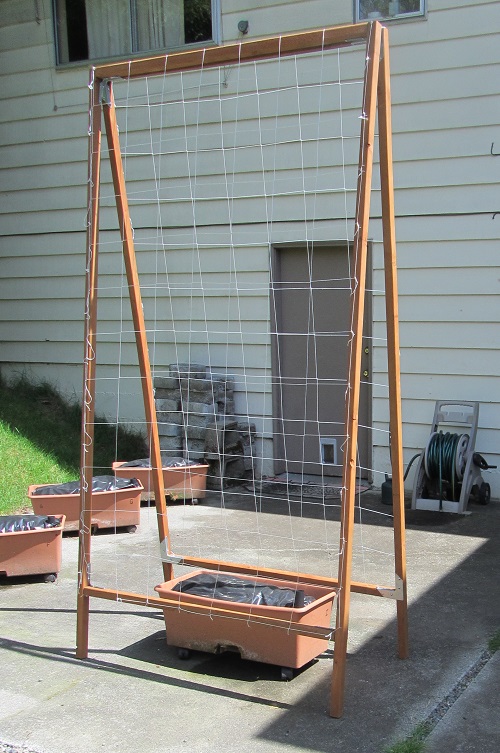
This year we thought we might try a vining zucchini, with the idea that a vining type may do better in the EarthBoxes, and that it may represent a more efficient use of patio space. The variety we’re targeting is “Tromboncino”. It’s supposed to be relatively resistant to powdery mildew and many other things that tend to plague squash. The vines grow to about 6-8 feet, so today I finished the trellis:

140501 trellis

It’s big. Like, really big — it’s 4′ wide by almost 8′ high. I think it’s going  to need to live in the back corner of the patio so that it doesn’t shade everything else out.

A picture of “Tromboncino” from the Territorial Seed Co. website:

territorial seed tromboncino

(“Tromboncino” Wikipedia page here. Territorial Seed Co. page here.)

I basically copied this design from the EarthBox forums. This EarthBox forums – “Trellis Design Gallery” link has some interesting  ideas as well.

Revisiting Expectations

By Blaidd Drwg

I said in this post that I would revisit the points I made about the Mariners at the end of the month, so that is what I am doing.

The team went 5-9 in the interim, losing 8 in a row and then winning 4 out of 5, so this team is definitely going to be Jekyll and Hyde all season.

My points for review:

1)      These boots are made for walking – Zunino and Miller specifically were my targets and they had combined for 1 walk in 84 plate appearances in the original article. Well, they improved to 3 walks in 159 – 2 for Miller and one for Zunino. It actually should be 2 in 159; the Zunino walk was intentional, when they were playing in Florida, with the pitcher due up next. So Mike Zunino has exactly 0 unintentional walks this season in 74 plate appearances. That is terrible. About the only thing keeping him in the lineup at this point is pitchers continue to throw him pitches near the strike zone and he has turned them into hits. At some point they will figure out the guy can’t hit or lay off a curve ball out of the zone. Miller probably would have played himself back to Tacoma at this point if it weren’t for the fact there is no better option. Nick Franklin can’t play short and Willie Bloomquist can’t hit, so you are stuck with Miller and his 3 for 32 slump, except when you get to see Willie Bloomquist in the lineup, which is much too often these days. The walks have been a team issue – they are 14th in the AL in runs, just 9 ahead of the Astros and last in the league in walks.

2)      Under pressure – Cano won’t be allowed to hit with runners on base. I was wrong; he has only drawn 5 walks in 34 PA with runners on, and has hit a whopping .241 in those situations. Maybe teams will pitch to him as long as he continues to not do anything with guys on.

3)      Round and round – the M’s OF is a mess. It continues to be a mess. Ackley is the best of the bunch with a .256/.298/.372 slash line. Romero/Saunders/Almonte have shown nothing at bat and the fielding has been less than stellar. Time to trade Nick Franklin and an arm for Andre Ethier and his insane contract. He can’t be worse than what the M’s are trucking out there right now.

4)      Hot mess – the M’s rotation. Iwakuma is still a couple weeks from coming back, Walker has been shut down indefinitely, Ramirez and Maurer have pitched their way out of the rotation and even Felix hasn’t looked great in his last few starts. It will probably get worse before it gets better when it comes to starting pitching.

Are we having fun yet? Lets revisit again at the end of May.

Beer of the Week: Reuben’s American Brown Randall with Cocoa Nibs and Raspberries

By Iron Chef Leftovers

untitled2I really have become a fan of the brown style of beer over the last year or so. Actually, that is not accurate, I have rediscovered my love of browns over the last year or so. They were a staple for me back in the late 90’s/early 2000’s before I discovered my love of hops. That, coupled with a decline in breweries making browns, I sort of forgot about them until the last year when the Ballard breweries started making them regularly. Reuben’s produces a great one and they took a shot at putting it on randall with cocoa nibs and raspberry. Couple those flavors with a nicely roasty, malty beer and we have potential for greatness.

The beer pours deep brown in color with a just a tinge of ruby color. Significant notes of malt and berries appear on the nose, with just hints of chocolate in the background. The beer is surprisingly chocolate forward with nice cocoa nib flavors coupled with hints of sweet chocolate from the malt, coupled with a light raspberry flavor, bringing a mild tartness to the picture. The beer then moves into the malt with touches of hop bitterness before finishing off slightly sweet and chocolaty with a pleasant dark chocolate bitterness and a very long chocolate finish. The chocolate and raspberry start to show more prominently as the beer warms, making this beer nice and deep with great balance and complexity, reminding me of a chocolate truffle.

Reuben’s American Brown Randall with Cocoa Nibs and Raspberries fills you days 4 worlds of pure imagination out of 5.