Wild Spending in the Baseball Offseason

By Blaidd Drwg

After years of screaming poverty in Montreal, Jeff Loria was part of the ridiculous scheme that gave the Expos to MLB, gave him the Marlins and gave John Henry, another fantastically rich man who was crying poverty in South Florida, the Boston Red Sox.

As you know, MLB did everything they could to make the Expos fail in Montreal and eventually moved them to DC, Henry all of a sudden “found” the ability to pay for a team with a 140 million dollar payroll and Loria just kept screaming poverty in his new home in South Florida, saying he needed a shiny new stadium paid for by public money to be successful. and effectively selling off any player that became a free agent.

This season, thanks to a new taxpayer financed stadium and a horrific new logo, Loria all of a sudden has found extra millions to do this:

December 9, 2011 Agreed to terms with LHP Mark Buehrle on a four-year contract. Designed RHP Clay Hensley for assignment.
December 8, 2011 Agreed to terms with SS Jose Reyes on a six-year contract.
December 5, 2011 Agreed to terms with RHP Heath Bell on a three-year contract.

The Marlins had a payroll of somewhere around 58 million in 2011. Care to guess what their expected payroll number in 2012 is? Well, according to baseball-reference’s wonderful salary tracker, somewhere around 105 million. Amazing what rebranding a franchise will do to loosen up the purse strings. The Marlins back loaded the above deals so that Buehrle and Bell are only making 6 million this season and Reyes is making 10 million. The problem with back loading a deal is at some point you get a big jump in what you are paying the players. Let’s take a look:

2012 2013 2014 2015 2016 2017
Reyes 10 million 10 million 16 million 22 million 22 million 22 million
Buehrle 6 million 11 million 18 million 19 million
Bell 6 million 9 million 9 million

It gets really ugly in 2014 for the Marlins. On top of the salaries above, their 2 best pitchers, Josh Johnson and Ricky Nolasco, are both free agents in 2014, Hanley Ramirez is scheduled to make 16 million and their stud first baseman, Mike Stanton, is eligible for arbitration. Just counting Reyes, Buehrle, Bell and Ramirez, the team is on the hook for 59 million in payroll. Heck, for 2013, the Marlins are projected to be somewhere between 125 and 145 million for payroll, which I don’t think is going to happen. I think we are going to see a repeat of a disturbing trend that has been there since the beginning in South Florida – owner bumps up the payroll to a long term unsustainable level to make a World Series run, sells off the players returning the team to mediocrity and then sell the team.

The Marlins could be in for an interesting ride – they have the ever volatile Ozzie Guillen at the helm, they have a new stadium which no one knows how it is going to play, they have a number of players coming off of injuries, Hanley Ramirez is unhappy about being moved to 3B and they added the ever entertaining Carlos Zambrano to the mix. My prediction is the circus in South Florida yields a .500 team this season and they are breaking the team up by June of next year.
No Knead Bread — What Happens When It’s Slashed

by A.J. Coltrane

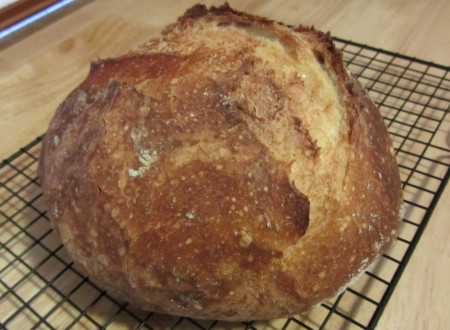
Jim Lahey’s No Knead Bread doesn’t need to be slashed.

Usually though, it comes out looking something like this:

Or these:

This is a lucky outcome, from an appearance standpoint:


But here’s what I got the first time I put it in the pot, then slashed it:

The nice thing is that the attractive slash and rise in the last photo represents a reproducible result. Note that the shape is a little more “regular” too — the bread didn’t just crack organically.

Which looks most appetising?

—–

Postscript:  Four different photos of bread using four different photo techniques, and the last picture uses the newer camera. The first bread obviously used more flour for proofing, and the left of the twin breads used a non-preheated pot. Still, at this point the baking has a more predictable outcome than I get from the photography — there are a lot more hours invested in the baking to date.

The Boston College Eagles Men’s Basketball Team

By Blaidd Drwg

One of the drawbacks about being on the West Coast and having your alma mater on the East Coast is that you don’t get to see a ton of games unless they happen to be nationally televised. As a result, this season, most of my knowledge of Boston College basketball is coming from what I read, and generally it is not good. Heck, they are currently 304th in the nation in scoring, which is just terrible.

The Eagles are a very young team with most of the roster consisting of freshman. That is not a good recipe for success, especially when you play your conference games in the ACC. Most of the pre-season write-ups on the Eagles were unfavorable and predicting a disastrous season. Their non-conference schedule, not exactly studded with tough opponents, was a disaster, leaving the team with a 5-9 record entering into ACC play. How bad was it? Here you go:

  • They beat New Hampshire by 3 at home. A nice way to start off the season.
  • They lost to Holy Cross by 18. HC was 6-8 in non-conference play.
  • They lost to Massachusetts by 36 at home. UMASS is actually pretty good, sporting a 14-5 record, but really hasn’t beaten anyone of consequence.
  • They lost to St Louis by 11. This might have been the highpoint of the season thus far – they were actually competitive with a decent team.
  • The beat UC Riverside by 4, in double OT. You should never need to go to double OT to beat UC Riverside.
  • They lost to New Mexico by 18.
  • They lost to Penn St. by 8 at home. Penn St. is probably the worst team in the Big 10.
  • They lost to Boston University by 14 at home. Ugh, nothing worse than losing the Battle of Comm Ave.
  • They lost to Providence by 7 on the road. PC is one of the worst teams in the Big East.
  • They beat Stony Brook by 15 at home.
  • They beat Bryant by 20 at home. Don’t look now, we have a winning streak!
  • They beat Sacred Heart by 10 at home. Three in a row!!!
  • They lost to Harvard by 21 at home. Not a surprise, Harvard is actually good and was ranked #23 going into that game.
  • They lost to URI by 6 in double OT at home. URI was 2-12 going into this game. Definitely the low point of the season.

Then ACC play starts with a 23 point drubbing by #4 UNC. I had just about written off the season completely and then BC surprises me with back to back wins against Clemson and Virginia Tech. Yes, both of those wins were by 2 points, and both of those teams are currently at the bottom of the ACC standings, and both of those wins came at home, but you know what, I was expecting the Eagles to go 0 for the conference, so I will take back to back wins right now, even if the chances of the Eagles winning another ACC game are pretty low. I think I need to post the ACC standing just for posterity, considering I doubt that BC will be this high up on the list again this season:

2011 – 12 ACC STANDINGS
TEAM CONF GB OVR
#4 Duke 3-0 15-2
Florida State 3-1 .5 12-6
#8 North Carolina 2-1 1 15-3
North Carolina State 2-1 1 13-5
Boston College 2-1 1 7-10
Maryland 2-2 1.5 12-5
#17 Virginia 1-1 1.5 14-2
Miami (FL) 1-2 2 10-6
Wake Forest 1-2 2 10-7
Georgia Tech 1-2 2 8-9
Clemson 1-3 2.5 9-9
Virginia Tech 0-3 3 11-6


A Reality Check On The Jumbaco By Serious Eats

by A.J. Coltrane

The commercial for the Jack In The Box “Jumbaco” has been almost unavoidable — it’s even spawned a petition page on facebook, collecting signatures to bring it to market for real.

The Jumbaco is a Jumbo Jack sandwiched between two tacos:


serious eats has taken the next logical step:  Erin Jackson made one, then ate the end product. Here’s the link, follow it for photos and her take on the taste.

I may have to make one for myself!

Chicken Breast, The Wonder Bread of the Meat World

By Iron Chef Leftovers

This article appeared in Seattle Weekly recently. It had the lovely title “Should a Restaurant Warn Its Customers Before Serving Dark Meat”. Basically, there was an editor of the Weekly, Caleb Hannan, who went to Skillet and ordered a fried chicken sandwich, expecting it to be a chicken breast but it was not. Hannan asked:

“When a menu says chicken, don’t you assume it’s the breast?,”

To which the author of the article, Hanna Raskin replied:

I don’t. I figure the chef will use whichever part of the chicken is best suited for the dish. While that’s frequently a breast, chefs who prize flavor aren’t averse to working with legs and thighs. If I received an unanticipated thigh, I’d be pretty psyched.

I am with Hanna Raskin here. If you went to a restaurant and ordered a burger, are you expecting it to always be ground chuck? If a menu just said steak, would you expect them to be serving fillet. Do you expect that your fish in your fish sandwich or fish and chips is always halibut? Of course not, so then why in hell would you expect a chicken sandwich to be breast meat.

To Caleb – if you don’t like dark meat and it doesn’t specifically say breast, DON’T FREAKING ASSUME IT IS BREAST MEAT. The rule in dining out or buying food to cook at home is always: if you are not sure about something, ASK!

I personally don’t understand the aversion to dark meat. It has tons of flavor, it doesn’t dry out (bones and collagen are wonderful things), it is at least as healthy if not more healthy for you than white meat and it is several dollars a pound cheaper. From the National Chicken Council:

The domestic preference for white meat is considerable. White meat beats out dark by a 2-1 margin, a statistic boosted by queasiness about eating meat on the bone and the false belief that white meat is healthier. Since the 1950s, when chicken processers began packaging meat so buyers wouldn’t be stuck with whole birds, white meat’s reigned as the default definition of chicken.

It also appears that the rest of the world prefers dark meat to white by about the opposite margin. Once again, America does the opposite of what the other 6.5 billion people on the planet do.

Chicken Breast is the Wonder Bread of meat – it is relatively flavorless, doesn’t provide you with a great deal of nutrition outside of the calories and is just a vehicle for whatever you are putting on it. People – buy the whole bird (I wrote about the reasons for it here). If you hate dark meat, just make stock out of it. Trust me, it will still be cheaper in the long run than buying those prepackaged chicken breasts, and who knows, you might start to appreciate the tastiness that is dark meat poultry.

A Very Agreeable Bread

by A.J. Coltrane

Here’s a typical french bread recipe (scaled to “15 servings”)

  • 3 cups all-purpose flour
  • 1-1/4 (.25 ounce) packages active dry yeast
  • 3/4 teaspoon salt
  • 1 cup warm water (110 degrees F/45 degrees C)

This is the same basic ratio of flour to water (3:1) as my “go to” pizza dough recipe. 3 cups of flour weighs about 375-400 grams (I’ve been using Lahey’s 400 grams as standard). 1 cup of water weighs 237 grams. Expressed as a baker’s percentage, the water weight is about equal to 60-63% of the flour weight.  (By rounding the water up very slightly to 240 grams:  240/400 = .60)

The beauty of using weights instead of volumetric measures is that it removes all of the variables from the paragraph above, and removing variables leads to more consistent results. Baking is enough of an inexact science as it is, without intentionally introducing variables into the process.

So here’s the point:  When using baker’s percentages a “classic” french bread formula would be called out as “60-2-2”. For every 100 parts flour the formula calls for 60 parts water, 2 parts salt, and 2 parts yeast. Everybody knows what french bread “is”, and that makes for a good jumping off point to try other things:

Ingredient Original French Bread Percentage Approx French Bread Volume French Bread Weight Agreeable Bread Weight
White Flour 100 3 cups 400g 300g
Wheat Flour 0     100g
Water 60 1 cup 240g 268g
Salt 2 1-1/4 tsp 8g 8g
Yeast 2 2 tsp 8g 8g

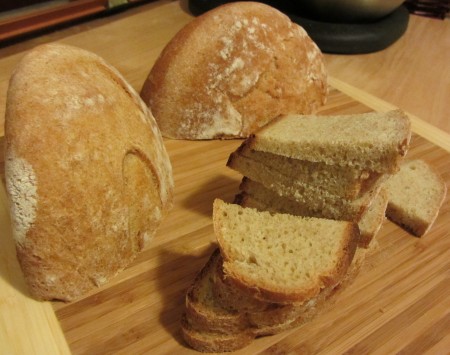
What happened here, exactly? I replaced 1/4 of the white flour with wheat flour, and I increased the hydration from 60% to 67% by adding 28 grams of water — about two tablespoons. The end goal was a slightly more rustic, somewhat “wheaty” bread. I also added two tablespoons of butter to the dough because there was butter in the fridge and I felt like adding it.

To bake the bread I used the Lahey “covered pot” technique (30 minutes covered, 15 minutes uncovered), decreasing the baking time from 45 minutes down to 40 (only 10 minutes of uncovered baking) —  the hydration of the Agreeable bread was 67% rather than the 75% in Lahey’s “no knead” dough; there was less water to cook out.

If I had to do over again I would have removed the pot lid 5 minutes sooner, to try to get a little more color on the crust. Slashing the dough may have also produced a slightly more open crumb, a “better” result — 60% hydration doughs pretty much always get slashed, and high hydration (75%) doughs basically never get slashed (they’ll often collapse into the slash); there’s a point in between there where slashing the dough is a good thing. Now I just have to figure out what that “point” is.

In any event, the Agreeable Bread went well with Saint Andre cheese, and it made a good breakfast sandwich too.

Moyer Making a “Comeback”

By Blaidd Drwg

The 'real' Methuselah rookie card. I am not sure he was old enough to drive when that picture was taken. Heck, I am not sure they had cars when that picture was taken.

Methuselah, err…I mean Jamie Moyer is planning on making a comeback, at age 49, with the Colorado Rockies. I like Jamie Moyer, I think he is a swell guy, but Jamie, it is time to hang it up.

Some reasons why this is not going to go well:

  • Despite being a lefty, he is 49 and not a knuckleballer and isn’t named Satchel. He was barely effective at 47, when he last pitched in the majors.
  • He is coming off reconstructive elbow surgery. Pitchers half his age sometimes don’t come back from that and I don’t think all of the conditioning in the world will help. On the flip side, I doubt that he could actually lose any speed on his “fastball”.
  • As mentioned, he wasn’t all that effective in his last stint in the majors in Philadelphia. He would be pitching in Coors Field. He has a tendency to give up the long ball. You do the math.

Somehow I don’t think that Jamie has any desire to be a LOOGY and will be expecting to make the team as a starter. I really hope that he doesn’t embarrass himself too badly.

My prediction – his elbow doesn’t hold up, he retires before playing a game in spring training and gets a job as a coach somewhere.

Odd Bits Dinner Menu

By Iron Chef Leftovers

There will be a dinner at the house of Iron Chef Leftovers in honor of the book Odd Bits and for my sister-in-law who wanted to try them. Recipes and review to follow next week.

The menu is as follows:

Course 1
Better than McDonald’s Chicken Nugget
-Fried Chicken “Oyster” , Honey Mustard Dipping Sauce

Course 2
Sweeter than Bread Raviolio
-Poached Sweetbread Raviolio; Taleggio, Mushroom and Marsala Cream

Course 3
Cheesesteak, Wiz, Wit
– Eye Round and Tongue Cheesesteak, Beecher’s Flagship “Cheese Whiz”, Caramelized Onions, Essential Baking Baguette

Course 4
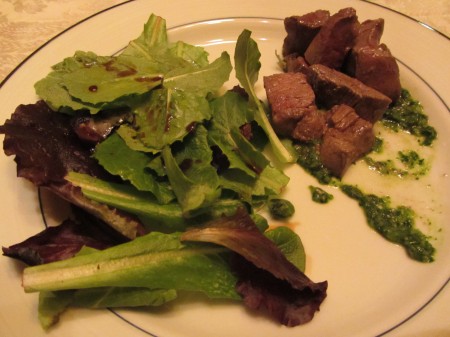
Peruvian Style Beef Skewers
-Grilled Marinated Heart and Tenderloin Skewers, Salsa Verde; Side Salad

Course 5
TBA*

* Course 5 was supposed to be Pig Blood Chocolate Ice Cream. Finding usable pig’s blood is pretty much impossible to find unless you can find someone slaughtering a pig, so I haven’t quite figured out the dessert at this point.