by A.J. Coltrane
[Edit after I’d written the rest of this post: The Catan Card Game was discontinued in 2010 and replaced by The Rivals For Catan. From everything I’ve read the new game is easier to learn and is most likely the better game. The new game is also faster, clocking in at 45-60 minutes rather than 90 minutes.]
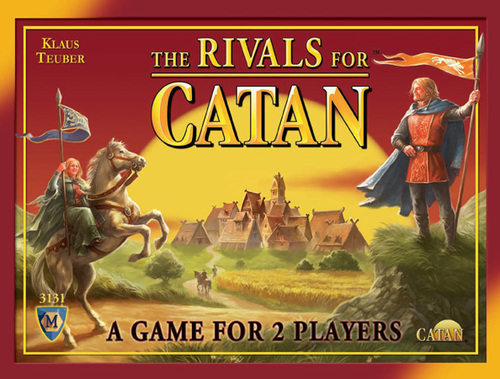
Title: Catan – Card Game
Game Type: Resource allocation – Euro “building” game.
Number of Players: 2
Complexity of Rules: Medium
Time to Play: 90 minutes
The Concept: Each turn the players roll a die and collect a random resource such as brick, ore, gold, or wood. Another die is rolled which represents a random “event”, such as a Brigand Attack or Year of Plenty.
The resources are used to purchase structures including new roads, villages, and cities — as well as expansions and improvements like trading fleets, sawmills, churches, garrisons, and knights. Some of the structures and expansions contribute one or two Victory Points to help the player win the game. Other purchases help by making the principality more productive, or by protecting it from attacks.
The first player to twelve Victory Points wins.

Why I Like It: The Card Game allows a lot more control over my destiny than the Board Game. The Card Game allows me to make moves and play cards that have a *much* larger impact upon my opponent.
I think the Catan Card Game is “tighter” than the original board game. The game moves at a faster pace — there seems to be less futzing around, at least in part because there’s very little trading in the Card Game, and trading is basically what the Board Game is all about. (And of course, by the time you get five people yapping at each other, rather than two.. the Board Game features a lot more downtime between turns.)
The Catan Card Game offers a lot of different ways to try to win, but there isn’t necessarily a “right” answer. The random Event each turn can compromise any “optimized” strategy; it ultimately leads to every game taking a different path to the finish.
Boardgamegeek page for The Rivals for Catan here. The discontinued Catan Card Game page is here.
Support your local game store.
 FlatbreadGarden
Have you tried “Carcasonne”? I introduced it to our group–usually a bunch of serious rules-based board game fanatics–and they really took to it.
Carcasonne is a tile-based, relatively free-form, semi-cooperative game. It comes as a base set (tiles, markers, rules) with several add-on sets, most of which can be added independently. By placing tiles, you build cities, farms, roads, monasteries, etc., and place your actors (knights, farmers, thieves, monks) on them. Scoring is in points.
The add-ons are relatively simple in concept, each adding a new object and/or role, each adding a bit more complexity to the scoring. Thus, it’s a good game to start new folks (or young folks) in, and build up as they learn. It’s also not as cutthroat as some other games, so the atmosphere stays friendlier than, say, when playing Risk (which can lead to fisticuffs in our group).
Anyway, it is easy, relatively fast, and allows experienced players to indulge in as much (or as little) strategy as desired.
LikeLike
We have Carcassonne. We played it once or twice and just didn’t get into it for some reason.
My recollection is that the rules weren’t as clear as they could have been — we spent too much time fighting the rulebook, though generally I can parse that stuff out pretty well.
I’ve played with enough rules lawyers that I can usually predict when and where they’re going to go with flawed language, before they actually go there.
I’ll have to give it another look now.
LikeLike
The rules for the add-ons in Carcasonne can be iffy, and I can’t speak to the rules for the card-game version. I’ve only played the tile-based version.
LikeLike