Matt (Kansas City)
Would Lorenzo Cain, Johnny Giavotella, Jorge Bonifacio, Chris Dwyer, Mike Montgomery, and Bruce Chen be enough to land Giancarlo Stanton from a value and a Union standpoint?
David Schoenfield
(2:10 PM)
No. You don’t really see the poo-poo platter trades in MLB.
Hehe. He said poo.
As Homer Simpson would say, mmmm…sampler platter….
Hard to believe this was 20 years ago. I remember sitting in my dorm common room watching this since it was the only place in the building that had cable.
When it comes to fresh hop beers, most of the local Washington breweries tend to go with an IPA or a Pale Ale style to showcase the hops. On occasion, you get a brewery that tries to do something different. Seattle based Big Al’s Brewing did that with the release of their Fresh Hopped Harvest Ale. I couldn’t find a description of the beer online so all I can tell you is that I had it in a 22 oz. bottle which was purchased at a local bottle shop for about $5.
The beer is a reddish-amber color. The nose is dominated by lots of malt and grain, with hints of citrus and hops in the background. The initial taste brings roasted malt on the front of the palate, so roasted that it is almost chocolate like, followed by a slightly grassy hop flavor. As the beer warms, it becomes slightly more bitter, the malt becomes more restrained, and the green hops become more citrus like, but are still a secondary player to the malt in this beer.
Personally I felt like this beer lacked balance between the malt and hops. The hops flavor, which is what I am really looking for in a fresh hop beer, seemed to be lost at times and just overpowered with what is a really malty beer. I appreciated the effort that Big Al’s put into this beer to make something different, but I think it needs some additional work. I would probably buy this beer again next year to see if it has gotten any better, but I don’t think I would run out and buy more than one either.
A disappointed Big Al’s reaps 2 combines out of 5 for their Harvest Ale.
From left to right: Team Name, Kenpom Rank (minimum, top 50), 3-point percentage and rank, free throw percentage and rank, 3-point attempted quantity and rank. The ranks are relative to all 347 Division I teams.
Then it’s me screwing around with numbers. The “Vol” is the Volatility of the team. It’s 3P% x 3PA%. These are the teams that rely upon 3-pointers for a lot of their offense. If they get hot they can beat anybody, and if they get cold they could lose to anybody. Conversely, a team with a low “Vol” doesn’t take many 3’s and isn’t good at shooting them. A team with a low “Vol” isn’t likely to shoot itself out of, or back into, a game.
The “VR” is that team’s “Vol” rank among the top 150 teams according to Kenpom. (I didn’t care about the Weak Sisters Of The Poor.) “Vol” wound up ranging from 1658 to something like 800. The lowest team on the “top 50 Kenpom list” is NC State at 920. I think it’s telling that the top 50 teams can all shoot at least a little, and with some volume.
Q-E is pretty self-explanatory: It’s 3PA% rank minus 3P% rank. (The Excel columns were “Q” and “E”. Yeah, I’m a big thinker.) As an example, Cincinnati is the first team listed with a -191. They’re 75th in 3-pointers attempted, and 266th in accuracy. 75 – 266 = -191. My suspicion is that the teams with large negative numbers are going to shoot themselves out of the tournament at some point. Offhand, I’d also guess that those teams lack a guy who can create his own shot, or slash and kick, leading to some desperation heaves late in the shot clock. I’ve seen Cincinnati. It doesn’t feel like an unrealistic set of assumptions. Watching them the other night I kept saying “They look really disjointed…”
On the other hand, the strongly positive teams may benefit from shooting more 3’s. That might bode well if they happen to fall behind and are forced to try to catch up quickly.
It’s interesting to me that there are only two “top-50” teams at worse than -100 “Vol”, but twenty-two teams at better than +100. A large percentage of the top teams are relatively judicious with their 3-point attempts. My guess is that the unwashed masses are shooting a lot of 3’s that they shouldn’t be, but they’ve got to create offense somehow, so that’s how it goes.
If I was smarter I’d be able to do a regression of 3P% vs FT%, I’d expect that there’s some positive correlation to it. At the very least, it illustrates that Cincinnati can’t shoot free throws, either. Poor free throw shooting may do them in, too.
Final note. I like Florida, but their 6th-ranked “Vol” score kinda gives me the heebies.
Zack Lowe of Grantland/ESPN on the impact on the trade deadline of the new NBA Collective Bargaining Agreement.
I don’t think he has a high opinion of Dwight Howard:
People seem to forget this, but we also had three massive deals between August and late January, two of which — for Rudy Gay and James Harden, respectively — were motivated at least in part by the new CBA. (The third was the Dwight Howard deal, motivated by candy and whatever else motivates Howard’s “camp.”)
I recently saw a list of the top 10 selling cookbooks for 2012 and it is a rather disappointing list, led by the Barefoot Contessa’s new tome. It got me thinking, if I were stranded on a dessert island (no that is not a typo, I really would love to be stranded on a dessert island; a desert island just doesn’t seem like it would be all that much fun) and could only have 10 cookbooks/food related books with me, what would they be? Let’s just assume that I, for some reason, have a fully stocked kitchen and pantry (just don’t ask me how).
Here is my list, in reverse order:
If you were to own just one book on cooking, this should be it.
10 – Silver Spoon – it is generally considered to be the most complete Italian cookbook ever created and didn’t exist in an English translation until about 10 years ago. If you are serious about Italian cooking, you should own this monster.
9 – Charcuterie by Michael Ruhlman. If you watch No Reservations, you know who Ruhlman is. This is a survival guide to curing meats which would come in handy in a stranded situation. It is also an in depth read about the how and why of charcuterie.
8 & 7 – I’m Just Here for the Food / I’m Just Here for More Food by Alton Brown. More useful for why and how things work with cooking than for recipes, I can pretty much assure you that if you ever had a recipe fail, you can find out exactly why here. Be careful, these books are a gateway drug into the world of molecular gastronomy.
6 – On Food and Cookingby Harold McGee. The book is incredibly long (800+ pages), very technical in parts and is not a quick read (it took me over a year to read it cover to cover), but it is probably the single most important book on food ever written. It covers pretty much every aspect of food and food science and you should have it on your bookshelf as reference even if you never read it cover to cover. I doubt there has been a food book written in the last 20 years that has not cited this one as a reference in its bibliography.
5 – Modernist Cuisine at Home. Another book that is more science than recipes, it is another one that you should own, even if you aren’t into the molecular gastronomy thing. Reading this book will make you a better cook even if you never try anything from the book.
However, if you were to own just two books on food, this should be the other one.
4 & 3 & 2 – Bones / Fat / Odd Bits – by Jennifer McLagan. These books are really essential for understanding and cooking the rest of the animal and should really be looked at as 3 parts of a single book; the ultimate in utility – you realize after reading them, everything is useable. They really fill in the gap for all of the stuff that most other cook books don’t address. It doesn’t hurt the descriptions are well written and the anecdotes are funny.
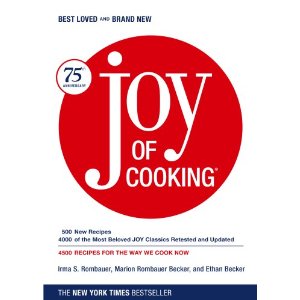
1 – Joy of Cooking – there should be a law that every home cook should have this book on their shelves since it pretty much has a recipe for everything in it. It has been updated about 14 times over its 75+ years in existence, but have some fun and get an edition that is printed before the 1960’s just to see how cooking has changed.
Living in Seattle, which does have a slight (and justified) reputation for being an over-caffinated city, you would expect that you would see more coffee based beers, but you don’t. For the 2012 Seattle Beer Week, Elysian Brewing was selected to come up with the beer for the event and they produced Split Shot Stout – marrying the city’s love of coffee with its love of beer. I generally will try anything new that Elysian puts out and I really think that their dark beers tend to be their best work. I have tried Split Shot both on tap and in 22 oz. bottles, and the review is for the bottle release. The beer runs around $6 at your local bottle shop (although it is often on sale at mega marts with a better beer selection).
From the Elysian Press Release on the beer:
In Seattle, beer and coffee grew up together. They’re like siblings, jealously balancing the day between go-go and go-slow, dividing the hip and tattoo’d into brewers and roasters, barkeeps and baristas. Split Shot Coffee Milk Stout combines the talents of Elysian Brewing and Lighthouse Roasters, and commemorates not only Seattle Beer Week as its official beer for 2012, but the fact that it took a lot of talk and lot of Lighthouse coffee to get Elysian off the ground back in 1996. Split Shot has a radically complicated malt bill, with C-15 and C-45 dextrine malts, Franco-Belges kiln coffee malt, Black, Roasted and Chocolate malts and flaked oats. It’s bittered with Magnum and slightly sweetened with milk sugar. OG 16 (1.065); alcohol 7.25% by volume., Split Shot is the official beer for 2012 Seattle Beer Week. Available in select Seattle area restaurants, bars and stores, on draft and in 22-oz. bottles.
Split Shot pours with a tan head and a pitch black body. There is absolutely no question what this beer is from the smell – coffee and lots of roasted malt dominate and that is from a foot away from the beer. Up close, this beer smells like a coffee shop roasting its beans – heavy espresso with hints of smoke and grains, taking me back to my bachelor days when I lived near Lighthouse coffee and would smell them roasting beans in the afternoon. The beer has a creamy mouth feel, like taking a sip of espresso with a good crema. Lingering coffee dominates the palate, with a slight bitterness and just a hint of malt and milk sweetness on the back end – this beer could easily be confused for an iced espresso. The coffee is strong but not completely overpowering, but I would still not recommend this beer unless you really liked coffee. As the beer warms, the coffee becomes more restrained and notes of chocolate, sugar, barley and grain start to appear. I would recommend serving this beer between 40 and 45 degrees if you like slightly bitter coffee and 45 to 50 degrees if you want to taste the full range of flavors that this beer has to offer.
If you like coffee and beer, get your over-caffeinated self to a bottle shop and pick this one up, you won’t regret it.
Elysian Split Shot Stout shakes itself down to the local coffee shop with a delicious 4 grande, non-fat mocha with whips out of 5.


 FlatbreadGarden