Tourney Wrapup II — The 3 Point Shooting Teams

By A.J. Coltrane

For purposes of Vegas/March Madness this year I thought it might be helpful to consider how 3-point dependent individual teams were during the regular season. Some of that screwing around was discussed in this post.

Below are the top 10 teams in what I called “Vol” (for volatility) in that post. Below it’s called 3DEP (3 point dependency), which is what I’ll stick with going forward. 3DEP is simply 3 point percentage (x) % of 3 pointers attempted. At least in theory these ten teams rely upon the 3-pointer for a large percentage of their offense, so I’d kind of expect their performances to be very “up and down”. (To have a wider than usual deviation in their level of performance.) If the 3-pointer abandoned them, they were screwed. The flipside is that maybe they can get hot and beat a better team.

Look what happened in the game that knocked them out of the tournament:

Team (Seed) 3DEP 3P% 2P% 3PA% 3P% in Loss 2P% in Loss
Creighton 7 1667 42.1 56.4 39.6 10.5 41.2
Iowa St. 10 1624 37 52.1 43.9 48.0 40.7
Florida 3 1539 38.1 54.9 40.4 20.0 45.7
Valparaiso 14 1493 37.5 56.1 39.8 28.0 41.4
Belmont 11 1485 37.6 57.1 39.5 29.6 50.0
SD St 13 1434 39.4 50.3 36.4 34.8 50.0
St. Mary’s 11 1421 37.3 53.2 38.1 20.0 37.2
Davidson 14 1409 36.6 52.2 38.5 35.3 44.8
Arizona 6 1376 36.3 50.3 37.9 33.3 50.0
Boise St. 13 1362 38.7 48.2 35.2 38.9 54.3
Total 38.1 53.1 38.9 31.0 45.4

Well, duh. They didn’t shoot well and they lost the game. They didn’t shoot well from 2 either. I’m sure that happened to a lot of the losers, regardless of how many 3’s they attempted. If something hadn’t gone wrong they’d still be playing. We don’t really learn anything from that.

Continuing to mess with data though — as a group those are some low seeds — 7 of the 10 teams are double digit seeds. They’d all be underdogs starting with their first game. Look at when they got knocked out of the tournament:

Team (Seed) Lost To Round?
Creighton 7 Duke Round of 32
Iowa St. 10 Ohio St Round of 32
Florida 3 Michigan Elite 8
Valparaiso 14 Michigan St Round of 64
Belmont 11 Arizona Round of 64
SD St 13 FGCU Round of 32
St. Mary’s 11 Memphis Round of 64
Davidson 14 Marquette Round of 64
Arizona 6 Ohio St Sweet 16
Boise St. 13 La Salle Play In

In aggregate the underdogs went 2-4 in their first “real” game (St Mary’s won their play-in game.) Given a fat enough money line of between +150 and +200,  maybe they’d be worth betting on. Hmm…

Here’s 2012:

2012 Team 3P% 3PA% 3DEP Round?
Florida 7 38.0 44.6 1695 Elite 8
Vanderbilt 5 38.8 41.2 1599 Round 32
Iowa St. 8 37.3 41.6 1552 Round 32
Belmont 14 38.1 40.1 1528 Round 64
Wisconsin 4 36.8 41.3 1520 Sweet 16
Missouri 2 39.8 37.9 1508 Round 64
Creighton 8 42.4 35.0 1484 Round 32
South Dakota St. 14 39.0 37.8 1474 Round 64
Duke 2 37.1 38.6 1432 Round 64
Nevada Las Vegas 6 36.7 38.9 1428 Round 64

Note the two upsets — both the #2 seeds lost. Is that useful? Maybe. But I am taking a note on it for later.

As far as the underdogs:  This year there were only two. And they both lost their first game. Our underdogs are now 2-6.

One more year. Here’s 2011:

2011 Team 3P% 3PA% 3DEP Round?
Belmont 13 37.8 42.3 1599 Round 64
Wisconsin 4 37.4 41.2 1541 Sweet 16
Virginia Commonwealth 11 37.0 41.2 1524 Final Four
Michigan 8 35.3 43.0 1518 Round 32
Northern Colorado 15 38.3 39.4 1509 Round 64
Notre Dame 2 38.6 38.6 1490 Round 32
Louisville 4 36.2 40.8 1477 Round 64
Arizona 5 39.7 36.1 1433 Elite 8
Richmond 12 39.0 36.6 1427 Sweet 16
Boston University 16 35.5 40.1 1424 Round 64

I wouldn’t bet a 16 seed to beat a one seed regardless, so we’re tossing that one out. That leaves four teams who combined to go 2-2 in their first game.  All three years combined for 4-6 (not counting St. Mary’s play-in game).

If we restrict it to only the #10, #11, and #12 seeds the record is 3-2. Maybe there’s something there. I may have to do more digging. Coincidentally, my only money-line bet this year was on #12 seed Oregon at +160, and that one worked out. But Oregon didn’t rely on 3’s — they were 138th out of 150 during the regular season…

The never-ending quest for an angle continues.

Tourney Wrapup

by A.J. Coltrane

Before the NCAA Tournament I thought it would be fun to get a few people, give them $100 in Monopoly money, and have a blind bid on the tournament teams. The entry fee was 1 “twinkie” per person. The high bidder on the team that won the tournament would receive 3 twinkies, and the 2nd highest bidder would break even and gets his/her twinkie back.

I thought it would be an interesting experiment in game theory — do you put all of your money on a big favorite? There’s a very real possibility that everyone else will want to do that too, so you’d better bid a lot or risk wasting your investment. Alternately you could spread your money around, but what would be the minimum to “claim” each team?

As an added twist, it was possible to bid on “The Field”. “The Field” was defined as every team “leftover” that nobody had expressly bid upon. So — do you bid a lot on The Field, or do you value certain teams enough to put a nominal amount of money on them and hope you don’t get outbid?

The Outcome Of The Bidding:

Team CW BD AJC AS Total Result
Louisville 30 30 12 72 Win Champ
Ohio St 20 10 6 20 56 Elite 8
Georgetown 20 10 20 50 1st Round
Florida 20 10 16 46 Elite 8
Kansas 20 22 42 Sweet 16
The Field 10 10 2 20 42 Final Four
Duke 16 20 36 Elite 8
Indiana 10 12 22 Sweet 16
Miami 2 20 22 Sweet 16
Michigan 2 2 Champ Game
Michigan St 2 2 Sweet 16
Syracuse 2 2 Final Four
Wisconsin 2 2 1st Round
Gonzaga 2 2 Round of 32
Pittsburgh 2 2 1st Round

I [AJC] went with the strategy of trying to get as many teams as possible. I feel like I did pretty well for myself — I “won” Kansas, Indiana, Michigan, Michigan State, Syracuse, Wisconsin, Gonzaga, and Pittsburgh. If Florida, Duke, or Miami won the tournament I’d still break even. Overall it represented two #1 seeds plus a bunch of good quality to back it up. That “quality” wound up being half of the Final Four teams (Michigan and Syracuse.)

But what was I thinking with Pittsburgh? Bleh.. at least they were cheap.

Ultimately my strategy didn’t work out, of course. The #1 overall seed in the tournament was Louisville, and they did indeed win it all. (Though I was feeling pretty smart when Michigan was up 12 in the first half of he championship game.) Louisville was the team that we bid the most upon in total, and there’s definitely a good correlation between where we chose to invest and how wells the teams actually fared. The biggest “overperformers” were Michigan and Syracuse, while Georgetown was the biggest letdown.

Anyhow, I had fun with it. Hopefully somebody will want to try it again next year.

Vegas, Briefly

by A.J. Coltrane

I’m back, and recovered, from Vegas. I can talk like a normal person again. I went 29-19 this year (60.4%), betting almost every game. That figure includes money lines that I won, which raised my “effective percentage” to 63.7%. That’s pretty good, though it’s about on par with how I’ve done each of the last two years. I’d estimate I’m now “effectively” winning about 65% over the last three years.

To avoid TL;DR, here are a few bullet points about what worked, what didn’t, and some other general observations and thoughts.

1.  I got in the neighborhood of “paying for the trip” this year. To actually succeed in paying for the vacation I’m going to need to lay off the stuff I don’t have a strong opinion on, and (probably) increase the size of the bets somewhat. I feel comfortable with the idea of increased bet size, though I’m not sure that everyone that I travel with shares that opinion. I may have to make little bets on the “unsure” pile, since I’m not in Vegas *not* to gamble.

2.  While watching the games we usually play video poker at the bar. One of our traveling companions was dealt a Royal Flush. Dealt! No “holding” cards.. just lots of hearts. She said she just saw “heart, heart, heart, heart, heart” and held them all. At that point she realized she had a Royal Flush and had won $1000! I’ve seen people hit Royals before, but never someone we traveled with. According to at least one “odds” site, the probability of being dealt a Royal Flush (without a re-deal) is one in 649,740. I’ll need to wait several lifetimes to see it again.

This guy got busted for trafficking.

3. The betting public had no idea what to do with VCU all weekend, and *that* turned  into absolute no-brainer profit on both games. Here’s why:  VCU’s entire offense and defense is/was predicated upon creating turnovers and scoring off of turnovers. In the first game they played Akron. The line had VCU favored by about 8. Akron’s problem is that their star point guard had been arrested (and suspended) for trafficking (5 pounds(!)) of marijuana. For whatever reason, the public didn’t notice, or didn’t react strongly enough — VCU forced 21 turnovers, gave up 5, led 50-25 at the half en route to winning 88-42.

In the next game VCU was a slight underdog against Michigan. Michigan had the lowest turnover percentage in the country this year. Final:  Michigan 78, VCU 53. Thank you VCU!

4.  I took the Oregon money line at +160 against St Louis. There were a couple of Vegas natives sitting to our right betting the games as well. When I told one I had the Oregon money line he gave me the “You’re smoking crack” hand gesture. Final score Oregon 74, St Louis 57. That one felt pretty good. (Nice guys, actually.)

5.  The worst losses are the close losses. Temple started well against Indiana. Temple looked “longer”, quicker, and skilled enough to play with Indiana. The halftime score was Temple by three. The sportsbook published a second-half line of Temple +8.5. I couldn’t believe it — Temple didn’t even have to win, they just had to lose by less than 6 (or win)! It seemed too good to be true, though it also looked really really strange. I paced back and forth a few times from the book to the bar, and eventually asked our bartender what he thought of that bet. He said that if it were him, he couldn’t make that bet  fast enough. I went ahead with it…

Indiana trailed by four with 2:56 to go. That means I was “10 points up” on that bet with less than three minutes to go. Indiana outscored Temple 10-0 the rest of the game, and I lost by 1/2 point. Temple did literally everything wrong, and Indiana did everything right. What a crusher.

6. I thought Colorado State would be able to take care of the ball against Louisville and keep it competitive. Colorado State had a low turnover rate this year… Wrong, wrong, wrong. Louisville 82, Colorado State 56.

7.  Creighton met their “better” doppleganger in Duke. Creighton had been a great 3-point shooting team all year, but they went 2-19 against Duke and lost 50-66. The line was 6, so that was an easy one to pick. After the tournament ends I’m going to do a post about the heavily 3-dependent teams and what happened to them.

Syracuse-Indiana post-game thought:  Cody Zeller does not have a strong lower body. It showed against Temple, and it really shouldn’t have come as a surprise that Syracuse swallowed him up. He got his shot blocked about six times against Syracuse. (He finished 4-10 against Temple and 3-10 against Syracuse, though he shot 62.3% during the season.) I think he may struggle at the NBA level, unless he gets a *lot* stronger.

In a not-unrelated note:  Kelly Olynyk went 8-22 while losing to Wichita State. (Though he did score 26 points.) Olynyk made 62.9% of his shots during the season.

Bracket Busters and History

By Blaidd Drwg

Is your bracket busted yet? It feels like there are a ton of upsets this year, but if you actually look at the numbers, percentage wise, it isn’t that many. If you don’t count the 8-9 games, which are two supposedly evenly matched teams (even though the 9 seed has historically won something like 54% of these games), higher seeds are 20-8 in the tournament, or have won 71.4% of their games.

This year, it was not a good idea to be a #5 seed as 3 of the 4 teams lost their game with VCU the only team in that seed to survive.
What does this actually mean historically? Well, I took a look at the last 5 NCAA tournament first rounds (including this year), and found that the higher seed (1-7) has won exactly 71.4% of their games. So this year is an exactly average year for upsets. Just for fun, I decided to look at the results by seed for the 5 year period:

Seed Wins Losses
1 20 0
2 17 3
3 18 2
4 15 5
5 10 10
6 10 10
7 10 10
8 12 8
9 8 12
10 10 10
11 10 10
12 10 10
13 5 15
14 2 18
15 3 17
16 0 20

What does it all mean? Well basically it means that any games involving seeds 5-12 are a toss-up and you could probably expect to see a 13, 14 or 15 seed knock off a higher seed at least once in the tournament. The key is picking the right upset.

The Cheap Seat Eats Bracket Of Peril (Well, let me have just a little bit of peril?)

by A.J. Coltrane

It’s the Cheap Seat Eats (hosted by ESPN) tournament bracket! Match wits with the CSE writers! It’s free!

Up to three brackets per entry.


Link

Bracket Name:  Cheap Seat Eats

Password:  TakeMeOut  (As in, take me out to the ballgame, note that it’s case-sensitive, and there are no spaces.)


The prize is absolutely nothing, which is what sir Galahad gets in this scene from The Holy Grail:


Narrative And Commentary

by A.J. Coltrane

Ken Pomeroy made some great points in February of 2012 (subscriber only):

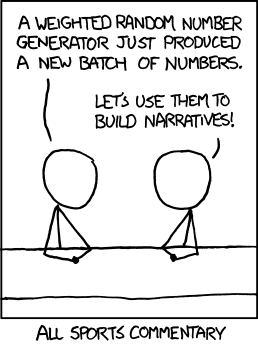
…It’s the manufactured stories that attempt to explain the often-unexplainable variability in a team’s performance that I take issue with. Some team salvages its season by going on a late winning-streak and the origins of the streak are explained by a players-only meeting or the team captain stepping up and being a leader, or a renewed emphasis on defense, etc. When in reality, the causes of the change may have been more complicated that anyone could truly understand. (Naturally, this xkcd comic comes to mind.)

Murray State’s loss last week provided one of the clearest such examples of this method of analysis. The general assumption after the loss was that the Racers cracked under the pressure [(1), (2), (3)] of their unbeaten record. Even the coach said so! The thing is, Murray never reached a point during the season where they were better than a 50% proposition to go unbeaten in conference. You play enough games in which you are heavily favored, and you are going to lose eventually. Put more precisely, a team that plays ten games as a 90% favorite is expected to lose once during that span, and the Racers have played a lot of such games this season, including the game against Tennessee State…

and

…There’s lots of unexplained variance in a college basketball game. The Vegas line has long been proven to be the best predictor of outcomes, and while it has the reputation among some of being scarily accurate, the average error in the Vegas line is 8.4 points. And, with all due respect to other prognosticators out there, that’s the best we can do.

Keep in mind that 8.4 points of unpredictable variability is the combination of the variability of the two teams involved in a game. When Duke unexpectedly won at North Carolina last week, was it because Duke played better than usual and UNC played worse than usual, or was it because UNC played better than usual and Duke played much, much better than normal? Or was it because both teams played worse than usual, but UNC just really played badly? I think it’s nearly impossible to disentangle the two. If one team shoots poorer than expected, is it because their form was off or because the defense was better than usual? It is difficult to determine the answers to questions like this without some serious video breakdown…

I love the comic that Pomeroy linked, it’s exactly why I don’t listen much to the talking heads:

sports


What Does That Mean, Really?

by A.J. Coltrane

From left to right:  Team Name, Kenpom Rank (minimum, top 50), 3-point percentage and rank, free throw percentage and rank, 3-point attempted quantity and rank. The ranks are relative to all 347 Division I teams.

Then it’s me screwing around with numbers. The “Vol” is the Volatility of the team. It’s 3P% x 3PA%. These are the teams that rely upon 3-pointers for a lot of their offense. If they get hot they can beat anybody, and if they get cold they could lose to anybody. Conversely, a team with a low “Vol” doesn’t take many 3’s and isn’t good at shooting them. A team with a low “Vol” isn’t likely to shoot itself out of, or back into, a game.

The “VR” is that team’s “Vol” rank among the top 150 teams according to Kenpom. (I didn’t care about the Weak Sisters Of The Poor.) “Vol” wound up ranging from 1658 to something like 800. The lowest team on the “top 50 Kenpom list” is NC State at 920. I think it’s telling that the top 50 teams can all shoot at least a little, and with some volume.

The teams are sorted by Q-E, explained below.

Team Rank 3P% FT% 3PA% Vol VR Q-E
Cincinnati  37 31.8 266 64.6 305 36.7 75 1167.1 75 -191
Illinois  36 32.8 211 71 116 40.9 28 1341.5 37 -183
Wisconsin  5 34.7 121 62.4 328 39.3 44 1363.7 30 -77
Iowa  34 30.4 304 72.1 77 31 230 942.4 122 -74
Akron  46 34.5 134 66 268 37.3 65 1286.9 45 -69
Wichita St.  35 34 164 68.6 197 35.8 101 1217.2 59 -63
Virginia Commonwealth  22 34.5 129 68.6 199 37.1 69 1280.0 48 -60
Nevada Las Vegas  30 32.7 214 70.4 137 33.8 156 1105.3 89 -58
Denver  42 36.7 53 74.2 34 45.2 3 1658.8 1 -50
Baylor  49 33.8 173 68.5 203 34.6 134 1169.5 73 -39
Iowa St.  38 37.3 42 72.9 61 43 12 1603.9 5 -30
Marquette  24 29.7 317 73.8 41 27.2 298 807.8 140 -19
Arizona  19 36 73 74.1 35 37.7 59 1357.2 33 -14
Oklahoma St.  15 32.4 229 74 38 31.3 219 1014.1 106 -10
Syracuse  9 32.2 240 68.4 205 30.9 235 995.0 110 -5
Mississippi  41 34 163 69.4 168 33.5 161 1139.0 83 -2
Florida  1 38.4 22 68 217 41.4 25 1589.8 6 3
San Diego St.  26 33.5 183 68 218 32.5 190 1088.8 91 7
Louisville  3 32 251 71.1 114 29.9 259 956.8 116 8
Oregon  39 31.3 283 71.8 91 27.8 292 870.1 138 9
New Mexico  28 34.7 120 72.7 66 34.5 136 1197.2 66 16
Belmont  32 38.6 15 72.7 65 40.2 32 1551.7 8 17
Missouri  27 33.5 185 75 23 31.8 205 1065.3 98 20
St. Mary’s  18 38.6 15 72.9 59 38.4 51 1482.2 16 36
Creighton  20 41.8 2 74.8 25 39.4 41 1646.9 3 39
Miami FL  13 35.5 90 65.9 270 34.1 147 1210.6 63 57
Minnesota  17 32.6 219 68.9 186 29 278 945.4 121 59
St. Louis  25 35.7 81 70.1 145 34 150 1213.8 61 69
Connecticut  47 35.9 77 75.1 21 34.2 146 1227.8 56 69
Michigan  10 38.5 20 70.8 122 35.3 106 1359.1 32 86
Georgetown  14 35.7 83 68.1 215 31.8 204 1135.3 84 121
Kansas St.  33 35.8 80 69.2 176 31.9 201 1142.0 81 121
Colorado St.  23 34.1 158 71.7 94 27.8 293 948.0 120 135
Colorado  43 34.5 136 67.3 240 28.4 286 979.8 113 150
Ohio St.  11 36.1 71 70.1 150 30.7 242 1108.3 88 171
Indiana  2 42.6 1 74.8 27 32.9 173 1401.5 25 172
Notre Dame  45 37.4 40 70.1 149 31.2 223 1166.9 76 183
Michigan St.  12 35 110 70.3 139 27.1 300 948.5 119 190
Kansas  8 35.9 75 72.4 68 29.4 271 1055.5 101 196
Duke  6 41.6 3 72.2 76 32 200 1331.2 39 197
North Carolina  31 36.3 66 65.8 276 29.5 269 1070.9 95 203
UCLA  48 34.5 130 71.6 97 23.3 335 803.9 141 205
Pittsburgh  7 35 108 66.3 260 25.6 317 896.0 131 209
Gonzaga  4 37.9 33 71.9 87 30.5 246 1156.0 77 213
Virginia  16 40.4 6 71.5 100 31.1 227 1256.4 53 221
Kentucky  29 36.6 58 64.8 301 28.9 282 1057.7 99 224
Memphis  40 36.5 59 67.7 230 27.6 296 1007.4 109 237
Middle Tennessee  21 38.5 19 69.1 181 26.8 303 1031.8 102 284
North Carolina St.  44 40.2 7 68.2 210 22.9 339 920.6 126 332

Q-E is pretty self-explanatory:  It’s 3PA% rank minus 3P% rank. (The Excel columns were “Q” and “E”. Yeah, I’m a big thinker.) As an example, Cincinnati is the first team listed with a -191. They’re 75th in 3-pointers attempted, and 266th in accuracy. 75 – 266 = -191. My suspicion is that the teams with large negative numbers are going to shoot themselves out of the tournament at some point. Offhand, I’d also guess that those teams lack a guy who can create his own shot, or slash and kick, leading to some desperation heaves late in the shot clock. I’ve seen Cincinnati. It doesn’t feel like an unrealistic set of assumptions. Watching them the other night I kept saying “They look really disjointed…”

On the other hand, the strongly positive teams may benefit from shooting more 3’s. That might bode well if they happen to fall behind and are forced to try to catch up quickly.

It’s interesting to me that there are only two “top-50” teams at worse than -100 “Vol”, but twenty-two teams at better than +100. A large percentage of the top teams are relatively judicious with their 3-point attempts. My guess is that the unwashed masses are shooting a lot of 3’s that they shouldn’t be, but they’ve got to create offense somehow, so that’s how it goes.

If I was smarter I’d be able to do a regression of 3P% vs FT%, I’d expect that there’s some positive correlation to it. At the very least, it illustrates that Cincinnati can’t shoot free throws, either. Poor free throw shooting may do them in, too.

Final note. I like Florida, but their 6th-ranked “Vol” score kinda gives me the heebies.

Burn After Reading mini-spoiler below.

The New NBA CBA

by A.J. Coltrane

Zack Lowe of Grantland/ESPN on the impact on the trade deadline of the new NBA Collective Bargaining Agreement.

I don’t think he has a high opinion of Dwight Howard:

People seem to forget this, but we also had three massive deals between August and late January, two of which — for Rudy Gay and James Harden, respectively — were motivated at least in part by the new CBA. (The third was the Dwight Howard deal, motivated by candy and whatever else motivates Howard’s “camp.”)