Recommended Game — Card Hunter

by A.J. Coltrane

Recommended Game — Card Hunter

It’s a lot of things. It’s a free-to-play browser based game. It’s a CCG (collectible card game) like Magic the Gathering, only it’s also a tactical turn-based high fantasy game with an old-school D&D flair to it.

Confused yet?

You control a party of three characters. The characters can be one of three archetypes – either fighter, wizard, or priest. I’m running with one of each, but if you wanted to you could have three wizards, or two fighters and a priest, or whatever else you wanted. Like almost every other rpg, the characters fight monsters to gain experience and better gear and become more powerful over time.

The monsters you fight live in modules (a themed adventure featuring 4-6 encounters, each on a different map), much like they can in D&D. When you defeat all the maps (“complete the module”) the characters gain the experience and gear mentioned above. Phat “loot”!

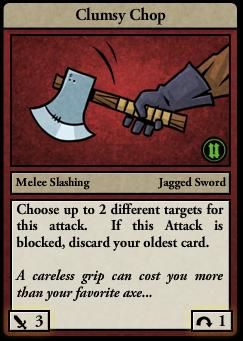
The loot  is where the CCG elements come into play. Every piece of equipment that your characters can wear is represented by 3-6 cards. As an example, here’s a card that might be associated with a crummy low-level weapon:
Clumsy_Chop

If a character has that card in his hand he could hit an enemy one square away and do 3 damage. In this case up to two enemies could be targeted, as indicated on the card text.

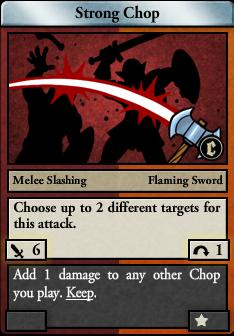
Here’s a much better card that would be associated with an weapon that was either rarer or higher level:
Strong_Chop

That card is way better, it does six damage instead of three, and it pumps up the effect of any other Chop that you play. That’s more like it!

So, every weapon is the game is a mixture of up to six different cards, some strong, some weak, and some that even might harm the user.

Each character’s deck (the cards that he has available to play)  is the aggregate of the cards that are associated with the equipment that he’s wearing. Get a better sword? Great, now he can do more damage. Better armor? Now he can withstand more punishment.

The game is now out of Beta, the release date is September 12. If you like CCGs, or tactical turn-based games, or some flavor of D&D, or loot based games like Diablo or Borderlands.. I’d strongly recommend giving Card Hunter a try.

Hopefully this trailer will make all of that a little more clear. (The whole thing is intentionally somewhat tongue-in-cheek.)

It got this glowing review from Tycho at PAX 2012: “My favorite game of PAX 2012 was Card Hunter. There is no pause between the question and the answer. Card Hunter now, Card Hunter forever.”

(That’s a big deal.)

Link to the Card Hunter home page for more info and to sign up to play.

Recommended Game — Citadels

by A.J. Coltrane

citadelsTitle:  Citadels (now sold with the Dark City expansion)

Game Type:  Card – hand management/ Bluffing/ City Building Game

Number of Players:  2 – 7 (8 with Dark City)

Complexity of Rules:  Low – Medium

Time to Play:  20-60 minutes.

The Concept:  From Boardgamegeek:

“In Citadels, players take on new roles each round to represent characters they hire in order to help them acquire gold and erect buildings. The game ends at the close of a round in which a player erects her eighth building. Players then tally their points, and the player with the highest score wins…

At the start of each round, the player who was king the previous round discards one of the eight character cards at random, chooses one, then passes the cards to the next player, etc. until each player has secretly chosen a character…

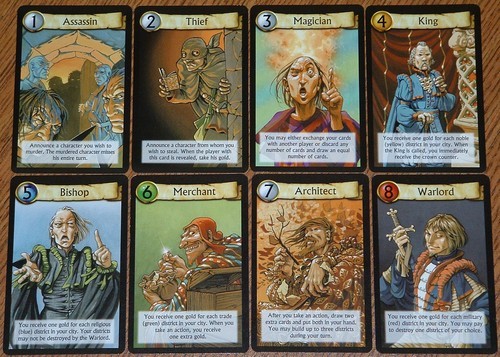
The characters then carry out their actions in numerical order: the assassin eliminating another character for the round, the thief stealing all gold from another character, the wizard swapping building cards with another player, the warlord optionally destroys a building in play, and so on.”


This is the “cheat sheet” that we use when we play — it contains a brief description of each role’s unique abilities. Using a 10-point font it just fits inside the box.

#1 Assassin: Announce a character that you wish to murder. The murdered character misses his entire turn. The murdered player must remain silent and not reveal his character card when called.

#2 Thief: Announce a character from whom you wish to steal. When that card is revealed, take his gold. You may not target the Assassin or the character that the assassin murdered.

#3 Magician: Either exchange your cards with another player or discard any number of cards and draw an equal number of cards.

#4 King: Receive one gold for each of your Noble (Yellow) districts. When the King is called you immediately receive the crown. Exception:  If the King is murdered you receive the crown at the end of the round as his “heir”.

#5 Bishop: Receive one gold for each of your Religious (Blue) districts. Your districts may not be destroyed by the Warlord.

#6 Merchant: Receive one gold for each of your Trade (Green) districts. After your action, you receive one extra gold.

#7 Architect: After your action, draw two district cards and keep both. You may build up to three districts during your turn.

#8 Warlord: Receive one gold for each of your Military (Red) districts. At the end of your turn, you may pay to destroy one district that is not your own. The cost to do so is one gold less than the cost of building the district. The Warlord may not destroy the 8th (“winning”) district in a city.

citadels - roles

Why I Like It:  It’s an easy game to teach and learn, but it has enough strategy (and bluffing) to keep it interesting — the Architect and Merchant are often “best plays” every turn, but that also makes them obvious targets to be assassinated and lose their turn. The game can be shortened by playing to fewer than eight districts. There isn’t much downtime, which I value in any game I play of anything.

prison and palace

To (maybe) quote Sid Meyer: “A game is a series of interesting decisions.”  Citadels qualifies on that front. We’ve had a lot of fun with it.

Link to a Sid Meyer speech at the Game Developers Conference. There’s some fascinating stuff.

Recommended Game – Borderlands 2

by A.J. Coltrane

Recommended Game:  Borderlands 2

Borderlands 2 is a first person shooter set in a futuristic Mad Max/ Western/ The World Is Running Down setting. It’s a high tech wasteland where the toilets don’t usually work. It’s sort of Halo mixed with equal parts Diablo II.

Why I like it:

The Diablo series is famous for its variable loot drops. When defeated, almost every enemy drops loot which may or may not be useful. Every opponent is a potential loot pinata! “What’s going to drop this time?! How will it work with what I already own?!”

Borderlands appoximates this by dropping shields, other goodies, and lots and lots of guns. Bazillions of guns. The guns themselves are collections of a scope, stock, magazine, etc — about seven pieces in all. Each piece of the gun is randomly generated, then all are combined to create the final weapon stats. There are guns that do corrosive damage and fire damage guns and explosive damage guns. There are wildly different fire rates and magazine sizes and damage outputs. The guns often handle *very* differently from one another, so you’ll want to use a different gun for each situation, which is fine. You can equip *four* of them and toggle through them as needed. (Plus another 18ish backpack slots for the other good situational candidates that you just can’t *bear* to sell.)

There are Diablo-style RPG elements to Borderlands 2 as well. As your character levels it gets more powerful and gains helpful special abilities, such as: “Your fire rate is increased by 20% for a few seconds after killing an enemy.” or “Your turret emits a small nuclear blast when deployed.” The leveling means that you outgrow your beloved guns over time, necessitating the constant search for more. You’ll say to yourself — “I need a corrosive sniper rifle for when we’re shooting at robots that are a long way away!” or “I need an explosive damage bullet hose with a huge magazine for crowd control!” Of course, those are just dreams. What actually drops may or may not be exactly what you had in mind, but will it “do”?

Borderlands features split-screen co-op too, so there can be much discussion of who has what, and how do we share to optimize our survivability? “Is your second-best fire damage submachine gun better than mine? Does that shotgun better suit your abilities and playstyle, or mine?” Splitscreen is totally the way to go, the game almost begs for it.

Borderlands 1 is a great game, but the enemy AI is better in Borderlands 2. The enemies are “smarter” in 2 because they don’t just sit still when they’re getting shot at; they’ll duck, roll, or run to another cover, making them a lot more challenging to hit. They also “patrol” when they spawn, rather than just standing there — no more “If I stand here I can head-shot that sentry over there before he can act.”

To sum up:  Borderlands has a fun foul-mouthed sense of humor, and the Bazillions of guns makes for some addictive gameplay and lots of replayability. And it’s fun!

Recommended Game: Call of Duty – Modern Warfare 3

by A.J. Coltrane

Recommended Game: Call of Duty – Modern Warfare 3.

Specifically, the Team Deathmatch mode, since most shooter campaign modes bore me. (Except for Borderlands’, which needs it’s own writeup.)

An impossibly busy staged "scene" -- if it wasn't staged then in about two seconds there'd be one guy left.

Why I like It:  Multiplayer Team Deathmatch pits two teams against each other in a race to get to 75 kills of the opposition.

The thing is, the game’s leveling system encourages running around like crazy, shooting everything in site and getting shot frequently in return… but if I did that I’d lose every encounter to some tween jacked up on Red Bull and pixie sticks (with a liberal assortment of other recreational stuff tossed in.)

As a fossil, there’s really one way to compete with a Twitchmaster 2000 — skulk around corners and wait for them to run into your sights. Then blast them with a silenced weapon. Skulking has the added advantage of allowing for more precise aiming; weapons inherently become more accurate when you’re not moving much.

The reason this strategy works is because whenever anybody fires a non-silenced weapon they show as a red dot on the minimap, so they can often be seen coming and prepared for. That, and opponents are often so impatiently charging around that they don’t bother to check corners — they’re just rushing to the next highlighted enemy on their map, so they’ll just cruise right on by if you’re reasonably concealed and quiet.

The silencer is essential to the strategy for two reasons: 

1.  It hides your location on the map, so the opponents don’t see a red dot and sprint to your spot. (It’s one thing to show up on the minimap when you don’t plan to be there ten seconds from now, but since skulking involves moving a lot more slowly, so it’s essential to keep a low profile.)

2. It often allows for multiple shots at an enemy before they figure out where the shots are coming from. That’s a good thing too, since it’s hard to hit a sprinting target sometimes.

Note that this is not considered an “honorable” way to play. Etiquette says that you’re supposed to run around like everyone else and not be a buzzkill crouching in the shadows. The slow, stealthy approach irritates the hell out of the Twitchmasters. (I know, because I hear them bitching when they’re not muted.)

…and it’s part of the reason I enjoy the game.

———

The essential parts of the build:

Type 95 Assault Rifle – Red Dot Scope and Suppressor. (Use “Attachments” to allow for both.)

Perks – Blind Eye, Assassin, Steady Aim.

This build is invisible on the minimap. The Type 95 is a high accuracy burst fire weapon — it forces me to not “spray and pray”. The burst fire encourages me to be more accurate, and I’m able to stretch the ammo a little further, which is important since I’m not dying much. The 95 also hits hard — it’s a two-bullet kill at close range, so I can deal better with goofballs with (short range, high damage) submachine guns. The Steady Aim helps in close quarters, and in situations where one or both parties are surprised and not scoped — I hate losing shootouts just because I walked around the corner at the same time as somebody else who is using a better short-range weapon; Steady Aim and the Type 95 help to even that playing field. All around, it’s a build with few weaknesses, and it has the benefit of stealth. Hard to beat.

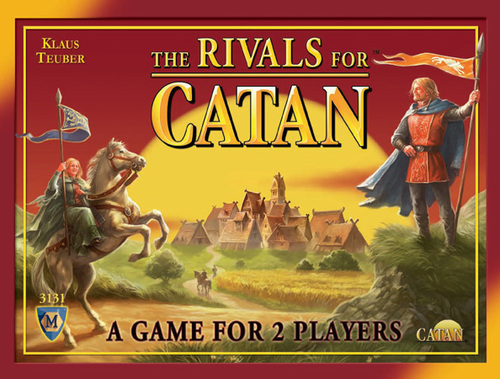
Recommended Game: Catan Card Game, Or, The Rivals For Catan

by A.J. Coltrane

[Edit after I’d written the rest of this post:  The Catan Card Game was discontinued in 2010 and replaced by The Rivals For Catan. From everything I’ve read the new game is easier to learn and is most likely the better game. The new game is also faster, clocking in at 45-60 minutes rather than 90 minutes.]

The version of the game that you can actually find in the store.

Title:  Catan – Card Game

Game Type:  Resource allocation – Euro “building” game.

Number of Players:  2

Complexity of Rules:  Medium

Time to Play:  90 minutes

The Concept:  Each turn the players roll a die and collect a random resource such as brick, ore, gold, or wood. Another die is rolled which represents a random “event”, such as a Brigand Attack or Year of Plenty.

The resources are used to purchase structures including new roads, villages, and cities — as well as expansions and improvements like trading fleets, sawmills, churches, garrisons, and knights. Some of the structures and expansions contribute one or two Victory Points to help the player win the game. Other purchases help by making the principality more productive, or by protecting it from attacks.

The first player to twelve Victory Points wins.

Why I Like It:  The Card Game allows a lot more control over my destiny than the Board Game. The Card Game allows me to make moves and play cards that have a *much* larger impact upon my opponent.

I think the Catan Card Game is “tighter” than the original board game. The game moves at a faster pace — there seems to be less futzing around, at least in part because there’s very little trading in the Card Game, and trading is basically what the Board Game is all about. (And of course, by the time you get five people yapping at each other, rather than two.. the Board Game features a lot more downtime between turns.)

The Catan Card Game offers a lot of different ways to try to win, but there isn’t necessarily a “right” answer. The random Event each turn can compromise any “optimized” strategy; it ultimately leads to every game taking a different path to the finish.

Boardgamegeek page for The Rivals for Catan here. The discontinued Catan Card Game page is here.

Support your local game store.

Recommended Game: Forbidden Island

by A.J. Coltrane

Title:  Forbidden Island

Game Type:  Cooperative “set collection” game.

Number of Players:  2-4

Complexity of Rules:  Low/ Low-Medium

Time to Play:  30 minutes

The Concept:  The Island Is Sinking! The players must work cooperatively to gather four treasures and escape the island before it completely sinks into the abyss! The island is composed of 24 tiles; as the game starts the tiles slowly begin to sink into the ocean. As the game progresses the tiles sink faster and faster. Each turn a player has the opportunity to move around the island, shore up sinking island tiles, and/or transfer a treasure card to other players. Treasures can be claimed when a player has four of the same treasure card and is standing on a tile that is named for that treasure. And each turn, the island sinks a little more…

The gray-blue tiles are "submerged". The missing tiles have sunk!

Why I Like It:  It’s cooperative, which is a nice change of pace. It’s fairly easy to teach and learn. The game is well executed and features a very visceral concept. Each player has a unique ability, and each game the abilities are randomly assigned, so every game is different. Everyone needs to play with a good sense of urgency to avoid going down with the island. Players actually cheer when they win — Forbidden Island seems to make people more “excited” than about any other game we play, from the beginning all the way through to the end.

Boardgamegeek page here. As always, support your local gameshop.

Recommended Game: Mr. Jack

by A.J. Coltrane

Title:  Mr. Jack  – Pocket Version

Game Type:  Deduction/ Bluffing strategy game.

Number of Players:  2

Complexity of Rules:  Low

Time to Play:  15-20 minutes

The Concept:  One player plays as Mr. Jack. The other plays as the Inspectors — Holmes, Watson, and Puggsly the Dog. The “board” is a 3×3 grid of tiles. Each tile contains a suspect and an overhead view of alleyways. Mr. Jack begins play as one of the suspects, and the Inspectors circle the board and try to peer down the alleys to get a good look him and the other suspects. If Mr. Jack can stay hidden for long enough, and prevent the Inspectors from eliminating all the other suspects, then Mr. Jack wins. The Inspectors win if they manage to narrow down the suspects to only one, thereby revealing the true identity of Mr. Jack.


Peering down the alleyways.


The “twist” is that the individual tiles can be rotated or exchanged for each other, changing the sightlines into the alleys, and the Inspectors continually move around the perimeter. Both Mr. Jack and the Inspectors share a choice of possible actions each turn, so choosing what to deny the opponent might be equally as important as what you could do yourself instead.

Why I Like It:  Mr. Jack takes maybe five minutes to learn but packs a surprising amount of strategy into very few rules. It’s portable, fast to play, and engaging without making people’s brains overheat. It’s a very satisfying little game.

Recommended Game: Agricola

by A.J. Coltrane

Title:  Agricola

Game Type:  Resource acquisition/allocation game.

The game is better than the box suggests.

Number of Players:  2-6

Complexity of Rules:  Medium/High

Time to Play:  2 players, over an hour. 3-4 players, 2-2.5 hours. The box says 30 minutes per player, which is probably true if everyone has played once or twice and they’re focused on the game. Four players is plenty if I’m going to be playing. (See “Why I Like It”, below, for more explanation.)

The Concept: The players are European farmers, around 1670 AD. Each player is striving to build the biggest and best house and farm, as well as have the most livestock and most vegetables/grains. Having a big family is desirable too. Players must balance this growth against the never-ending need to feed their family. Starvation is always possible at the next harvest.

Each turn the player designates a family member to acquire resources. Resources can be anything — grain, mud, reed, food, wood, sheep, coal, grain, cattle, stone, etc. (Even using a family member to claim “first player”, or to make more family members, costs an action.) Players then use their resources to build stuff — fences for livestock, more rooms for the house, upgrading the wood house to something better, building a brick oven, or digging a well, or a host of other things.

The game ends after 6 harvests (14 turns). Whoever has the biggest family and biggest and best farm wins. Ideally nobody starved out in the process.

Why I Like It: Agricola is a fairly involved game. Thinking about what you’re doing is highly rewarded — really, it’s mandatory. However, the “thinking” isn’t really *heavy* thinking. It’s not the thinking required for really deep strategy games like chess. There just aren’t that many viable decisions to choose from. It’s definitely possible to have a beverage, chips, and a conversation, and still keep the game moving.

But here’s the rub:

Note that the game lasts 14 turns. On average each player gets about three actions per turn. Let’s say we’re playing with four players. That’s 14 x 3 x 4 = 168 actions. If people are thinking ahead and paying attention it might take 30-40 seconds per action, and the game will conclude in about 2 hours, like it says on the box … if the group isn’t paying attention and they’re not thinking about what their options might be when it’s their turn to play, or they can’t make up their minds, or they’re taking smoke breaks — look out. 168 actions at 1 minute per action is 3 hours, and at 90 seconds per action it’s 4.5 hours. 

Having said that, Agricola has been either liked or loved with everyone I know. Get two or three friends together and turn off the tv and the cell phones. Agricola finds a nice balance of strategy without being headache-inducing. Highly recommended.

Available at Gary’s Games in Seattle or Amazon(dot)com. BoardGameGeek page is here.

Also recommended is a Plano 3500 to go with it. (Photo by Brian Spieles via BoardGameGeek images.) I believe that’s the same one that I have here.


Recommended Game: Angry Birds

by A.J. Coltrane

The Slingshot

The premise of Angry Birds is simple:  Use the slingshot to launch birds and attack structures that are hiding pigs. The object on each level is to “pop” all of the pigs before running out of birds.

Different birds do different things: some split into pieces, some explode upon impact, and so on. Each offers a different twist on demolition strategy.

I purchased this as a $3.99 download for the PSP, and I’ve gotten way more mileage out this title than most games I’ve spent actual money on. It’s sort of a spiritual successor to Artillery for the Apple 2e — I’ve been looking like a game like that for ages.

Blue Birds causing mayhem!

Download it for your favorite platform, it’s hours of addictive fun!

Angry Bird!


In closing, isn’t the resemblance uncanny between the Angry Bird, and:

Giada De Laurentiis!