GNOIF: You Are My Density — The Recap

by A.J. Coltrane

GNOIF #4 Recap — GNOIF:  You Are My Density (Trying for a “Back To The Future” Theme. Note the Star Fluxx, Rocketville, Omega Virus, and Robo Rally… that was the big idea anyway..)

Games That Got Played:  Agricola, Flash Duel, Star Fluxx, Magic The Gathering, The Omega Virus, Ticket to Ride Card Game, Ticket to Ride Europe.

The white boxes are Dominion and Magic The Gathering.

Games That Didn’t Get Played:  Caesar and Cleopatra, Settlers of Catan, Dominion, Lost Cities, Mr. Jack (pocket), Robo Rally, Rocketville.

We’re now getting to the point that people who learn games at one GNOIF can teach them to people at a future GNOIF, and as more people get more comfortable with more games it makes the games themselves go faster too. Ticket To Ride Europe required no introduction and wrapped up pretty quickly; even something as complicated as Agricola didn’t need host involvement to get going. Good progress!

Early in the evening I played a few games of Magic The Gathering. I’d forgotten how much I enjoy M:TG — I haven’t played it in ages, but we trotted out some of my decks from 1999 and had a good time. I could have played more.

Guests brought The Omega Virus, a “talking” electronic game from 1992. It’s a timed game, so it’s fast paced and kind of hectic, and we all had a good time. Ultimately JC was able to pull out a win at the last minute. (Which was much better than the “computer” winning…I’ve never been called “Human Scum” before, but now I think I’ve been insulted that way about fifty times.)

An action shot of The Omega Virus.

I’d be interested to hear what everyone thought of what they played. Thanks for playing all!

Recommended Game: Call of Duty – Modern Warfare 3

by A.J. Coltrane

Recommended Game: Call of Duty – Modern Warfare 3.

Specifically, the Team Deathmatch mode, since most shooter campaign modes bore me. (Except for Borderlands’, which needs it’s own writeup.)

An impossibly busy staged "scene" -- if it wasn't staged then in about two seconds there'd be one guy left.

Why I like It:  Multiplayer Team Deathmatch pits two teams against each other in a race to get to 75 kills of the opposition.

The thing is, the game’s leveling system encourages running around like crazy, shooting everything in site and getting shot frequently in return… but if I did that I’d lose every encounter to some tween jacked up on Red Bull and pixie sticks (with a liberal assortment of other recreational stuff tossed in.)

As a fossil, there’s really one way to compete with a Twitchmaster 2000 — skulk around corners and wait for them to run into your sights. Then blast them with a silenced weapon. Skulking has the added advantage of allowing for more precise aiming; weapons inherently become more accurate when you’re not moving much.

The reason this strategy works is because whenever anybody fires a non-silenced weapon they show as a red dot on the minimap, so they can often be seen coming and prepared for. That, and opponents are often so impatiently charging around that they don’t bother to check corners — they’re just rushing to the next highlighted enemy on their map, so they’ll just cruise right on by if you’re reasonably concealed and quiet.

The silencer is essential to the strategy for two reasons: 

1.  It hides your location on the map, so the opponents don’t see a red dot and sprint to your spot. (It’s one thing to show up on the minimap when you don’t plan to be there ten seconds from now, but since skulking involves moving a lot more slowly, so it’s essential to keep a low profile.)

2. It often allows for multiple shots at an enemy before they figure out where the shots are coming from. That’s a good thing too, since it’s hard to hit a sprinting target sometimes.

Note that this is not considered an “honorable” way to play. Etiquette says that you’re supposed to run around like everyone else and not be a buzzkill crouching in the shadows. The slow, stealthy approach irritates the hell out of the Twitchmasters. (I know, because I hear them bitching when they’re not muted.)

…and it’s part of the reason I enjoy the game.

———

The essential parts of the build:

Type 95 Assault Rifle – Red Dot Scope and Suppressor. (Use “Attachments” to allow for both.)

Perks – Blind Eye, Assassin, Steady Aim.

This build is invisible on the minimap. The Type 95 is a high accuracy burst fire weapon — it forces me to not “spray and pray”. The burst fire encourages me to be more accurate, and I’m able to stretch the ammo a little further, which is important since I’m not dying much. The 95 also hits hard — it’s a two-bullet kill at close range, so I can deal better with goofballs with (short range, high damage) submachine guns. The Steady Aim helps in close quarters, and in situations where one or both parties are surprised and not scoped — I hate losing shootouts just because I walked around the corner at the same time as somebody else who is using a better short-range weapon; Steady Aim and the Type 95 help to even that playing field. All around, it’s a build with few weaknesses, and it has the benefit of stealth. Hard to beat.

Recommended Game: Catan Card Game, Or, The Rivals For Catan

by A.J. Coltrane

[Edit after I’d written the rest of this post:  The Catan Card Game was discontinued in 2010 and replaced by The Rivals For Catan. From everything I’ve read the new game is easier to learn and is most likely the better game. The new game is also faster, clocking in at 45-60 minutes rather than 90 minutes.]

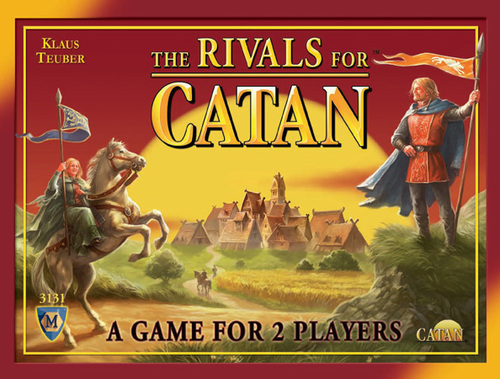
The version of the game that you can actually find in the store.

Title:  Catan – Card Game

Game Type:  Resource allocation – Euro “building” game.

Number of Players:  2

Complexity of Rules:  Medium

Time to Play:  90 minutes

The Concept:  Each turn the players roll a die and collect a random resource such as brick, ore, gold, or wood. Another die is rolled which represents a random “event”, such as a Brigand Attack or Year of Plenty.

The resources are used to purchase structures including new roads, villages, and cities — as well as expansions and improvements like trading fleets, sawmills, churches, garrisons, and knights. Some of the structures and expansions contribute one or two Victory Points to help the player win the game. Other purchases help by making the principality more productive, or by protecting it from attacks.

The first player to twelve Victory Points wins.

Why I Like It:  The Card Game allows a lot more control over my destiny than the Board Game. The Card Game allows me to make moves and play cards that have a *much* larger impact upon my opponent.

I think the Catan Card Game is “tighter” than the original board game. The game moves at a faster pace — there seems to be less futzing around, at least in part because there’s very little trading in the Card Game, and trading is basically what the Board Game is all about. (And of course, by the time you get five people yapping at each other, rather than two.. the Board Game features a lot more downtime between turns.)

The Catan Card Game offers a lot of different ways to try to win, but there isn’t necessarily a “right” answer. The random Event each turn can compromise any “optimized” strategy; it ultimately leads to every game taking a different path to the finish.

Boardgamegeek page for The Rivals for Catan here. The discontinued Catan Card Game page is here.

Support your local game store.

Hello To Gary’s Games And Hobbies

by A.J. Coltrane

Hello to everyone who got here through the Gary’s Games And Hobbies Facebook page!

Obviously, our principal focus here isn’t just games — it’s sports, food, and beer too.. it’s all the Good Stuff. You like all those things, right? (At least the games, food, and beer part anyway.)

A couple of minor site changes:  I’ve added a Recent Comments section to the right hand column, and I’ve added a new page describing our GNOIF — Game Night Of Indeterminate Frequency. (See the tab at the top for how we host our game night. It seems to work pretty well.)

Anyway, poke around, and we’d love to hear from you.

And speaking of beer – I believe we may be going to Chuck’s this weekend. Iron Chef Leftovers is a regular customer there and says it’s a great place.. I haven’t been yet, somehow.

Recommended Game: Forbidden Island

by A.J. Coltrane

Title:  Forbidden Island

Game Type:  Cooperative “set collection” game.

Number of Players:  2-4

Complexity of Rules:  Low/ Low-Medium

Time to Play:  30 minutes

The Concept:  The Island Is Sinking! The players must work cooperatively to gather four treasures and escape the island before it completely sinks into the abyss! The island is composed of 24 tiles; as the game starts the tiles slowly begin to sink into the ocean. As the game progresses the tiles sink faster and faster. Each turn a player has the opportunity to move around the island, shore up sinking island tiles, and/or transfer a treasure card to other players. Treasures can be claimed when a player has four of the same treasure card and is standing on a tile that is named for that treasure. And each turn, the island sinks a little more…

The gray-blue tiles are "submerged". The missing tiles have sunk!

Why I Like It:  It’s cooperative, which is a nice change of pace. It’s fairly easy to teach and learn. The game is well executed and features a very visceral concept. Each player has a unique ability, and each game the abilities are randomly assigned, so every game is different. Everyone needs to play with a good sense of urgency to avoid going down with the island. Players actually cheer when they win — Forbidden Island seems to make people more “excited” than about any other game we play, from the beginning all the way through to the end.

Boardgamegeek page here. As always, support your local gameshop.

GNOIF Just Wants To Have Fun – The Recap

by A.J. Coltrane

GNOIF #3 recap: GNOIF Just Wants To Have Fun (Ladies choice of games)

Games That Got Played: Dominion; Gloom; Forbidden Island; Agricola; Ticket To Ride – Europe

Games That Didn’t Get Played: Mr. Jacket (Pocket); Ticket To Ride (Card Game); Starship Catan; Monty Python Fluxx

The big hit of the night was Forbidden Island, though both Agricola and Ticket To Ride (Europe) got a lot of post-mortem conversation.

We won the Forbidden Island game that I played in. The concept of the game is that the island is sinking, and that you and the other players team up to try to gather four treasures from the island before it completely submerges beneath the sea. The island is represented by 24 tiles, and in the game that I played we had two tiles that were still above water when we escaped the island.

The other group lost their game when a key tile sank early on, splitting the group in two. Eventually a critical treasure tile sank, ending the game. Had that tile not sank they would have won on the next turn!

 Thanks to everyone who played

Recommended Game: Mr. Jack

by A.J. Coltrane

Title:  Mr. Jack  – Pocket Version

Game Type:  Deduction/ Bluffing strategy game.

Number of Players:  2

Complexity of Rules:  Low

Time to Play:  15-20 minutes

The Concept:  One player plays as Mr. Jack. The other plays as the Inspectors — Holmes, Watson, and Puggsly the Dog. The “board” is a 3×3 grid of tiles. Each tile contains a suspect and an overhead view of alleyways. Mr. Jack begins play as one of the suspects, and the Inspectors circle the board and try to peer down the alleys to get a good look him and the other suspects. If Mr. Jack can stay hidden for long enough, and prevent the Inspectors from eliminating all the other suspects, then Mr. Jack wins. The Inspectors win if they manage to narrow down the suspects to only one, thereby revealing the true identity of Mr. Jack.


Peering down the alleyways.


The “twist” is that the individual tiles can be rotated or exchanged for each other, changing the sightlines into the alleys, and the Inspectors continually move around the perimeter. Both Mr. Jack and the Inspectors share a choice of possible actions each turn, so choosing what to deny the opponent might be equally as important as what you could do yourself instead.

Why I Like It:  Mr. Jack takes maybe five minutes to learn but packs a surprising amount of strategy into very few rules. It’s portable, fast to play, and engaging without making people’s brains overheat. It’s a very satisfying little game.

GNOIF From The Crypt – The Recap

by A.J. Coltrane

GNOIF #2 recap: GNOIF From The Crypt.

The Games That Got Played: Last Night On Earth – the Zombie Game; Mystery of the Abbey; Mr. Jack (small box); Betrayal at House on the Hill.

The Murderer's Row

Games That Didn’t Get Played: Dracula; Vampire Hunter; Munchkin Zombies; Mr Jack (Hex based/ large box).

One group played an exciting game of Last Night On Earth:

Billy the Track Star and Sally the school Sweetheart began the zombie invasion in the high school. Jake the Drifter came in from the road out of town, and Nurse Becky began at the Old Truck in the center of town. The heroes goal was clear — they had to find gasoline for the Old Truck, the Truck Keys, and make a getaway out of town.

Everyone ran for the high school, hoping for strength in numbers. (And really, how often does “let’s split up” end well in horror films?) That idea worked well, until the power was cut to the high school and the school was overrun by zombies. In the photo below the heroes are beating back the zombies and trying to make it into the school gym:

Jake and the Nurse in the school -- Billy and Sally have fought their way into the gym.

Billy found the Keys, but time was running short before nightfall, and the zombie horde kept coming. The heroes also had to deal with a sudden rainstorm, making outdoor movement tricky and slow. A decision was made: The heroes would make a run for it! Billy sprinted to the opposite corner of town – to the gas station to pick up a can of gas, and the others ran for the Old Truck. Our heroes all met at the truck, but unfortunately, so did the zombies:


The zombies last chance to stop the heroes! (Note the gym and high school to the northeast.)

Our heroes managed to fend off the zombies long enough to start the truck and speed away!

Last Night on Earth recommended here. Betrayal at House on the Hill recommended here.

GNOIF #3 date TBA!

Recommended Game: Agricola

by A.J. Coltrane

Title:  Agricola

Game Type:  Resource acquisition/allocation game.

The game is better than the box suggests.

Number of Players:  2-6

Complexity of Rules:  Medium/High

Time to Play:  2 players, over an hour. 3-4 players, 2-2.5 hours. The box says 30 minutes per player, which is probably true if everyone has played once or twice and they’re focused on the game. Four players is plenty if I’m going to be playing. (See “Why I Like It”, below, for more explanation.)

The Concept: The players are European farmers, around 1670 AD. Each player is striving to build the biggest and best house and farm, as well as have the most livestock and most vegetables/grains. Having a big family is desirable too. Players must balance this growth against the never-ending need to feed their family. Starvation is always possible at the next harvest.

Each turn the player designates a family member to acquire resources. Resources can be anything — grain, mud, reed, food, wood, sheep, coal, grain, cattle, stone, etc. (Even using a family member to claim “first player”, or to make more family members, costs an action.) Players then use their resources to build stuff — fences for livestock, more rooms for the house, upgrading the wood house to something better, building a brick oven, or digging a well, or a host of other things.

The game ends after 6 harvests (14 turns). Whoever has the biggest family and biggest and best farm wins. Ideally nobody starved out in the process.

Why I Like It: Agricola is a fairly involved game. Thinking about what you’re doing is highly rewarded — really, it’s mandatory. However, the “thinking” isn’t really *heavy* thinking. It’s not the thinking required for really deep strategy games like chess. There just aren’t that many viable decisions to choose from. It’s definitely possible to have a beverage, chips, and a conversation, and still keep the game moving.

But here’s the rub:

Note that the game lasts 14 turns. On average each player gets about three actions per turn. Let’s say we’re playing with four players. That’s 14 x 3 x 4 = 168 actions. If people are thinking ahead and paying attention it might take 30-40 seconds per action, and the game will conclude in about 2 hours, like it says on the box … if the group isn’t paying attention and they’re not thinking about what their options might be when it’s their turn to play, or they can’t make up their minds, or they’re taking smoke breaks — look out. 168 actions at 1 minute per action is 3 hours, and at 90 seconds per action it’s 4.5 hours. 

Having said that, Agricola has been either liked or loved with everyone I know. Get two or three friends together and turn off the tv and the cell phones. Agricola finds a nice balance of strategy without being headache-inducing. Highly recommended.

Available at Gary’s Games in Seattle or Amazon(dot)com. BoardGameGeek page is here.

Also recommended is a Plano 3500 to go with it. (Photo by Brian Spieles via BoardGameGeek images.) I believe that’s the same one that I have here.


GNOIF: The Awakening — The Recap

by A.J. Coltrane

GNOIF: The Awakening, has come and gone and I think everybody had fun, so I’m going to call it an unqualified success.

We put out a selection of games, from left to right:  Fluxx, Caesar and Cleopatra, Lost Cities, Mr. Jack, The Gardens of Alhambra, Forbidden Island, Ticket to Ride, Dominion, and Agricola. The games to the right are the more complex games, the quicker and simpler games are to the left.

Note that there’s also some text on the cards– each game got a short description to help everyone decide what they wanted to play. (The dice were keeping the cards from blowing away. It was a windy and hot day, and we had the windows open.) I’m not sure if anyone read the cards.

What we played:  Fluxx, Lost Cities, The Gardens of Alhambra, Forbidden Island, and Dominion.

What we learned:  Next time I’ll show people the more complicated games *before* the beverages begin to add up.

Thanks to everyone who played! 

Next up — GNOIF:  GNOIF from the Crypt!

Thanks to D for the cool shirts celebrating the inaugural GNOIF:

Game Night Of Indeterminate Frequency T Shirt. Ignore the wrinkles.