Grill Roasted Beef Tenderloin

By Iron Chef Leftovers

Mrs. Iron Chef and I recently entertained her aunt, uncle and a couple of cousins, who had been on a whirlwind tour of the Pacific Northwest, and I decided that they needed a good, home cooked meal. Since there were 6 of us and the weather was nice, I thought that the meal called for a nice grill-roasted beef tenderloin. It is easy to cook, always a crowd favorite and doesn’t require a ton of prep. The below recipe and technique was taken from Cook’s Illustrated magazine and modified a bit by yours truly.

The Software
1 – 2 ½ lb. beef tenderloin, silver skin removed
1 tablespoon + 1 teaspoon kosher salt
1 tablespoon granulated garlic
1 teaspoon of olive oil
1 teaspoon ground black pepper
Soaked wood chips for smoking (optional)

The Prep
Remove any silver skin that may be on the roast. Pat dry and sprinkle1 tablespoon of salt on all sides of the roast. Wrap tightly in plastic wrap and return to the fridge for at least 4 hours (you can let it sit overnight if you want, it won’t hurt anything). When you are ready to fire up the grill, pull the meat out of the fridge and pat dry with paper towels. Rub with the oil and then sprinkle with garlic, salt and pepper to get even distribution. Tie the roast with 5 pieces of butcher’s twine spaced at even intervals to make the roast as uniform as possible. Let rest until you are ready to put on the grill.


A whole beef tenderloin – the two “wings” are called the chain meat. You want to get your roast from that end of the muscle and remove the chain meat before cooking.

The Grill
Gas grill – turn all burners on high for 15 minutes to preheat the grill. Add wood chips to your smoking box at this time. Once grill is heated, clean the grill grates. Turn off all of your burners except for your primary burner. Leave that on – you are looking to maintain about 300-325 degrees in the grill. For my grill it means leaving the primary burner just above medium high.

Charcoal grill – prep 6 quarts of charcoal and heat until covered in ash. Add the charcoal to the far side of the grill, not exposing more than half of the grill grate to direct heat (you are going to cook the meat off of direct heat). Add wood for smoking directly to the charcoal. Heat the grate for 10 minutes with the grill covered.

The Roast
Gas grill – put the meat on the grill about 8” from the edge of the primary burner (you don’t want to put in directly on the heat from the primary burner). Roast for 25 minutes, and then flip the meat over. Continue roasting until the meat reaches 125 degrees on a meat thermometer (that is medium rare). Remove from the heat to a plate and cover with foil. Let rest 15-20 minutes before cutting.

Charcoal Grill – Put the meat over the direct heat of the charcoal for about 2 minutes on each side to get a crust to form. Move the meat to be about 8” from the direct heat and cook on the first side for about 15 – 20 minutes. Turn over and continue cooking until the meat reaches an internal temperature of 125 degrees. Remove from the heat to a plate and cover with foil. Let rest 15-20 minutes before cutting.

Notes
If your fire starts to die down on a charcoal grill, add more charcoal. This recipe is easier on a gas grill (better temperature control), but tastes a ton better on a charcoal grill. I used a simple salt, garlic and pepper rub for this, but you can use any type of spice rub you would like. If you opt for tenderloin, you want to get a roast that is as uniform as possible and ask your butcher to remove the silver skin for you, it will save you 10 minutes of prep time. If you don’t want to use tenderloin, eye round also works in about the same amount of time. You could also easily substitute a boneless leg of lamb roast or a pork loin roast (not the tenderloin, it is too thin) and they will all cook in about the same amount of time. Tying the roast is essential to making it a uniform as possible – it will prevent some pieces from being more cooked than others. Serve with some roasted veggies and a nice chimichurri sauce.

A Burger with Heart

By Iron Chef Leftovers

I have been accused of being a food snob over the years because I tend to shun crappy, mass produced foods in favor of items that are freshly prepared on a small scale and because I will eat things that most Americans won’t, despite, in most of those cases, most of the rest of the world does eat it.

One case in point – beef heart. Before you go “yuck”, understand this – heart is a muscle that is no different from the steaks that you eat and it actually contains significantly less fat than most other cuts of beef. It also has an incredibly beefy flavor (not the metallic flavor that most people would assume it has since it is considered “organ meat”), much more so than just about any other cut off the cow. If you haven’t tried it, you should – it is cheaper than a steak and cooks incredibly quickly so it can be prepared for a weeknight meal.

All of this lead author Jennifer McLaglan to include a recipe for a heart burger in her Odd Bits cookbook. Before you say “yuck” again, be aware that if you are eating any commercially produced burger or using commercially produced ground beef, you probably have had heart already without knowing it. As she writes:

This is a great way to try heart for the first time…

I took this recipe and made it at home without telling Mrs. Iron Chef Leftovers what was in the burgers and she loved them. I suggest you try it for yourself before saying “yuck.”

The Software
¾ lbs. brisket, fat cap on, ground
¾ lbs. heart, fat on, cleaned and ground
1 ¼ teaspoons salt
Freshly ground black pepper
1 tablespoon olive oil, beef drippings or bacon fat

The Recipe
In a large bowl, combine all ingredients, except the oil, mixing gently until combined. Divide into 4 portions and form into patties about 1 inch thick. Place the patties on a large plate or sheet pan, cover with plastic wrap and refrigerate for at least 1 hour. Pre-heat a pan or grill over medium high heat and add oil. When the oil begins to smoke, add the burgers. Cook for 4-5 minutes until a nice brown crust forms and flip, reducing the heat to medium. Cook for another 4-5 minutes until the burgers reach your desired doneness, Server with your favorite burger toppings.

Notes
I would highly recommend sourcing your heart from a small grower and preferably from a grass fed animal. You will get a better quality product with better flavor. I usually get mine from Skagit River Ranch. You probably won’t be able to find either ground heart or ground brisket easily, so you can see if you purveyor will grind it for you, or better yet, grind it at home yourself. I also added about 2 strips of uncooked bacon to my meat mix before I formed the patties and it took these burgers over the top. This comes in especially handy if the brisket you use does not have much fat. I would not recommend cooking these burgers all the way to well-done; they will dry out as a result and won’t be particularly tasty. If you are grinding the meat yourself and you have a good source, you shouldn’t need to cook these beyond medium-rare to medium. If you don’t like beef, pork belly or lamb shoulder can be subsituted for the brisket and the heart of those respective animals can be used.

Belgian Beef Carbonnade

By Iron Chef Leftovers

I really love things that are braised. Tender chunks of meat, rich unctuous sauces, loads of flavor, the ideal comfort food on a cold day. Braising’s dirty little secret is that you really should make it one day in advance and reheat it the next day. It gives the sauce a chance to infuse itself and increase the flavor.

One of my favorite braises is a classic Belgian dish, Beef Carbonnade. It uses an inexpensive cut of meat, a handful of ingredients and very little prep to produce what I think is the perfect example of what beef stew is. It also combines two of my favorite things – meat and beer. The below recipe was originally taken from Cook’s Illustrated and I have made a few modifications, most notably the amount of liquid used in the dish. My biggest problem with the recipe is that there was not enough sauce, so I took care of that. Also, the original recipe calls for equal parts of chicken stock and beef stock. I replaced that with only chicken stock and I think it actually turned out better. Then again, I was using my homemade stock, which is about 1000 times better than anything that you can get in a store.

Serve over rice, potatoes, pasta, frites or just in a bowl with some bread on the side. The leftovers will freeze nicely for 3-6 months.

The Software
3 1/2 pounds blade steaks, 1-inch-thick, trimmed of gristle and fat and cut into 1-inch pieces
Salt and ground black pepper
3 tablespoons olive oil
2 pounds yellow onions (about 3 medium), halved and sliced about 1/4-inch-thick (about 8 cups)
1 tablespoon tomato paste
2 medium cloves garlic, minced or pressed through garlic press (about 2 teaspoons)
3 tablespoons all-purpose flour
1 1/2 cups chicken stock
2 1/2 cups Belgian brown beer
4 sprigs fresh thyme leaves, tied with kitchen twine
2 bay leaves

The Recipe
Adjust oven rack to lower-middle position; heat oven to 300 degrees.
Dry beef thoroughly with paper towels, then season generously with salt and pepper.
Heat 2 teaspoons oil in large heavy-bottomed Dutch oven over medium-high heat until beginning to smoke; add about one-third of beef to pot.
Cook without moving pieces until well browned, 2 to 3 minutes; using tongs, turn each piece and continue cooking until second side is well browned, about 5 minutes longer.
Transfer browned beef to medium bowl.
Repeat with additional 2 teaspoons oil and half of remaining beef. (If drippings in bottom of pot are very dark, add about 1/2 cup of above-listed chicken or beef broth and scrape pan bottom with wooden spoon to loosen browned bits; pour liquid into bowl with browned beef, then proceed.)
Repeat once more with 2 teaspoons oil and remaining beef.
Add remaining 1 tablespoon oil to now-empty Dutch oven; reduce heat to medium-low.
Add onions, 1/2 teaspoon salt, and tomato paste; cook, scraping bottom of pot with wooden spoon to loosen browned bits, until onions have released some moisture, about 5 minutes.
Increase heat to medium and continue to cook, stirring occasionally, until onions are lightly browned, 12 to 14 minutes.
Stir in garlic and cook until fragrant, about 30 seconds.
Add flour and stir until onions are evenly coated and flour is lightly browned, about 2 minutes.
Stir in stock, scraping pan bottom to loosen browned bits;
Stir in beer, thyme, bay, browned beef with any accumulated juices.
Increase heat to medium-high and bring to full simmer, stirring occasionally; cover partially, then place pot in oven.
Cook until fork inserted into beef meets little resistance, about 2 – 3 hours.
Discard thyme and bay.
Remove about 2 1/2 cups of the sauce to a saucepan and reduce over medium heat by 1/2.
Add the reduced sauce back to the pot with the beef.
Adjust seasonings with salt and pepper to taste and serve to a grateful public. (Can be cooled and refrigerated in airtight container for up to 4 days; reheat over medium-low heat.)

Notes
You can probably use any low hop beer for this recipe, but I prefer to use either the Belgian beer Duval (about $8 for a 750 ML bottle) or the Trader Joe’s Vintage Brown Ale (about $4.50 for a 750 ML bottle). The Belgian beers are malty and sweet and will really enhance the sauce. You won’t use the entire thing, so drink with the meal. I have been contemplating trying this recipe with skipping the searing step for 2/3 of the beef. The meat that is above the liquid will brown during the braise, so it might actually save some time that would be used for searing. I would still want to sear 1/3 of it to build the fond in the bottom of the pan (the browned bits), because there is a ton of flavor in that. The recipe also originally called for 1 teaspoon of cider vinegar. I removed it since I didn’t think it really added anything to the braise.

NY Strip with Blue Cheese, Bacon and Crispy Onions

By Iron Chef Leftovers

Early on in the cooking process, the bacon and sacuce are not yet in their happy places.

Mrs. Iron Chef loves bacon wrapped tenderloin. While I love cow, this is probably my least favorite part of the animal – it has very little flavor, is very expensive and can be picky to cook with since you don’t have any protection from overcooking because of its lack of fat. Personally, if you are talking supermarket cuts, give me a nice bone-in rib eye. This past Valentines Day, I wanted to do steak, but I didn’t want to do tenderloin, so I went with my compromise cut – the New York strip. It has a fair amount of fat, so it is a little more forgiving to cook, has a more beefy flavor and is still fairly tender. In case you are unaware, the strip is the muscle the run parallel to the tenderloin on the back of a cow – when you get a t-bone steak, the larger side is the strip, and the smaller is the tenderloin. This is the recipe that I came up with – it is pretty simple to put together, cooks relatively quickly and really looks impressive when done.

The Software
2 NY strip steaks, 6-8 oz each
5 strips of bacon, cooked crispy, fat reserved
1 cup chicken stock
1/2 cup dry red wine
1/4 cup Marsala or port wine
2 tablespoons of cognac
1/2 onion, sliced thin
3 oz blue cheese
1 oz butter
salt
pepper

The steaks after being salted for 10 minutes. See how much liquid has come out of them?

The Recipe

The Steak
About 30 minutes before cooking, remove the steaks from the fridge and season on each side with salt. Put the steaks on a wire rack over a plate. This is going to draw out water from the meat and will lead to a better sear.
Cook the bacon in a large skillet until brown and crispy. Crumble after it is cooked.
Remove from the pan and reserve the fat. Wipe out any brown bits that remain.
Pat the steaks dry with a paper towel.
Heat the skillet on medium-high heat, adding 1 tablespoon of bacon fat until barely smoking.
Add the steaks carefully.
Cook on the first side for 4 minutes. DO NOT MOVE THE STEAKS UNTIL THE 4 MINUTES IS UP.
Flip and reduce heat to medium and cook to desired doneness (it will be roughly 4 minutes for medium rare).
Remove to a plate with the side that you cooked first facing up.
Allow the steaks to rest for 8 minutes.
Wipe out any fat and hit the pan with a shot of wine and deglaze. Add to the sauce.

The Sauce (this can be made ahead of time and stored in the fridge)
In a medium saucepan, combine the stock, wine and port over medium heat.
Reduce the contents by 2/3 this should take about 30 minutes or so.
When ready to serve, over low heat, whisk in the butter and any accumulated juices from the steak.
Taste and adjust the seasonings.
Spoon over steak.

The Onions
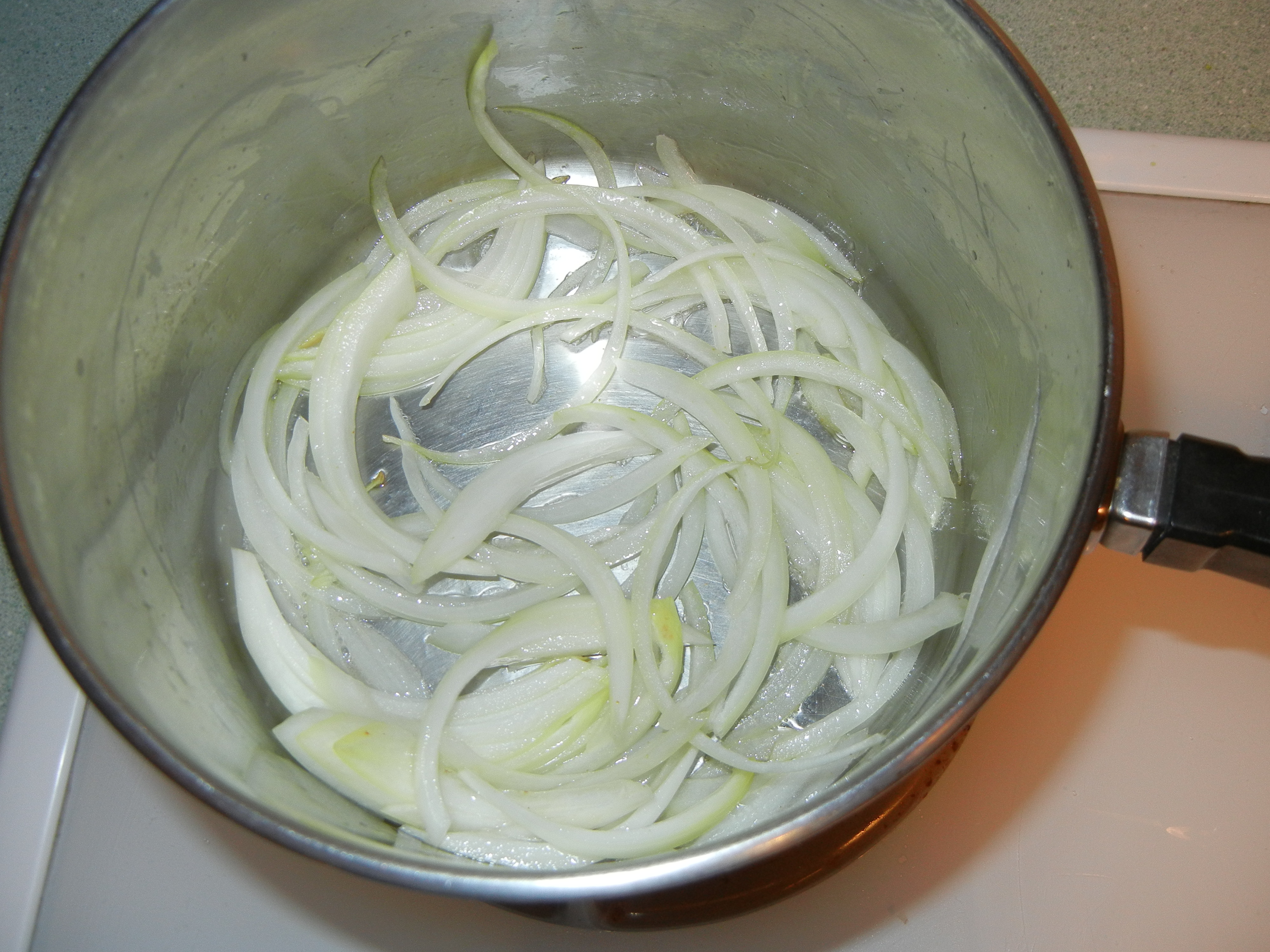
In a heavy bottom pan add 3 tablespoons of bacon fat over medium heat. Add the onions and a pinch of salt and cook until they become crispy, stirring occasionally, making sure they do not begin to burn. This should take about 20 minutes or so.

Onions on their way to crispy goodness.

The Assembly
Heat your broiler and adjust the top rack to the position just below the broiler element.
In a bowl, take the blue cheese and mash with the back of a spoon until soft and spreadable.
Place the steaks in a broiler safe pan and spread the cheese on top. You should have about 1/8 inch layer on the steaks – you also don’t need to worry about going to the edge, the melting cheese will take care of that for you.
Place the steaks under the broiler for 2 minutes, until the cheese is melted and bubbly. Check it after 1 minute and every 30 seconds after that – it can go from bubbly to burnt in a hurry.
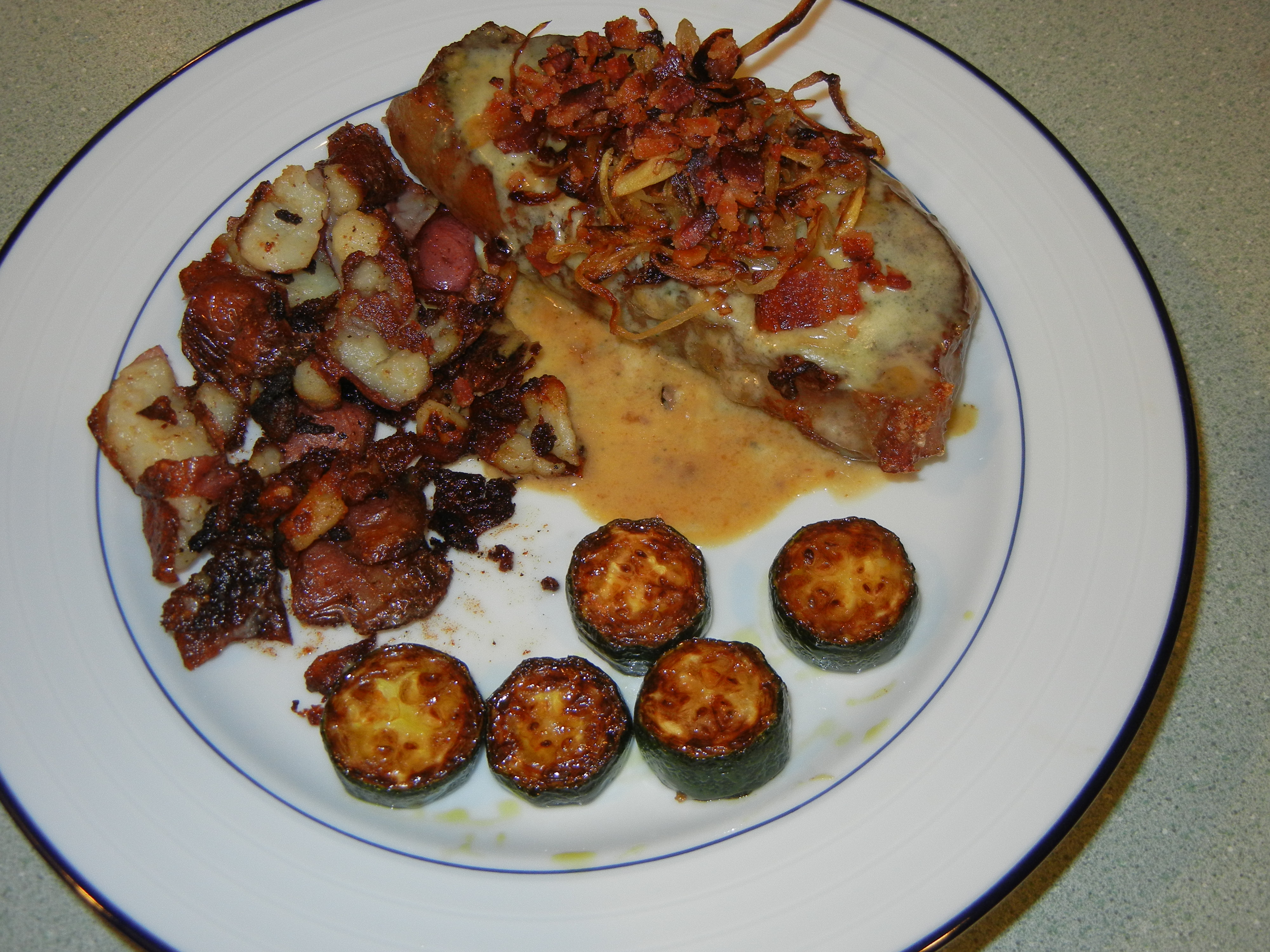
Remove the steaks to a plate. Drizzle with sauce (and any melted blue cheese from the pan) and top with crispy onions and bacon crumbles.
Serve to a happy wife.

The final product. I am drooling on my keyboard as I am typing this.

Notes
I use Point Reyes Blue out of California. I consider this to be the best cheese on the planet and I love the balance of smoky, sweet and pungent that it brings to the dish. You can use just about any blue cheese you want, depending on your tastes. I also highly recommend using a grass fed beefsteak for this – they have a more pronounced beef flavor that blends well with the blue cheese and bacon. You want the beef as dry as possible before you sear it – it will form a much better crust this way. You don’t need to worry about pre-heating the broiler; since you are using the broiler just to melt the cheese you don’t need to get the entire oven hot to do it. If you don’t want to use the broiler, you could do this on the stovetop in a pan with a lid, but I would highly recommend only cooking the steak on the second side for 2 minutes before trying to melt the cheese. A blowtorch is also effective in doing this (I am not joking – try it sometime). I served this with some skillet-fried potatoes and seared zucchini medallions, but you can use whatever sides you would like. Be careful adding salt to the sauce – the blue cheese might be salty and you might end up over salting everything.