The Magic of Jeremy Lin

By Blaidd Drwg

Jeremy Lin is a good story – a guy who is a Harvard grad, was cut by 2 teams and languishing at the bottom of the Knicks bench, gets a chance to start and leads the team to a 6 game winning streak where he is averaging 26.8 points per game.

I have a feeling that this is going to take a turn for the worst soon – the Knicks have Mr. Ego himself, Carmello Anthony, currently injured, but expected back soon, not to mention Amare Stoudemire coming back from an injury. Those two guys represent the Knicks 2 leading scorers and represent 38 shot attempts a game between them. They both want the ball. Lin is currently taking 24 shots a game. Something is going to have to give and I have a feeling it is going to be Lin’s shot total. The Knicks are going to need him to be more John Stockton than Michael Jordan in order to keep Melo and Amare happy. The problem is I am not sure that Lin can be Stockton. As a starter, Lin is averaging 8.5 assists and 5.1 turnovers per game. While the assists are fine, the turnovers are scary. The Knicks are already 29th in the league as a team in turnovers per game. While Lin’s sample size is small, the number is a bit disturbing – his turnovers have been 1, 8, 2, 6, 6, and 8. To put it in perspective, he has averaged about 1 more turnover a game than the current league leader, Russell Westbrook.

I really want to see Jeremy Lin do well, but I have a feeling the Knicks are headed for a disgruntled player showdown with Melo, and the guy making 18 million a year is always going to win out over the guy making the league minimum.

Gary Carter’s Battle with Cancer

By Blaidd Drwg

It appears that Hall of Fame catcher Gary Carter’s doctors have found more cancer. Carter has been battling brain cancer off and on for the last few seasons. It is probably not good – the cancer was aggressive and inoperable, when he was first diagnosed. Normally I would not go out of my way to mention this, but Gary Carter is one of the good guys out there. He has spent a good part of his life raising money for charity, even during his playing days, and is very sincere and humble if you ever get a chance to talk to him. I had the opportunity to meet him in Montreal in 2002 during an Expos game and I asked him about his charity work, especially as a player when he would go to visit children’s hospitals to bring some cheer to the kids there. He said he felt it was his responsibility as a celebrity to give back to the community.

In 2011, MLB made a “Stand Up to Cancer” commercial. At the 19 second mark, the Baseball Tonight Crew is pictured. On the left, you have John Kruk, who is a cancer survivor. On the far right, you have Ron Darling, who was Carter’s teammate with the Mets in the late ‘80’s. Darling is holding up a sign for “My Catcher” referring to Gary Carter. I am not sure how many people even realized what that referred to, but it still gets me choked up when I see it.

The commercial is here:

Update – ESPN is reporting that Gary Carter has passed away at age 57.


Belgainfest – A Review

By Iron Chef Leftovers

[Photos and captions – A.J. Coltrane]

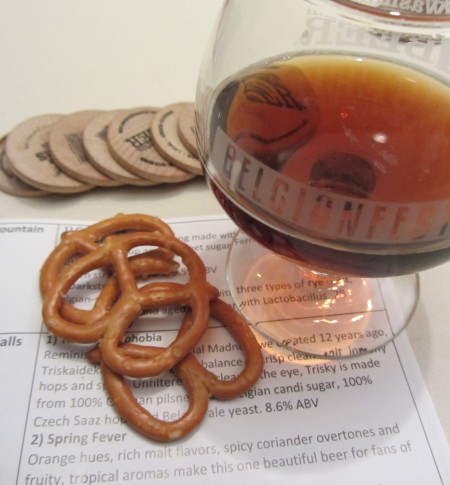
Last weekend, Coltrane, Annie S., Mrs. Iron Chef and I ventured to the Bell Harbor Conference Center for the 3rd Annual Belgianfest, presented by the Washington Beer Commission. Thirty plus breweries, 70+ Belgian style beers and 600 people graced the new venue for what is rapidly becoming a great event. The beers ranged from golden and abbey style beers on the lighter end of the taste spectrum to heavy wood aged and sour beers on the other end of the spectrum, most of which were high in alcohol. I took copious amounts of notes, but I didn’t take notes on everything that I had. After a couple of hours, palate fatigue set in, so I stopped writing things down. Here is what I had (listed by order of their appearance in the Belgianfest program):


The lines at the men's rooms were long. Total Johnsonfest.

American Brewing Company
• Big Pucker – a beer that lives up to its name. Lip puckering sour all the way through with no hint of wood. Like sucking on a sour patch kid all day.

Anacortes Brewing
• Dubbel- slightly sweet and off dry, hints of hops with honey and sugar on the back of the palate.
• Trippel – a very characteristic Belgian Trippel on the front of the palate, with a refreshing crispness on the back, with subtle banana hints teasing you the entire way.
• Sour Red – A great beer to introduce someone to sour beers. Slightly sour with the initial hit on the palate but fading into a malty red ale with hints of wood. Not overpoweringly sour like most brett beers.

Black Raven Brewing
• Cask Saison – Off-dry on the front of palate yielding to a malty saison with a hint of sour. Nicely balanced and not overwhelming.

Diamond Knot
• Strong Belgian IPA – great hop character on the initial sip that does not overpower with a long finish reminiscent of an abbey beer. If you drank this one blind, you would not be sure if you were drinking an IPA or an abbey beer.

Elliott Bay Brewing
• Long Black Veil – drinks like a wonderful dry stout with a hint of sweetness on the finish from the Belgian yeast. A beer worth sipping on a cold winter day.

Engine House No. 9
• Love Child Kriek – a crisp beer that had overtones of oak with a hint of cherries on the back of the palate. Too much oak, not enough cherry, but not unenjoyable.

Fremont Brewing
• Return of the Blood Funnel Saison – heavy citrus notes on the palate and the nose give way to a crisp ending. Very refreshing and reminiscent of an aranchata.


Sweet waffle with brie and basil. I think they've shrunk since we first saw them. Still, a hit everytime.


Gallagher’s Where U Brew
• The Monk – orange and coriander on the nose and palate. A supercharged version of a Celis White.
• Black Imperial Belgium – a confusing beer with fruity overtones and a malty finish. Liquid dark bread. Did I detect some Rye or Caraway in this beer?

Hales Ales
• Tres Fem – collaboration brew. Tart cherries and malt dominate this beer. Made me want to get a pint and a scoop of vanilla ice cream and make a float.

Schooner Exact
• Biere de SODO – a beer with a confused identity in a very good way. It first wants to be a pilsner, then Belgian ale and then an IPA. Throw in a slight funkiness at the end and you have 3 great beers in one.

Silver City
• The Giant Made Of Shadows – lots of dried fruit with a distinctive Tempranillo hit on the back of the palate from aging in Tempranillo barrels. This beer paired wonderfully with a piece of 85% dark chocolate.
• Nutcracker 2005 Special Brown Ale – a very crisp beer. Yeast gives way to citrus fruit with a pleasant oak finish. Really great for a 7 year old beer (and that was by design).
• La Fat 2007 – a Belgian/Scotch hybrid. Lots of toffee and caramel but no noticeable oak or Belgian character.

Snipes Mountain
• Darkstrong – a “sweet and sour” beer. Lots of sugar on the front of the palate with a sour finish. Detected hints of chocolate but none of the rye malt that it was made with.

Wingman
• Black Widow – subtle hints of Cab Sav on the nose and a touch of oak on the finish, but predominately figs and dried fruit. Didn’t pick up much of the Belgian character, but it hid its 11.4% alcohol really well.

Not Iron Chef Leftovers' floral cursive, in case you were wondering.

So many great beers. I loved the trend of brewing more common styles with Belgian yeast strains and I am starting to see a lot more restraint with the use of wood in Washington beers – for so long, oak dominated most barrel aged beers brewed here. The brewers are still using the oak, but tuning it back and really letting the beer shine. It was nice to see some new breweries at the event and a few aged beers making an appearance. Overall, it was a fun 4 hours of beer tasting.

My top 3 for the day:

The Bronze Monk goes to:
Silver City – The Giant Made Of Shadows. I love Tempranillo and was happy to see someone use a Tempranillo barrel in brewing.

The Silver Farmhouse goes to:
Anacortes Brewing – Sour Red. So balanced, I probably could drink this one all day long and be very happy (and it has nothing to do with my love of Anacortes beers).

The Gold Abbey goes to:
Schooner Exact – Biere de SODO – I really loved that you could taste all of the individual components in this beer. The pilsner characteristics were there without being overwhelmed by the hops and the Belgian characteristics really displayed without being overrun buy the bret that was present. I want to drink this beer again and again.

Playing Hack-a-Shaq

By Blaidd Drwg

Dwight Howard recently broke the NBA record for free throw attempts in a game with 39. Howard, a career 59% free throw shooter, managed to hit only 21 of his attempts but still scored over 40 points and lead his team to victory. It got me thinking, how well does the hack-a-Shaq approach work? There have been 29 instances of a player shooting 25 or more free throw attempts since 1985. Here are the results of them:

Player Points Scored FTA FTM Career FT% Game Result
Dwight Howard 45 21 39 59.5% Win
Shaquille O’Neal 41 19 31 52.7% Win
LeBron James 47 24 28 74.4% Loss
Shaquille O’Neal 39 15 28 52.7% Loss
Shaquille O’Neal 40 14 28 52.7% Win
Karl Malone 32 15 28 74.2% Loss
Willie Burton 53 24 28 78.6% Win
Kobe Bryant 52 20 27 83.7% Win
Kobe Bryant 45 18 27 83.7% Loss
Gilbert Arenas 60 21 27 80.4% Win
Allen Iverson 60 24 27 78.0% Win
Vince Carter 46 22 27 79.7% Loss
Charles Barkley 26 22 27 73.5% Win
Sleepy Floyd 30 22 27 81.5% Win
Michael Jordan 58 26 27 83.5% Win
Kevin Martin 50 23 26 86.4% Loss
Kevin Durant 46 24 26 87.9% Loss
Kobe Bryant 40 23 26 83.7% Win
Tracy McGrady 62 17 26 74.7% Win
Kobe Bryant 47 23 26 83.7% Win
Rony Seikaly 30 12 26 67.9% Win
Charles Barkley 47 21 26 73.5% Loss
Gilbert Arenas 45 23 25 80.4% Win
Kobe Bryant 62 22 25 83.7% Win
Gilbert Arenas 43 21 25 80.4% Loss
Jermaine O’Neal 55 19 25 71.1% Win
Latrell Sprewell 41 22 25 80.4% Loss
David Robinson 71 18 25 73.6% Win

In cases where someone went to the line 25+ times in a game, that player’s team came out ahead 18 out of 29 times. It isn’t a good comparison, since in a large number of those cases, it was the team’s best free throw shooter, and that is usually the last guy you want to foul. If you saw that 75% is where you want an NBA free throw shooter to be, lets take a look at all of the guys under that mark. There were 13 cases in which the guy at the line was under 75% and they won 9 of those games.

I was also surprised that Shaq didn’t end up on this list more often. I then though, maybe teams only use hack-a-Shaq in the playoffs. So I looked at Shaq’s playoff numbers from 1993-2005 and here is what I found:

  • Shaq played in 192 games and his teams sported a 121-71 record, good for a 63% win rate.
  • In those 192 games, Shaq only shot 20+ free throws 7 times, with a high of 39.
  • I lowered the threshold to 15+ per game, thinking that they played hack-a-Shaq later in the game and found that there were 41 games where he went to the line at least 15 times.
  • In those 41 games, his team sported a 29 – 12 record, good for 71% win rate.

I don’t want to bother doing this for anyone else since I have to look manually through the game logs to figure this out, but I am willing to make at least one general assumption:

The moral of the story, repeatedly fouling the big guy really doesn’t pay off.


Surplus Superbowl Swine Snacks

by A.J. Coltrane

In keeping with the “excess” theme for Superbowl food, I thought it’d be fun to make an oddball dish (in addition to the Sizeable Pizza Bianca Sendup.) Something like Hum Bao. Or something like a pulled pork sandwich. Except that I wanted a crisp, crunchy, wonton wrapper instead of the typical Hum Bao steamed dough, or a floppy pulled pork hamburger bun.

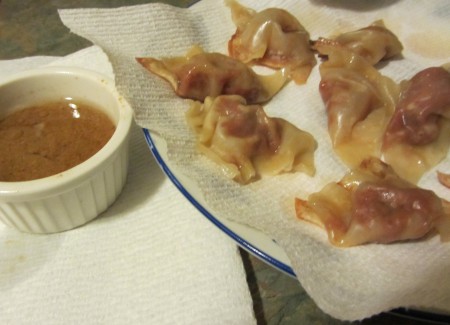
I settled on BBQ Pulled Pork Potstickers.


We put these together in the morning before the Superbowl. I had intended to cook them once everyone got to the house… By that point though, we had so much food on the table that I forgot all about them.


We didn’t miss them. We even decided to skip baking the pizza rolls (a SB tradition) and still did fine on food.

The filling was a combination of pulled pork, bbq sauce, soy, worcestershire, lime juice, lemon juice, red wine vinegar, and sambal oelek.

The dipping sauce was Gulden’s mustard, soy, sesame oil, canola oil, and honey. Sort of an asian inspired honey-mustard.

The cooking was standard potsticker technique: Preheat a non-stick skillet with a little canola oil. Add the dumplings and cook 3-4 minutes. Add 1/8 cup of water and quickly cover the pan, cook about 6 minutes covered. Uncover and cook about another 3 minutes until the bottoms of the potstickers are crispy.

I was fairly pleased with how it came out. The honey mustard sauce played nicely with the bbq pulled pork, the bottoms were crispy/crunchy, and the asian “bend” to the whole thing kept it from feeling like something I’ve had 1,000 times. I wouldn’t make it again for the Superbowl though — it’s too much cooking to do with that many guests in the house.

Yu Darvish, the next “Next Big Thing?”

By Blaidd Drwg

There is always the “next big thing” pitcher coming out of Japan. First it was “Nomo Mania”, then it was Hideki “Fat Toad” Irabu, then “Dice-K” Matsuzaka and his mysterious “gyro-ball” and “No-Kei” Igawa and now you have Yu Darvish. Darvish just signed a $60 million dollar contract with the Rangers. The Rangers also had to pay $52 million to Darvish’s Japanese League team as a posting fee, so they essentially signed him to a 6 year, 112 million dollar contract, roughly what Matsuzaka cost in 2007 and roughly the average of what Jered Weaver is making a season.

Japanese starters have largely been unsuccessful making the leap to MLB (there are a number of relief pitchers that have done well though). Nomo is far and away the best and Matsuzaka had a couple of decent seasons (there were a few other decent back of the rotation guys, but no one worth mentioning) , but neither had been dominant to the point of being called a franchise pitcher. Both Nomo and Matsuzaka entered the league at age 26, so let’s take a look at how they did, year by year compared to Jered Weaver. Yes, Weaver had already been in the league 3 years by the time he turned 26, but it is a fair comp since Nomo and Matsuzaka were both expected to be top of the rotation starters the second they entered the league.

Year 1 – Age 26

Year W-L ERA IP K/9 BB/9 ERA+ WAR
Nomo 1995 13-6 2.54 191.1 11.1 3.7 150 4.9
Matsuzaka 2007 15-12 4.40 204.2 8.8 3.5 108 3.2
Weaver 2009 16-8 3.75 211.0 7.4 2.8 117 4.5


Year 2 – Age 27

Year W-L ERA IP K/9 BB/9 ERA+ WAR
Nomo 1996 16-11 3.19 228.1 9.2 3.4 122 4.4
Matsuzaka 2008 18-3 2.90 167.2 8.3 5.0 160 5.1
Weaver 2010 13-12 3.01 224.1 9.3 2.2 132 5.6


Year 3 – Age 28

Year W-L ERA IP K/9 BB/9 ERA+ WAR
Nomo 1997 14-12 4.25 207.1 10.1 4.0 91 1.7
Matsuzaka 2009 4-6 5.76 59.1 8.2 4.6 82 0.3
Weaver 2011 18-8 2.41 235.2 7.6 2.1 158 6.6


Rest of Career

Year W-L ERA IP K/9 BB/9 ERA+ WAR
Nomo 1998-2008 80-80 4.66 1349.1 8.1 4.4 92 9.6
Matsuzaka 2010- Current 12-9 4.81 191.0 7.5 4.6 90 1.0

Nomo basically became league average in his 3rd season and then broke down after that, posting just 1 season with an ERA+ over 105 the rest of his career. Matsuzaka basically broke down in his 2nd season and, despite some nice looking numbers in 2008 (thanks to a ton of run support), really wasn’t all that good – he threw a lot of pitches and averaged less than 6 innings a start when healthy. He also probably won’t pitch in 2012 due to arm injuries. It really seems to be a trend where Japanese pitchers come into the league, take it by storm for a year or two and then fade away. These guys should be following a career curve like Jered Weaver, putting up their best seasons between the ages of 26 and 29, but they are not.

I have a few theories on as to why this is:

  • They are abused and throw a ton of innings in Japan prior to coming over to the majors. I can’t find pitch counts for Japan, but I would be willing to bet these pitcher routinely through in the 120-130 pitch range early in their career.
  • Their conditioning is not sufficient enough for the longer MLB season (the season is longer by about 20 games or 4 starts). Four starts may not seem like a lot, but it is roughly 15% more pitching than what they are used to. To put it in perspective, imagine running a 26 mile marathon and then being told you have to run another 4 miles before you are actually finished.
  • They don’t adjust to the talent level in MLB. Basically, they are getting by on raw stuff their first couple of years until hitters figure them out and make adjustments. Once the hitters make adjustments, the pitchers don’t and become hittable.
  • They don’t adjust to the strike zone. If you look at the stats of Matsuzaka in his last few seasons in Japan, he walked 84 hitters in 401 innings; he walked 80 in 205 innings in his first big league season. The same hold true for Nomo.
  • Their deliveries put too much torque on their arms. Hence the breakdowns at around age 28.

I am not saying that Darvish is going to flop. He shares a lot in common with Nomo and Matsuzaka – they are all power pitchers, they all threw a ton of innings in Japan at an early age, they are all 26 in their first MLB season. Maybe Darvish will be different and have a long career as a top of the rotation starter. Then again, maybe he will fall apart after a couple of seasons.

My prediction: Darvish will have a 135 ERA+ type season, winning the ROY in 2012 and then basically be a league average starter by 2015. I figure he will have ERA+ of something like 118 in 2013, 108 in 2014 and 100 in 2015, getting hurt sometime in 2014-2015 for an extended period of time. I would love to come back to this post in a few years just to see how accurate I am.

Pizza Bianca — A Sizeable Superbowl Sendup

by A.J. Coltrane

A Superbowl sendup on the Roman “Pizza Bianca”, inspired by this recipe, created by J. Kenji Lopez-Alt at Serious Eats. He describes his process here. Here’s the photo from Serious Eats:

Kenji's Pizza Bianca. Check out his process at Serious Eats.
A little bit of background:  The Pizza Bianca I’m referring to is created at Antico Forno in Rome. It’s a flatbread about 2 meters long; made with olive oil, salt, and rosemary. The baker scrunches up the dough like an accordian onto a peel, then shimmies the dough out to its full expanse in the oven. The pizza is sold by length, rather than by the slice.

That sounds good to me, though I don’t have an oven that’s six feet across.

What I do have is a grill that’s 24″ x 18″. It’s my biggest cooking surface, and I thought that for the Super Bowl it’d be fun to make a flatbread the size of the grill.

Here are the two formulas, Kenji’s is the “Original” in the center column (Baker’s Percentage definition here):

Weight in Grams Original Sizeable
Flour 500, Bread Flour 800, AP Flour
Water 375 544
Salt 10 16
Yeast 5 5
Olive Oil 1/4 cup 3/8 cup
Rosemary 1 TBP, minced 1.5 TBP, minced
     
     
Baker’s Percentage Original Sizeable
Flour 100 100
Water 75 68
Salt 2 2
Yeast 1 0.63
Olive Oil 10.6 10
Rosemary 1 TBP, minced 1.5 TBP, minced

Kenji’s uses a 75% hydration and an overnight rise, since his is based around the Lahey No Knead recipe. I decided in advance that if I used a hydration that high then I’d be unlikely to get *that* much wet, oily, dough onto the grill without a mishap. I cut back the hydration to a more manageable 68% and allowed for a three day rest in the refrigerator. (My “regular” pizza dough is 60% hydration.)

Sizeable.

The recipe:

Use a spatula to combine all of the ingredients above in a large bowl, cover with plastic wrap. Leave the dough in the refrigerator for 3 days in total, folding the dough (in the bowl) a couple of times per day. Remove the dough from the refrigerator about 4-5 hours before it’s time to grill. (If the dough is threatening to rise too much then either go ahead and grill it, or fold it again to buy another hour or two.) Flour a work surface and roll the dough out to into a 16″ x 22″ rectangle.

Arrange the dough so the long dimension goes from left to right. Generously brush both the dough, and the back of an inverted sheet pan, with olive oil. Fold the dough in half (left to right) to transfer it to the sheet pan (see below).

Further explanation:  The 16″ side of the dough (what *was* the short side) goes lengthwise on the sheet pan, the “long” side of the dough (which is now 11″, because it’s folded in half) sits folded across the short dimension of the sheet pan. The “inside” of the dough has now already been oiled. The bottom on the dough is now sitting on oil. All that remains is to oil the new top. Preheat the grill to medium.

To transfer to the grill:  Pick up the dough (still folded in half) and rapidly move it over to the grill, then unfold the dough and carefully try stretch it out a little if it needs it. When the dough stiffens up, shows some color on the bottom, and feels about half cooked then it’s time to flip the monster. I slid a cheap pizza pan under the dough and flipped it over. I used the same pan to remove the finished pizza from the grill — the pan was smaller than the pizza, but it worked ok overall. Hot pads are recommended, the pizza will be lava hot. I used a pizza cutter to score the pizza, to try to make it easier for everyone to tear off a piece. As part of a nice Super Bowl layout this easily fed 10 people with leftovers — it’s basically the same size as two large pizzas, combined.

Pasta all’amatriciana

By Iron Chef Leftovers

I like incredibly simple meals. One of the simplest and tastiest is pasta all’amatriciana. It has a whopping 5 ingredients – guanciale (essentially pork jowl bacon), tomatoes, pepper flakes, cheese and pasta (well, technically 6 if you count the pasta water) and takes probably 20 minutes to prepare. The recipe that I used was stolen (with a few modifications) from Jennifer McLagan, James Beard Award winning cookbook author, who pilfered it from another cookbook. The only thing that I really did differently was used cappelini instead of bucatini since Mrs. Iron Chef doesn’t like thick pasta. It worked, but it would have been better with thicker pasta as the thin pasta really does absorb more of the sauce. Either way, this was a pretty killer dish.

Note – I converted the measurements from metric, but I used the metric measures when I made this, so it might be a little off. I also left the metric measurements in there if you are so inclined.

The Software
6 oz (175 g) guanciale – sliced into 1/4 inch lardons
2 cups of diced roma tomatoes
1/2 teaspoon red pepper flakes
2 tablespoons grated Parmiggiano Reggiano
2 tablespoons grated Pecorino-Romano (plus extra for topping the pasta)
16 oz (400 g) pasta
1 cup reserved pasta water

The Recipe
Cook the pasta until al dente (time depends on the type of pasta), reserving 1 cup of the pasta water. Cook the guanciale over medium heat until browned, stirring occasionally, about 10 minutes. DO NOT DRAIN THE FAT FROM THE PAN. Add the tomatoes. Cook over medium heat for about 5 more minutes. Add about 1/2 of the pasta water and cook for 2 more minutes. If the sauce is still too thick, add more of the pasta water (it should be slightly watery). Add the pasta and cheese, stir to combine. If the sauce looks too thick, add a bit more pasta water, if not, serve with some grated cheese and ground black pepper.

Notes
If you like more heat, add more red pepper. If you can’t find guanciale, use really fatty pancetta or bacon and you may need to add some olive oil to the pan for additional fat. It won’t be as good, but it will work in a pinch. Use your judgment in adding the water – my tomatoes were very dry so I needed more water that I thought I would. You can add less. Canned tomatoes would probably work if you drained them before adding them to the guanciale. I didn’t take a picture of the sauce, but here is what it should look like before you put the pasta in (I am linking rather than posting my pictures because Chef McLagan is a professional and, frankly, hers was much prettier than mine).

Random Super Bowl Thoughts

By Blaidd Drwg

One of the Puppy Bowl Starters - Aberdeen. So much cuter than Tom Brady.

Unless you have been living under a rock for the last 2 weeks, you know that the Super Bowl is this weekend and is a rematch between the Patriots and the Giants. As outlined here, I will be rooting for the Giants and to make the game interesting, I have a bet on the game (straight up – I have the Giants) with a friend of mine, Big Mike, who is a rabid Pats fan. If I win, I get lobsters shipped from Massachusetts (and maybe a reimagining of a lobster dinner I did a couple of years ago). If he wins, he gets a Northwest goodies basket.

I really don’t have a great deal of interest in the game and I really just want it to be over. I am tired of the 2 weeks of analysis of every aspect of the game, I am tired about hearing about Tom Brady and Eli Manning and frankly, I am tired of Patriots fans in general – they are obnoxious, sore winner, even worse losers; essentially the Yankees fans of the NFL.

If you aren’t much of a football fan or just want to watch something other than a 50+ year old Madonna doing a pre-recorded halftime show, switch on over to Animal Planet – they are running their 8th annual “Puppy Bowl”. What is Puppy Bowl? It is several hours of puppies running around, playing and generally looking cute to raise awareness for shelter animals. It is really just puppy overload. If that isn’t enough, you also get the kitty halftime show, which is a bunch of kittens playing, and, new this year, is the piglet cheerleaders. Overall it is just going to be hours of animal cuteness. Animal Planet runs it on a loop pretty much all day, so you can see pretty much any time you want. You can see more pics of Puppy Bowl here.

If for some reason you really want to watch the game, Volkswagen has 2 great Star Wars themed spots for this year’s game. If you really care to see them in their entirety, they are below. The first one is brilliant, the second one is just laugh out loud funny.

Danny Ainge and the Demise of the Celtics Empire

By Blaidd Drwg

There is an article on ESPN about Danny Ainge being willing to break up the Celtics Big 3 of Garnett, Allen and Pierce. The Celtics are an old team, more than half of their roster is 29 or older and 4 of their 5 starters are over the age of 33. That is really not a recipe for success in the NBA. Is it any real wonder that the Celtics have started 5-8? What I really found interesting is a comment Ainge made in the article:

Ainge saw the Celtics pass up deals when Larry Bird, Kevin McHale and Robert Parish were aging, and the result was a steady deterioration that saw Boston not make the playoffs or advance beyond the first round from the 1992-93 to 2000-01 seasons.

“First of all, it’s a different era,” Ainge told The Globe. “I sat with Red (Auerbach) during a Christmas party (in the 1990s). Red was talking to Larry, Kevin, and myself and there was a lot of trade discussion at the time, and Red actually shared some of the trade discussions. And I told Red, what are you doing? Why are you waiting?

“He had a chance to trade Larry (to Indiana) for Chuck Person and Herb Williams and (Steve) Stipanovich and he had a chance to trade Kevin (to Dallas) for Detlef Schrempf and Sam Perkins. I was like, ‘Are you kidding?’ I mean, I feel that way now. If I were presented with those kind of deals for our aging veterans, it’s a done deal to continue the success.”

Maybe it is just me, but it seems that this conversation took place after Bird, Parrish and McHale were retired. If that is the case, why the heck would you have said “What are you doing? Why are you waiting?” If this conversation took place in the 1990’s, those deals were long since past being able to be made. So either the conversation took place in the 1980’s, which would be odd, or Ainge didn’t think about the tense of his quote and should have used the past tense. My best guess is that this offer came around 1988-1989, which, ironically, would have been the year the Celtics traded Ainge to the Kings with Brad Lohaus for Ed Pinckney and Joe Kleine (not one of the better deals for the Celtics).

Would these deals have benefited the Celtics, most likely. The Celtics would have come out way ahead on the McHale deal. The problem is much more than just swapping players. I lived in Boston for 12 years. Larry Bird is pretty much as close to God as you can get in Boston after Ted Williams. I remember going to Celtics games well after Bird retired and he would get a standing ovation from the crowd, at half time, every time he walked across the floor to the tunnel. Red may have been the architect of the greatest franchise in history and not even he would be dumb enough to be known as the guy who traded Larry Bird. Bird was going to be a Celtic player as long as he wanted to be, as long as Red had any say in the matter.

I think what really did the Celtics in was poor drafting and a change in the way the game was played. Right around 1990, the NBA went from being a sport about teamwork to a game dominated by inside post players. Let’s look at the Celtics 1st Round picks from 1988 – 1995.

1988 – Brian Shaw (24th Overall)
1989 – Michael Smith (13th Overall)
1990 – Dee Brown (19th Overall)
1991 – Rick Fox (24th Overall)
1992 – Jon Barry (21st Overall)
1993 – Acie Earl (19th Overall)
1994 – Eric Montross (9th Overall)
1995 – Eric Williams (14th Overall)

Only one of those players, Dee Brown, averaged better than 10 Points per Game in his career. Granted, they were generally drafting in the bottom half of the first round, but the effectively drafted a bunch of role players and never supplemented that with a solid free agent signing. There were 2 truly awful picks in that group, solely on where they drafted.

In 1989, which is one of the deepest drafts in NBA history, the Celtics got 3 lousy seasons of Michael Smith and passed up the following players, all of whom were drafted in the first round after Smith: Tim Hardaway, Dana Barros, Shawn Kemp, BJ Armstrong and Vlade Divac (although the Celtics did redeem themselves a bit by taking Dino Radja in the second round).

In 1994, they completely blew it by taking the “great white hope”, a slow footed center from UNC, Eric Montross. Granted, there wasn’t a huge amount of talent at the back end of the draft, but honestly, it wasn’t hard to see that Montross wasn’t going to be the force in the middle the Celtics needed him to be. The poor drafting was supplemented by poor roster management. Here is the roster the Celtics fielded the year after Bird retired:

No. Player   Pos Ht Wt Birth Date Exp College
4  Alaa Abdelnaby   F-C 6-10 240 June 24, 1968 3 Duke University
7 Dee Brown G 6-1 160 November 29, 1968 3 Jacksonville University
12 Chris Corchiani G 6-0 185 March 28, 1968 2 North Carolina State University
20 Sherman Douglas G 6-0 180 September 15, 1966 4 Syracuse University
55 Acie Earl F-C 6-10 240 June 23, 1970 R University of Iowa
44 Rick Fox F-G 6-7 230 July 24, 1969 2 University of North Carolina
34 Kevin Gamble F-G 6-5 210 November 13, 1965 6 University of Iowa
43 Tony Harris G 6-3 190 May 13, 1967 1 University of New Orleans
30 Todd Lichti G-F 6-4 205 January 8, 1967 4 Stanford University
31 Xavier McDaniel F 6-7 205 June 4, 1963 8 Wichita State University
27 Jimmy Oliver G-F 6-5 205 July 12, 1969 1 Purdue University
00 Robert Parish C 7-0 230 August 30, 1953 17 Centenary College of Louisiana
54 Ed Pinckney F 6-9 195 March 27, 1963 8 Villanova University
40 Dino Radja F-C 6-11 225 April 24, 1967 R
50 Matt Wenstrom C 7-1 250 November 4, 1970 R University of North Carolina

Not exactly striking fear into the hearts of opponents, huh?

A few years ago, when Ainge started building the current Celtics roster, I told a friend of mine they probably were built for a 3-4 year run before the team got too old (and I had a very low opinion of Ainge as a GM and his ability to build a team with home grown talent). This is year 5 of that Celtics run. The Celtics have gotten old and have gotten little out of their last 5 drafts. Unfortunately, I believe the Celtics are headed for yet another down period in their storied franchise history.